How Can Government See What You Search With a VPN?
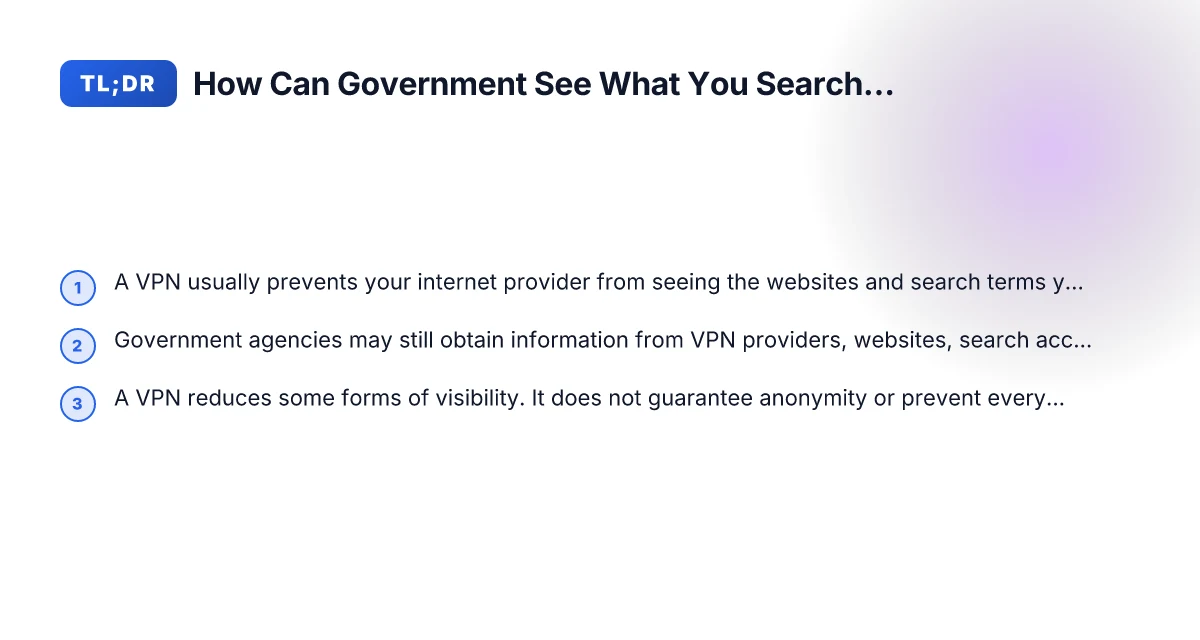
A VPN hides search traffic from your internet provider, but it cannot erase account, device, or VPN-provider records.
A government generally cannot read the contents of your VPN traffic just by monitoring your internet connection. The VPN encrypts data between your device and the VPN server, so your internet provider can usually see that you connected to a VPN, but not the searches or pages inside that connection. However, agencies may get information through other sources, such as the VPN company, a search engine, a logged-in account, or your device. What they can see depends on the service, its records, and the circumstances.

Editor's pick: NordVPN — fast, secure VPN — Strong encryption, a no-logs policy and apps for every device. 30-day money-back guarantee. Get NordVPN →
What a VPN hides from different observers
| Observer | Can see your VPN server connection? | Can see sites you visit? | Can see search terms? | Key limitation |
|---|---|---|---|---|
| Internet provider | Yes | Usually not directly | Usually not directly | Sees connection metadata |
| VPN provider | Yes | Potentially | Potentially | Depends on logging and encryption |
| Search engine | Yes, if you use its service | Yes, for its own service | Yes, for searches you submit | VPN does not hide activity from the service |
| Website | Yes, if you visit it | Yes, for its own service | Only if you enter searches there | May identify accounts or collect data |
| Employer or school network | Yes, if traffic uses its network | Usually not directly with a VPN | Usually not directly with a VPN | Can see network use and VPN connection |
| Government agency | Potentially | Potentially, through other sources | Potentially, through other sources | Access depends on legal authority and available records |
Compiled November 2026; check the provider's site for current details.
| VPN | Obfuscation | From / month | Plan | Free plan | Refund | Alipay | UnionPay | Crypto | Website opens in China | Trustpilot | |
|---|---|---|---|---|---|---|---|---|---|---|---|
 ZoogVPN | Turn on manually Shadow | $2.49/mo | 27 months: $59.99 | Yes | 7 days | ✓ | ✓ | ✓ | ✓ | Official site blocked; our special link opens (4.4 s) | 4.2/5 (195 reviews) |
 NordVPN | Turn on manually Obfuscated Servers / NordWhisper | $3.49/mo | 27 months: $94.23 | No | 30 days | ? | ✗ | ✓ | ✓ | ✗ Blocked | 4.2/5 (51,628 reviews) |
 ExpressVPN | ✓ On by default all servers | $3.00/mo | 28 months: $84 | No | 30 days | ✗ | ✗ | ✓ | ✗ | ✗ Blocked | 4.4/5 (29,706 reviews) |
 Surfshark | ✓ On by default Camouflage, with OpenVPN | See site | See site | No | 30 days | ✗ | ✗ | ✗ | ✓ | ✗ Blocked | 4.3/5 (31,823 reviews) |
 Proton VPN | Turn on manually Stealth, free plan too | $2.99/mo | 12 months: $35.88 | Yes | 30 days | ✗ | ✗ | ✗ | ✓ | ✗ Blocked | 2.1/5 (1,040 reviews) |
 Astrill VPN | Turn on manually StealthVPN / OpenWeb | $12.50/mo | 24 months: $300 | No | See site | ✗ | ✗ | ✗ | ✓ | ✗ Blocked | 1.3/5 (110 reviews) |
 Private Internet Access | Turn on manually Shadowsocks, OpenVPN only | $2.03/mo | 40 months: $81.2 | No | 30 days | ✗ | ✗ | ✗ | ✗ | ✗ Blocked | 4.2/5 (11,033 reviews) |
 CyberGhost | Turn on manually selected servers | $2.19/mo | 28 months: $61.32 | No | 45 days | ✗ | ✗ | ✗ | ✓ | ✗ Blocked | 4.0/5 (24,178 reviews) |
 PureVPN | Turn on manually switch to OpenVPN | $1.69/mo | 60 months: $101.55 | No | 31 days | ? | ? | ✗ | ✓ | ✗ Blocked | 4.4/5 (17,994 reviews) |
 AdGuard VPN | ✓ On by default TrustTunnel | $2.99/mo | 24 months: $71.76 | Yes | 30 days | ✓ | ✗ | ✓ | ✓ | Official site blocked; our special link opens (3.7 s) | 4.3/5 (290 reviews) |
 Mullvad | Turn on manually QUIC / Shadowsocks / LWO | $5.61/mo | €5/mo | No | 14 days | ✗ | ✗ | ✗ | ✓ | ✗ Blocked | 3.2/5 (192 reviews) |
 Windscribe | Turn on manually Stealth / WStunnel | $5.75/mo | 12 months: $69 | Yes | See site | ✗ | ✗ | ✗ | ✓ | ✗ Blocked | 4.7/5 (13,355 reviews) |
 StrongVPN | Turn on manually Scramble, OpenVPN TCP | See site | See site | No | 30 days | ✓ | ✗ | ✗ | ✗ | ✗ Blocked | 4.4/5 (2,695 reviews) |
 LightXtreme 闪连 | Not listed | $7.08/mo | 12 months: $84.99 | Yes | 30 days | ✓ | ✓ | ✓ | ✓ | ✓ Yes (3.5 s) | No page |
Prices checked 2026-11-10 on each vendor's pricing page (cheapest long plan, USD). Check the vendor's checkout for the final price.
Obfuscation checked 2026-11-14 on each vendor's site and help center: "on by default" = nothing to set; "turn on manually" = switch protocol or mode in settings; "not listed" = the vendor describes no obfuscation.
Payment methods checked 2026-11-10 on each vendor's payment pages: all 14 take cards and PayPal; ✗ = not listed, ? = the vendor's own pages disagree.
China access: whether the official website opens from mainland China networks (tests the website only, not the VPN connection). Last checked 2026-11-18 01:02 Beijing time.
Trustpilot score and review count checked 2026-11-10.
What a VPN hides, and what it does not
When you search online with a VPN switched on, your traffic travels through an encrypted tunnel to a VPN server. Your internet provider can typically observe connection details, such as that you are using a VPN and when you connect. It generally cannot read the contents of your encrypted connection.
The VPN server then sends your requests to websites or search services. Those services may see the VPN server’s IP address rather than your home IP address. But a VPN does not make your activity invisible to every party.
A VPN does not automatically hide:
- Searches made while signed in to a search or social media account
- Information you submit to a website
- Activity recorded on your device or browser
- Data a website or service keeps about your account
- The fact that you are connecting to a VPN
HTTPS also matters. Most major websites use it, encrypting traffic between your browser and the website. A VPN adds an encrypted connection between your device and the VPN server, but it does not stop a site from recognizing your account or recording activity on its service. NordVPN Account: How to Sign In, Manage Your Subscription, and Stay Secure
Who may be able to see your searches?
Different parties have different views of your connection. A government investigation may involve records from more than one source, subject to the applicable law and process.
| Party | What it may generally see |
|---|---|
| Internet provider | That you connected to a VPN, and connection timing or data volume; usually not the contents of encrypted traffic |
| VPN provider | Your connection to its server and potentially some activity-related data, depending on its systems and policies |
| Search engine or website | Searches or actions on its service, especially when you are signed in |
| Device or browser | Local history, cookies, saved data, or monitoring software, if present |
| Government agency | Information available through monitoring, legal requests, investigations, or other sources |
This table describes general possibilities, not a guarantee about any particular provider or investigation.
How government agencies could obtain information
A VPN makes direct observation by your internet provider less useful for learning the contents of your browsing, but it does not prevent other ways of linking activity to a person.
Requests to a VPN provider
Authorities may seek records from a VPN company. What the provider can supply depends on what it collects and retains. Some services say they keep limited or no activity logs, but users should review the provider’s privacy policy and independent information about its practices. A “no-logs” claim does not mean a service has no operational records whatsoever. Split Tunnelling VPN iPhone: What Works and What to Know
Records held by websites and search services
A search engine or website may keep activity associated with an account, cookies, or other identifiers. If you sign in while using a VPN, the service can still associate activity with that account. A VPN changes the network path. It does not conceal your identity from a service where you have identified yourself.
Device access or other evidence
Search history may be stored in a browser, app, or account, depending on your settings. If an agency lawfully accesses a device or obtains records from a service, a VPN may not prevent that information from being found. Investigators may also use evidence beyond browsing data to connect activity to an individual.
Can the FBI or police track you using a VPN?
A VPN does not make someone untraceable. Law enforcement may be able to investigate activity by seeking available provider or website records, examining a device, or combining information from multiple sources. Whether they can identify a person depends on the facts, the records that exist, and the legal authority available.
That does not mean an agency can simply see every search in real time because a person uses a VPN. The VPN’s encryption limits what can be read from the connection between the user and the VPN server. The key distinction is between directly observing encrypted traffic and obtaining information from other sources. Microsoft Edge VPN Extension Free: What to Know Before You Install
How agencies may obtain information about VPN use
| Information source | What it may reveal | Does a VPN prevent access? | Possible route | Privacy consideration |
|---|---|---|---|---|
| Internet provider records | Connection times and VPN server connection | No | Legal request or other lawful process | Does not usually show encrypted VPN contents |
| VPN provider records | Account, connection, or activity data | No | Legal request or applicable process | Data available depends on provider practices |
| Search engine records | Searches associated with an account or session | No | Service records or lawful request | VPN does not hide searches from the search engine |
| Website or app records | Visits, account activity, and submitted information | No | Service records or lawful request | Logged-in activity can identify a user |
| Device records | Local browsing data and app activity | No | Device access under applicable authority | A VPN does not erase device history |
| Traffic observation | Connection patterns and timing | No | Network monitoring | May reveal metadata, not necessarily page contents |
Compiled November 2026; check the provider's site for current details.
What can your internet provider see?
With a VPN connected, your provider can generally see that your device is communicating with a VPN server. It may also observe connection times and the amount of data transferred. It normally cannot see the specific search terms or page contents inside the encrypted tunnel.
If the VPN disconnects unexpectedly, traffic could sometimes leave the device without the VPN, depending on the app and its settings. A kill switch is designed to block internet access if the VPN connection drops. Check that the feature is available and enabled if you rely on it. Nord VPM Login: How to Sign In and Fix Common Access Problems
Practical ways to improve privacy
A VPN can be useful for reducing what your internet provider can learn from your browsing connection, but it is only one part of privacy protection.
- Choose a reputable VPN and read its logging and privacy policies.
- Keep the VPN app, browser, and operating system updated.
- Use a kill switch if available, and check that the VPN remains connected.
- Remember that signing in can link activity to your account.
- Review browser history, account activity, cookies, and privacy settings.
- Avoid treating a VPN as protection against device access or every form of tracking.
Practical privacy choices when using a VPN
| Choice | Helps hide from internet provider | Helps hide from VPN provider | Helps hide searches from search engine | Main limitation |
|---|---|---|---|---|
| Use a reputable VPN | Yes, for destinations and contents in transit | No | No | Provider may see connection data |
| Review VPN logging practices | No | May reduce stored data | No | Claims and practices can differ |
| Sign out of search accounts | No | No | May reduce account linkage | Searches may still be recorded |
| Use private browsing | No | No | No | Does not make activity anonymous |
| Clear local browsing history | No | No | No | Does not remove provider or service records |
| Limit personal details on websites | No | No | May reduce direct identification | Websites can still collect activity |
| Use secure connections (HTTPS) | Protects page contents in transit | No | No | Does not hide activity from the destination service |
Compiled November 2026; check the provider's site for current details.
Recommendation
Use a VPN to encrypt the connection between your device and the VPN server, not as a promise that nobody can discover your searches. For stronger privacy, choose a trustworthy provider, keep your device secure, and understand what your accounts and websites may record. Can't Connect VPN Tunnel Through Virgin Home WiFi? Try These Fixes