VPN for Home Network: How to Choose and Set It Up
Learn what a VPN for your home network protects, how to choose a setup, and when a router or individual apps make more sense.
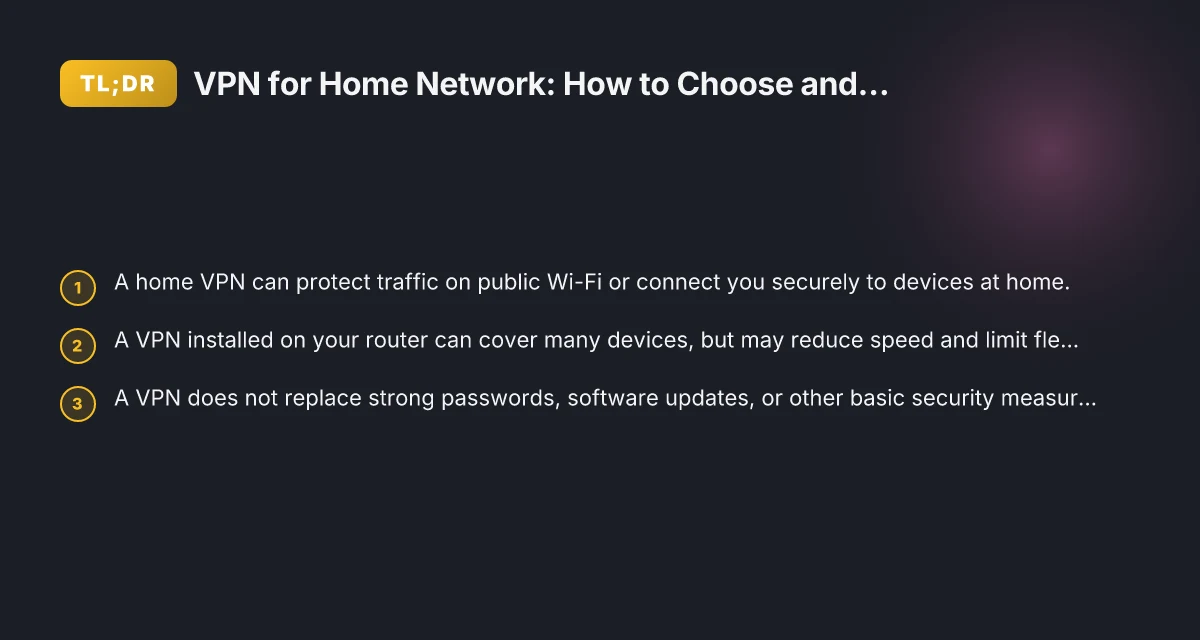
A VPN for a home network can encrypt internet traffic between your devices and a VPN provider, or let you securely access your home network while away. The best setup depends on what you want to do: protect a few devices, cover most devices at home, or reach files and smart-home equipment remotely. For many households, installing a reputable VPN app on selected devices is the simplest starting point. A VPN-capable router is useful when you need broader coverage.

Editor's pick: NordVPN — fast, secure VPN — Strong encryption, a no-logs policy and apps for every device. 30-day money-back guarantee. Get NordVPN →
Compare common VPN setups for a home network
| Setup | Devices covered | Setup effort | Requires compatible router | Best for |
|---|---|---|---|---|
| VPN app on each device | Devices with the app | Low | No | A few devices |
| VPN on the router | Devices using that router | Medium | Yes | Whole-home coverage |
| VPN on a dedicated travel router | Devices connected to it | Medium | Yes | Flexible or temporary coverage |
| VPN on a computer acting as a gateway | Devices routed through that computer | High | No | Advanced users |
| VPN on a mesh system | Devices on supported mesh network | Medium | Yes | Mesh households |
| VPN on a smart TV | The TV only | Low to medium | No | A single streaming device |
Compiled November 2026; check the provider's site for current details.
| VPN | Obfuscation | From / month | Plan | Free plan | Refund | Alipay | UnionPay | Crypto | Website opens in China | Trustpilot | |
|---|---|---|---|---|---|---|---|---|---|---|---|
 ZoogVPN | Turn on manually Shadow | $2.49/mo | 27 months: $59.99 | Yes | 7 days | ✓ | ✓ | ✓ | ✓ | Official site blocked; our special link opens (4.4 s) | 4.2/5 (195 reviews) |
 NordVPN | Turn on manually Obfuscated Servers / NordWhisper | $3.49/mo | 27 months: $94.23 | No | 30 days | ? | ✗ | ✓ | ✓ | ✗ Blocked | 4.2/5 (51,628 reviews) |
 ExpressVPN | ✓ On by default all servers | $3.00/mo | 28 months: $84 | No | 30 days | ✗ | ✗ | ✓ | ✗ | ✗ Blocked | 4.4/5 (29,706 reviews) |
 Surfshark | ✓ On by default Camouflage, with OpenVPN | See site | See site | No | 30 days | ✗ | ✗ | ✗ | ✓ | ✗ Blocked | 4.3/5 (31,823 reviews) |
 Proton VPN | Turn on manually Stealth, free plan too | $2.99/mo | 12 months: $35.88 | Yes | 30 days | ✗ | ✗ | ✗ | ✓ | ✗ Blocked | 2.1/5 (1,040 reviews) |
 Astrill VPN | Turn on manually StealthVPN / OpenWeb | $12.50/mo | 24 months: $300 | No | See site | ✗ | ✗ | ✗ | ✓ | ✗ Blocked | 1.3/5 (110 reviews) |
 Private Internet Access | Turn on manually Shadowsocks, OpenVPN only | $2.03/mo | 40 months: $81.2 | No | 30 days | ✗ | ✗ | ✗ | ✗ | ✗ Blocked | 4.2/5 (11,033 reviews) |
 CyberGhost | Turn on manually selected servers | $2.19/mo | 28 months: $61.32 | No | 45 days | ✗ | ✗ | ✗ | ✓ | ✗ Blocked | 4.0/5 (24,178 reviews) |
 PureVPN | Turn on manually switch to OpenVPN | $1.69/mo | 60 months: $101.55 | No | 31 days | ? | ? | ✗ | ✓ | ✗ Blocked | 4.4/5 (17,994 reviews) |
 AdGuard VPN | ✓ On by default TrustTunnel | $2.99/mo | 24 months: $71.76 | Yes | 30 days | ✓ | ✗ | ✓ | ✓ | Official site blocked; our special link opens (3.7 s) | 4.3/5 (290 reviews) |
 Mullvad | Turn on manually QUIC / Shadowsocks / LWO | $5.61/mo | €5/mo | No | 14 days | ✗ | ✗ | ✗ | ✓ | ✗ Blocked | 3.2/5 (192 reviews) |
 Windscribe | Turn on manually Stealth / WStunnel | $5.75/mo | 12 months: $69 | Yes | See site | ✗ | ✗ | ✗ | ✓ | ✗ Blocked | 4.7/5 (13,355 reviews) |
 StrongVPN | Turn on manually Scramble, OpenVPN TCP | See site | See site | No | 30 days | ✓ | ✗ | ✗ | ✗ | ✗ Blocked | 4.4/5 (2,695 reviews) |
 LightXtreme 闪连 | Not listed | $7.08/mo | 12 months: $84.99 | Yes | 30 days | ✓ | ✓ | ✓ | ✓ | ✓ Yes (3.5 s) | No page |
Prices checked 2026-11-10 on each vendor's pricing page (cheapest long plan, USD). Check the vendor's checkout for the final price.
Obfuscation checked 2026-11-14 on each vendor's site and help center: "on by default" = nothing to set; "turn on manually" = switch protocol or mode in settings; "not listed" = the vendor describes no obfuscation.
Payment methods checked 2026-11-10 on each vendor's payment pages: all 14 take cards and PayPal; ✗ = not listed, ? = the vendor's own pages disagree.
China access: whether the official website opens from mainland China networks (tests the website only, not the VPN connection). Last checked 2026-11-18 01:02 Beijing time.
Trustpilot score and review count checked 2026-11-10.
What a VPN does for your home network
A virtual private network (VPN) creates an encrypted connection, often called a tunnel, between a device and a VPN server. When you use a commercial VPN service, websites generally see the VPN server’s IP address rather than your home IP address. Your internet service provider can still see that you are connecting to a VPN, but the tunnel helps prevent it from reading the contents of your VPN-protected traffic.
A VPN can be useful when you connect to public Wi-Fi, want to reduce what your internet provider can learn from your browsing, or need to access a service that is available through a particular region. It does not make you anonymous, guarantee access to restricted content, or stop every online threat. Websites can still identify you through account logins, cookies, and other tracking methods.
There are two different meanings of “VPN for home network”:
- A commercial VPN for outbound traffic: Your devices connect through a VPN provider to reach the internet.
- A personal VPN into your home: You connect back to your home network from outside, perhaps to reach a computer, storage device, or home server.
These serve different purposes. A commercial VPN does not automatically give you secure access to your home devices. For remote access, you need a VPN server or secure remote-access feature set up on your home router or another device. VPN Best in 2026: How to Choose the Right VPN
Choose a setup that fits your household
You can run a VPN app on each device, configure a VPN on your router, or use both. The right choice depends on how many devices need protection and how much control you want.
| Setup | Best for | Main advantages | Main trade-offs |
|---|---|---|---|
| VPN apps on devices | Phones, laptops, and tablets | Easy to install and manage; settings can differ by device | Each device needs setup; some devices may not support apps |
| VPN on a router | Many devices, including some smart TVs and consoles | Can cover devices that cannot run VPN apps | Router must support it; setup and troubleshooting can be harder |
| Personal VPN server at home | Secure access to your home network while away | Can provide access to home devices and services | Requires secure configuration and ongoing maintenance |
A router VPN is not necessarily the same as a router’s remote-access VPN. Check the router’s documentation to confirm which feature it provides. Some routers support a commercial VPN client, while others let you create a server for secure connections back home. Certain routers offer both.
Choose a setup based on household needs
| Household need | App on each device | Router VPN | Dedicated VPN router | Check before choosing |
|---|---|---|---|---|
| Cover phones and laptops | Supported | Supported | Supported | Device app compatibility |
| Cover devices without VPN apps | No | Supported | Supported | Router compatibility |
| Protect guests’ devices | Per-device setup | Supported | Supported | Guest network routing |
| Keep local devices accessible | Usually supported | Depends on setup | Depends on setup | Local network settings |
| Use different VPN locations | Per-device control | Depends on router | Often flexible | Provider and router features |
| Avoid routing every device | Supported | Depends on router | Supported | Per-device routing options |
Compiled November 2026; check the provider's site for current details. Top VPN for Android: Best Options for Privacy, Speed, and Streaming
How to set up a VPN at home
Start with your goal
Before buying a subscription or changing router settings, decide what you need the VPN to do. If you mainly want protection on public Wi-Fi, install a VPN app on your phone and laptop. If you want connected TVs or other household devices to use a commercial VPN, check whether your router supports VPN-client mode. If you want to reach home files while traveling, look for a secure server or remote-access option.
Check compatibility and performance
For router-wide coverage, confirm that the router supports the VPN protocol required by your provider. If it does not, you may be able to install compatible firmware or use a separate VPN router, but those options require more technical work. A faster router can help, yet encryption and the VPN server’s distance or capacity can still affect performance.
Before routing every device through a VPN, test a single phone or computer. Compare connection speed and check whether services you rely on still work. Video calls, online games, banking sites, and streaming platforms may behave differently when traffic appears to come from a VPN server.
Configure carefully
Use the provider’s official setup instructions and keep router firmware up to date. Choose a well-supported protocol, enable the VPN’s kill switch where available, and set up automatic reconnection if your router offers it. A kill switch can prevent traffic from using the ordinary connection if the VPN drops, though its behavior varies by app and device. V2Ray Free: What It Is, How to Find It, and What to Check
For a personal VPN server, use strong, unique credentials and keep the server software updated. Avoid exposing remote-access services to the internet unless you understand the security settings. Disable features you do not use, and consider limiting access to specific devices or users.
Choosing a trustworthy VPN provider
A VPN provider can see information about your connection, so choosing one is a matter of trust as well as features. Look for clear explanations of what data is collected, how long it is retained, and whether the provider has undergone independent security or privacy audits. Read the privacy policy rather than relying only on a “no logs” slogan.
Useful features may include:
- Apps for the devices you own
- Support for a modern, well-maintained VPN protocol
- A kill switch and protection against DNS leaks
- Clear pricing and cancellation terms
- Reliable customer support and setup guides
- The option to choose server locations that suit your needs
Be cautious of free VPNs that rely on unclear business models, intrusive advertising, or broad data collection. A free service is not automatically unsafe, but you should understand how it is funded and what information it handles. Best VPNs in France: A Clear Guide to Choosing the Right One
Limitations and common mistakes
A VPN shifts some trust from your internet provider to the VPN operator. It does not prevent malware, phishing, weak passwords, or data leaks caused by an app. Keep devices updated, use a password manager and multifactor authentication, and enable your router’s firewall.
A VPN can also make your connection slower, especially when the router has limited processing power or the selected server is far away. If performance suffers, try a nearby server, test another supported protocol, or route only selected devices through the VPN. Split tunneling, when available, lets you choose which apps use the VPN and which use your regular connection.
Finally, do not assume that a VPN on one device protects every device in the house. A phone’s VPN app normally covers that phone only. Router configuration is needed to include other devices, and some routers or internet service setups may require extra configuration.
Compare VPN providers before subscribing Best VPNs in 2026: How to Choose the Right One
| Check | What to look for | Why it matters | Warning sign |
|---|---|---|---|
| Privacy policy | Clear data handling terms | Shows what information is collected | Vague promises |
| Logging practices | Specific, understandable claims | Helps assess privacy | Unclear logging language |
| Independent audits | Public audit details | Adds outside scrutiny | Unsupported claims |
| Security features | Current protocols and encryption | Helps protect connections | Outdated options only |
| Router support | Setup guides and compatible configurations | Enables whole-home coverage | No router instructions |
| Device limits | Clear simultaneous connection policy | Helps cover the household | Restrictions are unclear |
| Support | Responsive help and troubleshooting guides | Useful during setup | Little practical assistance |
| Subscription terms | Transparent pricing and renewal terms | Avoids surprise charges | Confusing fees or cancellation terms |
Compiled November 2026; check the provider's site for current details.
Recommendation
For most households, begin with a reputable VPN app on the devices you use outside the home. Choose a router-based commercial VPN if you specifically want broader coverage and your hardware supports it. If your goal is to access files or devices at home while traveling, set up a properly secured personal VPN server instead. In every case, treat the VPN as one layer of privacy and security, not a replacement for good device and account protection.