V2Ray Free: What It Is, How to Find It, and What to Check
Learn what “V2Ray free” means, how free access works, and how to assess safety, privacy, and reliability.
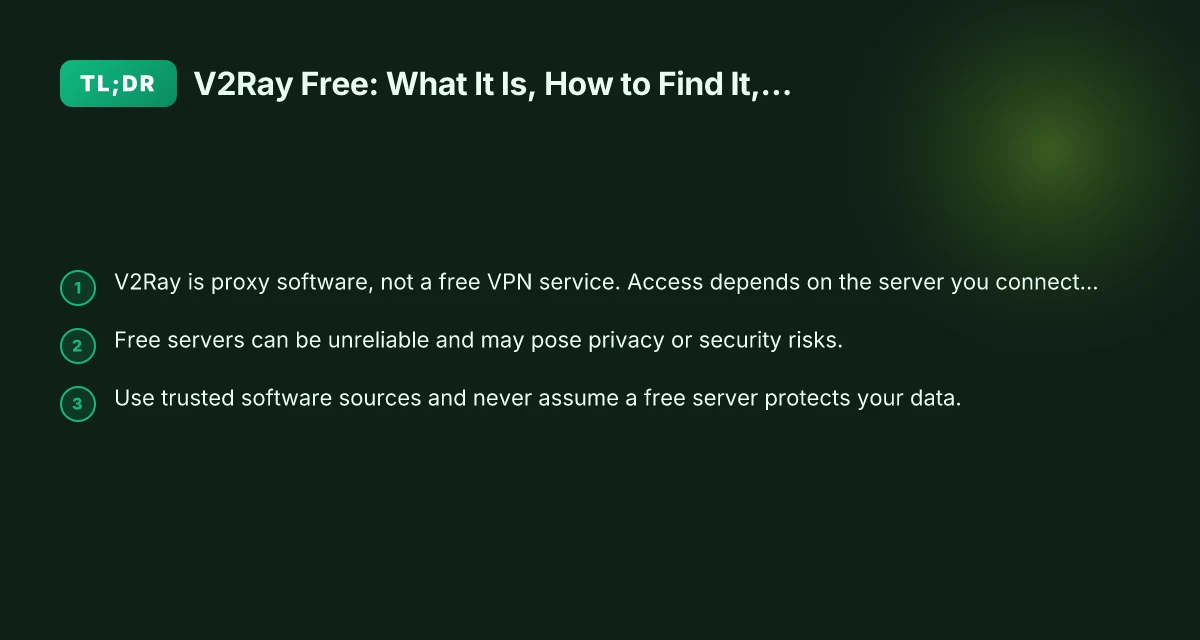
“V2Ray free” usually refers to using V2Ray-compatible software or finding a free server configuration. V2Ray itself is a toolkit for routing network traffic through proxy protocols. It does not automatically provide servers, internet access, or anonymity. To use it, you need a compatible client and a server operated by you or a provider. Free access may be useful for testing, but its speed, availability, privacy, and safety depend on who runs the server.

Compare free V2Ray access options
| Option | Cost | Who controls the server? | Privacy considerations | Best fit |
|---|---|---|---|---|
| Public free server | Free | Provider or unknown operator | Operator may see connection data | Short-term testing |
| Free tier from a provider | Free within limits | Provider | Check logging and terms | Light, occasional use |
| Paid provider | Subscription | Provider | Review privacy policy and reputation | Ongoing convenience |
| Self-hosted server | Hosting costs may apply | You | You manage server security and logs | More control |
| Trial access | Free for a limited time | Provider | Check trial terms and renewal | Evaluating a service |
| Shared configuration | Usually free | Configuration publisher or server operator | Source and operator may be unclear | Testing only |
| Personal server shared by someone you trust | Usually free | Contact who runs it | Trust and server practices still matter | Limited trusted access |
Compiled November 2026; check the provider's site for current details.
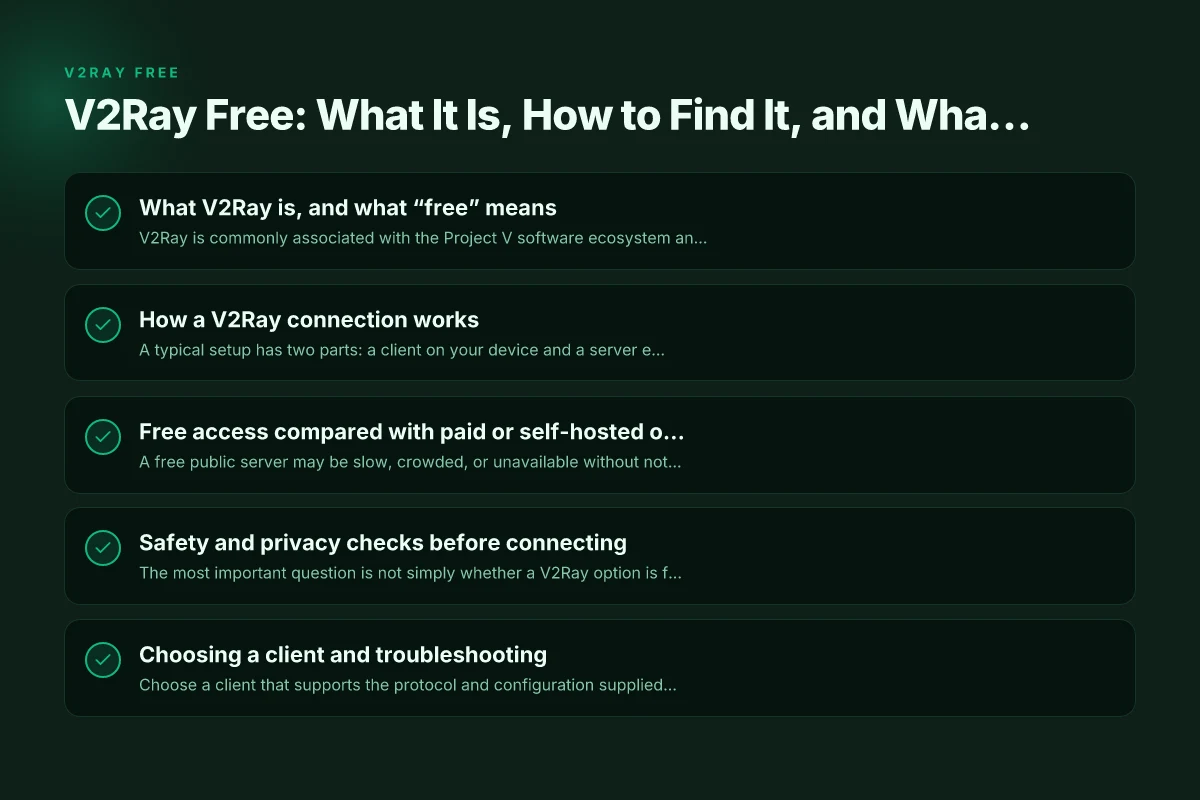
What V2Ray is, and what “free” means
V2Ray is commonly associated with the Project V software ecosystem and tools that support protocols such as VMess and VLESS. It can help route traffic through a remote server, but it is not the same thing as a subscription VPN with a managed network and customer support.
The word “free” can mean several different things:
- Free client software: An app may cost nothing to download, while still requiring a server.
- A free server or configuration: Someone else supplies connection details, sometimes temporarily.
- A free trial: A provider offers limited access before charging.
- A self-hosted server: You use software on a server you control, but hosting, bandwidth, or domain costs may apply.
These options are not interchangeable. A free client does not make the connection free, and an available configuration does not establish that its operator is trustworthy.
How a V2Ray connection works
A typical setup has two parts: a client on your device and a server elsewhere. You add the server’s configuration to the client, then select it to route supported traffic through that server. The exact process varies by operating system, client, protocol, and provider. Best VPNs in France: A Clear Guide to Choosing the Right One
A configuration may include a server address, port, protocol, and authentication details. Treat these details like credentials. Avoid posting them publicly or importing files from unknown sources, since a configuration determines where your traffic is sent.
V2Ray-compatible connections may be used for privacy on untrusted networks, remote access, or network routing. However, a proxy does not make every online activity anonymous. Websites can still identify you through account logins, cookies, browser fingerprinting, or information you choose to share.
Free access compared with paid or self-hosted options
| Option | Typical cost | Main advantage | Main concern |
|---|---|---|---|
| Free public configuration | No direct fee | Quick to try | Unknown operator, unstable service |
| Free trial from a provider | Free for a limited period | Easier to evaluate a managed service | Limits or automatic renewal terms |
| Paid provider | Subscription | Often more consistent support and performance | Requires trust in the provider |
| Self-hosted server | Hosting fees may apply | Greater control over the server | Setup, maintenance, and security are your responsibility |
A free public server may be slow, crowded, or unavailable without notice. Its operator may also collect connection metadata or handle traffic in ways you cannot verify. A paid service is not automatically safe, either. Read its privacy policy and consider its reputation rather than relying on price alone.
Self-hosting can improve control over the server, but it does not guarantee privacy from the hosting company, the websites you visit, or other parts of the network path. It also requires updates and secure configuration. Best VPNs in 2026: How to Choose the Right One
Check a V2Ray connection before connecting
| Check | What to look for | Why it matters | Caution sign |
|---|---|---|---|
| Configuration source | A known provider or trusted person | Identifies who supplied the access details | Anonymous or unsolicited link |
| Server operator | Clear identity and contact details | The operator controls the server | Operator cannot be identified |
| Privacy policy | Plain-language logging and data terms | Shows how data may be handled | No policy or vague claims |
| Connection security | Encrypted transport where supported | Helps protect traffic in transit | Security settings are unexplained |
| Permissions | Only those needed by the client | Limits unnecessary device access | Requests unrelated permissions |
| Client download | Official project or trusted app store | Reduces risk of modified software | Unknown download site |
| Configuration handling | Keep credentials private | Configurations can contain access secrets | Publicly posting a working config |
| Service terms | Usage limits and restrictions | Prevents surprises or policy violations | Unclear limits or conditions |
Compiled November 2026; check the provider's site for current details.
Safety and privacy checks before connecting
The most important question is not simply whether a V2Ray option is free, but who controls the server and what happens to your traffic.
Before using a server, consider these checks: Best VPN Network: How to Choose the Right Service
- Verify the source. Download client software from its official project page or a reputable app store. Be cautious of modified apps and unofficial downloads.
- Read the provider’s privacy terms. Look for clear information about logs, data retention, and how support requests are handled.
- Avoid sensitive activity on unknown servers. Do not assume a free proxy is suitable for banking, work accounts, or confidential communications.
- Use HTTPS. HTTPS protects data between your browser and a website, but it does not hide all connection information from a proxy operator.
- Protect configuration details. A shared profile may contain credentials or other information that allows someone else to use the service.
- Check local rules and service terms. Network tools and their use may be subject to local laws, workplace policies, or provider restrictions.
A proxy operator may be able to see connection metadata, such as when you connect and which destination services you contact. Encryption can limit what the operator can read, but it does not remove all privacy risks. Be especially wary of claims that a free configuration guarantees complete anonymity, unlimited speed, or zero logging without credible evidence.
Choosing a client and troubleshooting
Choose a client that supports the protocol and configuration supplied by your provider. Check that the app is actively maintained and that its publisher is identifiable. Popularity alone is not proof of safety, so review permissions and avoid apps that request unrelated access.
If a connection fails, check the basics before changing security settings:
- Confirm that the server details are current and entered correctly.
- Check whether the provider has usage, device, or bandwidth limits.
- Try another network to see whether the issue is local.
- Update the client from a trusted source.
- Contact the server operator if you have a legitimate support channel.
Do not install unknown certificates, disable device protections, or run commands from strangers just to make a free connection work. A server that repeatedly disconnects or requires suspicious changes is not worth the risk. Best VPN 2025: Top Picks for Privacy, Streaming, and Value
Choose a client and troubleshoot
| Situation | Client choice or check | First step | If it still fails |
|---|---|---|---|
| New to V2Ray | A client with clear setup guidance | Follow the provider’s instructions | Check the client’s official help |
| Using a phone | A client that supports the device and protocol | Confirm the app source is trustworthy | Review app permissions and settings |
| Using a desktop | A client that supports the operating system | Import the configuration as instructed | Check for client updates |
| Import fails | Confirm the configuration format | Copy or scan it again carefully | Ask the configuration provider |
| Connection times out | Check the server address and port | Try again on a stable network | Contact the server operator |
| Connects but pages do not load | Review routing and DNS settings | Test a different permitted setting | Consult the client or provider guidance |
| Connection is slow | Check network conditions and server load | Try another server if available | Consider a different service option |
| Access stops working | Check expiry, limits, and service status | Confirm the configuration is current | Request updated details from the provider |
Compiled November 2026; check the provider's site for current details.
Recommendation
For a brief test, a free V2Ray-compatible client can be reasonable when downloaded from a trusted source and paired with a server whose operator you understand. Avoid relying on random public configurations for sensitive activity. If you need dependable access, compare reputable paid services or consider self-hosting only if you can maintain the server securely. In every case, judge the server, not just the software, before sending traffic through it.