Kaspersky VPN Doesn't Connect: Causes and Fixes

Fix Kaspersky VPN connection problems with practical checks for your network, app, device settings, and account.
If Kaspersky VPN doesn’t connect, first confirm that your internet works without the VPN, then restart the app and try a different server. Connection failures are often caused by a weak network, an outdated app, a temporary server issue, or settings that block VPN traffic. Work through the checks below in order, testing the connection after each one.

Editor's pick: NordVPN — fast, secure VPN — Strong encryption, a no-logs policy and apps for every device. 30-day money-back guarantee. Get NordVPN →
Compare what to check when Kaspersky VPN won’t connect
| Check | What to try | What it can reveal | If it works |
|---|---|---|---|
| Internet connection | Open a website without the VPN | Whether internet access is available | Check VPN settings |
| VPN service | Check whether the service is available | A service-side issue | Wait and retry |
| App state | Close and reopen the app | A temporary app problem | Continue using the app |
| VPN server | Select another server | A problem with the selected server | Keep the working server |
| App version | Check for an update | Whether the app is out of date | Install the update |
| Account | Check account status | An account or subscription issue | Resolve the account issue |
| Network settings | Review settings that may block VPN traffic | A local connection restriction | Adjust the blocking setting |
| App installation | Reset the connection or reinstall | A connection or installation problem | Test the VPN again |
Compiled November 2026; check the provider's site for current details.
| VPN | Obfuscation | From / month | Plan | Free plan | Refund | Alipay | UnionPay | Crypto | Website opens in China | Trustpilot | |
|---|---|---|---|---|---|---|---|---|---|---|---|
 ZoogVPN | Turn on manually Shadow | $2.49/mo | 27 months: $59.99 | Yes | 7 days | ✓ | ✓ | ✓ | ✓ | Official site blocked; our special link opens (4.4 s) | 4.2/5 (195 reviews) |
 NordVPN | Turn on manually Obfuscated Servers / NordWhisper | $3.49/mo | 27 months: $94.23 | No | 30 days | ? | ✗ | ✓ | ✓ | ✗ Blocked | 4.2/5 (51,628 reviews) |
 ExpressVPN | ✓ On by default all servers | $3.00/mo | 28 months: $84 | No | 30 days | ✗ | ✗ | ✓ | ✗ | ✗ Blocked | 4.4/5 (29,706 reviews) |
 Surfshark | ✓ On by default Camouflage, with OpenVPN | See site | See site | No | 30 days | ✗ | ✗ | ✗ | ✓ | ✗ Blocked | 4.3/5 (31,823 reviews) |
 Proton VPN | Turn on manually Stealth, free plan too | $2.99/mo | 12 months: $35.88 | Yes | 30 days | ✗ | ✗ | ✗ | ✓ | ✗ Blocked | 2.1/5 (1,040 reviews) |
 Astrill VPN | Turn on manually StealthVPN / OpenWeb | $12.50/mo | 24 months: $300 | No | See site | ✗ | ✗ | ✗ | ✓ | ✗ Blocked | 1.3/5 (110 reviews) |
 Private Internet Access | Turn on manually Shadowsocks, OpenVPN only | $2.03/mo | 40 months: $81.2 | No | 30 days | ✗ | ✗ | ✗ | ✗ | ✗ Blocked | 4.2/5 (11,033 reviews) |
 CyberGhost | Turn on manually selected servers | $2.19/mo | 28 months: $61.32 | No | 45 days | ✗ | ✗ | ✗ | ✓ | ✗ Blocked | 4.0/5 (24,178 reviews) |
 PureVPN | Turn on manually switch to OpenVPN | $1.69/mo | 60 months: $101.55 | No | 31 days | ? | ? | ✗ | ✓ | ✗ Blocked | 4.4/5 (17,994 reviews) |
 AdGuard VPN | ✓ On by default TrustTunnel | $2.99/mo | 24 months: $71.76 | Yes | 30 days | ✓ | ✗ | ✓ | ✓ | Official site blocked; our special link opens (3.7 s) | 4.3/5 (290 reviews) |
 Mullvad | Turn on manually QUIC / Shadowsocks / LWO | $5.61/mo | €5/mo | No | 14 days | ✗ | ✗ | ✗ | ✓ | ✗ Blocked | 3.2/5 (192 reviews) |
 Windscribe | Turn on manually Stealth / WStunnel | $5.75/mo | 12 months: $69 | Yes | See site | ✗ | ✗ | ✗ | ✓ | ✗ Blocked | 4.7/5 (13,355 reviews) |
 StrongVPN | Turn on manually Scramble, OpenVPN TCP | See site | See site | No | 30 days | ✓ | ✗ | ✗ | ✗ | ✗ Blocked | 4.4/5 (2,695 reviews) |
 LightXtreme 闪连 | Not listed | $7.08/mo | 12 months: $84.99 | Yes | 30 days | ✓ | ✓ | ✓ | ✓ | ✓ Yes (3.5 s) | No page |
Prices checked 2026-11-10 on each vendor's pricing page (cheapest long plan, USD). Check the vendor's checkout for the final price.
Obfuscation checked 2026-11-14 on each vendor's site and help center: "on by default" = nothing to set; "turn on manually" = switch protocol or mode in settings; "not listed" = the vendor describes no obfuscation.
Payment methods checked 2026-11-10 on each vendor's payment pages: all 14 take cards and PayPal; ✗ = not listed, ? = the vendor's own pages disagree.
China access: whether the official website opens from mainland China networks (tests the website only, not the VPN connection). Last checked 2026-11-18 01:02 Beijing time.
Trustpilot score and review count checked 2026-11-10.
1. Check your internet and the VPN service
Turn off Kaspersky VPN and open a few websites or apps. If they still won’t load, the problem is your internet connection rather than the VPN. Restart your router, reconnect to Wi-Fi, or switch to mobile data to test another network.
If the internet works without the VPN, check whether Kaspersky reports a service interruption or maintenance. A particular server can also be temporarily unavailable even when the service is working overall. Try a nearby location or select the automatic server option, if available.
Before troubleshooting further, note any error message shown in the app. The wording can help distinguish a network problem from an account, settings, or server issue.
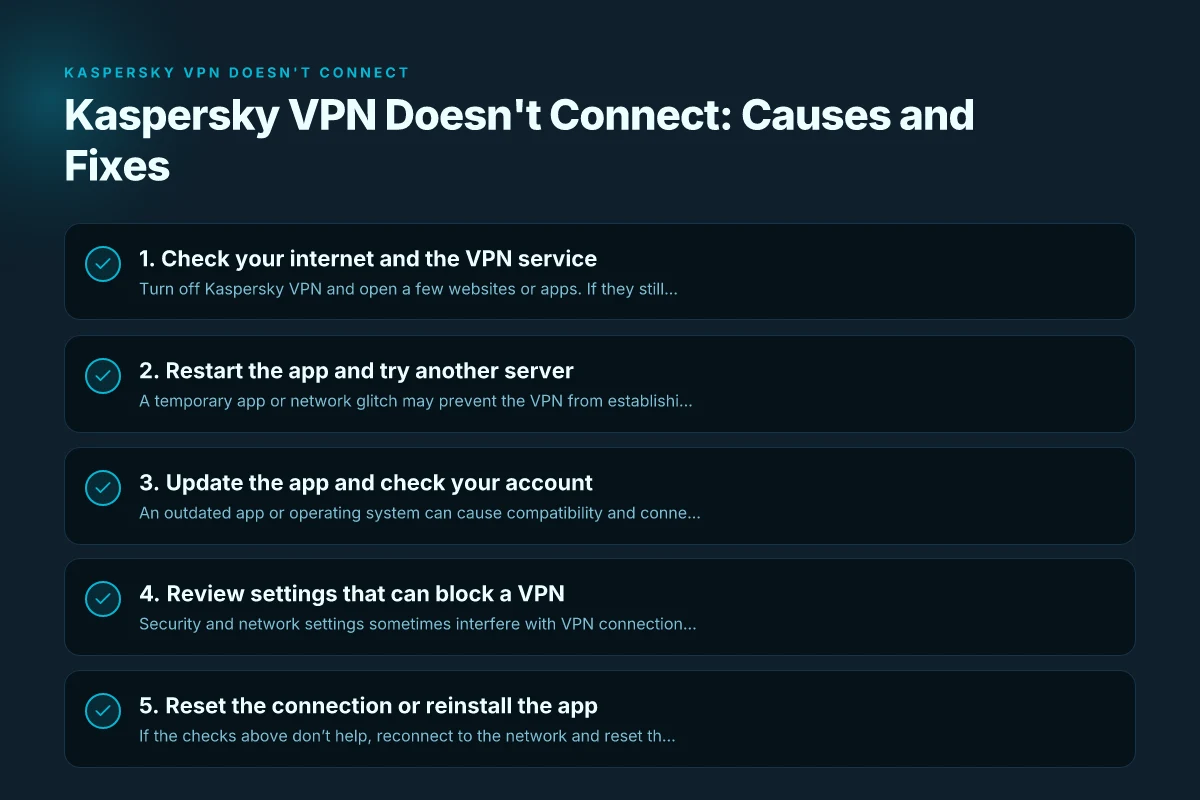
2. Restart the app and try another server
A temporary app or network glitch may prevent the VPN from establishing a connection. Fully close Kaspersky VPN, not just minimize it, and reopen it. Restarting your device can also clear a stuck network connection. Mac VPN: How to Choose, Set Up, and Use a VPN on Your Mac
Then try these steps:
- Disconnect and reconnect to the VPN.
- Choose a different server location.
- Switch between Wi-Fi and mobile data, where available.
- Turn Airplane Mode on briefly, then turn it off and reconnect.
- Check that your device’s date and time are set automatically.
If Kaspersky VPN connects on one network but not another, the second network may be restricting VPN traffic. Public Wi-Fi, workplace networks, school networks, and some hotel connections may require you to sign in through a browser before using a VPN. Complete that sign-in first, then reconnect.
Choose a troubleshooting step based on the symptom
| Symptom | First option | Next option | What to check |
|---|---|---|---|
| No internet with VPN off | Restore internet access | Retry the VPN | Network connection |
| VPN service unavailable | Wait and retry | Check service status | Service availability |
| App is unresponsive | Restart the app | Restart the device | App state |
| One server will not connect | Try another server | Retry later | Server selection |
| App may be outdated | Update the app | Restart the app | App version |
| VPN access is restricted | Review network settings | Try another network | VPN-blocking settings |
| Account access issue | Check account status | Resolve account issue | Subscription or sign-in |
| Connection still fails | Reset the connection | Reinstall the app | App installation |
Compiled November 2026; check the provider's site for current details. Where Is the VPN Located? Find It on Your Device or Online
3. Update the app and check your account
An outdated app or operating system can cause compatibility and connection problems. Install available updates for Kaspersky VPN and your device, then restart the device and test the connection again. Download the app only from the official app store or Kaspersky’s official website.
Also verify that you’re signed in to the correct Kaspersky account and that your subscription or included VPN access is active. If the app says your plan has expired, your account needs attention, or you’ve reached a usage or device limit, follow the instructions shown in the app or account portal.
Avoid repeatedly signing out, removing devices, or changing subscription settings unless the app indicates that this is necessary. First confirm your account status and save any sign-in details you may need.
4. Review settings that can block a VPN
Security and network settings sometimes interfere with VPN connections. Temporarily check whether another VPN, proxy, firewall, or security app is already controlling the connection. Disconnect any other VPN and disable conflicting proxy settings, then test Kaspersky VPN again. How to VPN iPhone: Set Up and Use a VPN Safely
A firewall or network administrator may block VPN traffic. If you’re using a managed work or school device, don’t change security policies without permission. Ask the administrator whether VPN use is allowed on that network.
On phones and tablets, battery-saving features or background restrictions may interrupt the VPN app. Allow Kaspersky VPN to run in the background and use the permissions the app requests. Menu names vary by operating system and device, so consult the manufacturer’s instructions if you can’t find a setting.
| What you notice | Likely area to check | First step |
|---|---|---|
| Nothing loads, even with VPN off | Internet connection | Restart the router or try another network |
| VPN fails only on one server | Server availability | Choose another location |
| VPN works on mobile data but not Wi-Fi | Wi-Fi restrictions | Complete the network sign-in or contact its administrator |
| The app reports an account or plan issue | Account or subscription | Check your Kaspersky account |
| VPN disconnects when the screen locks | Device background settings | Review battery and background restrictions |
5. Reset the connection or reinstall the app
If the checks above don’t help, reconnect to the network and reset the VPN app’s connection settings if that option is available. The exact steps vary by device and app version, so use Kaspersky’s instructions for your platform rather than changing unfamiliar network settings.
Reinstalling can resolve damaged app files. Before uninstalling, make sure you know how to sign back in and can access your account. Remove Kaspersky VPN, restart the device, reinstall the latest version from an official source, and sign in again. IPsec MTU: How to Calculate and Troubleshoot It
If the app still won’t connect, contact Kaspersky Support. Include your device model, operating system and app version, the server location you tried, the network type, and the exact error message. Mention whether the VPN works on a different network. This information can help support identify whether the issue is tied to your device, account, network, or a particular server.
Compare reset and reinstall options before the next step
| Option | Best time to try | Main action | What to do afterward |
|---|---|---|---|
| Retry connection | After a brief interruption | Connect again | Check whether it succeeds |
| Change server | When one server fails | Select another server | Keep the working server |
| Restart app | When the app seems stuck | Close and reopen it | Retry the connection |
| Update app | When an update is available | Install the latest version | Reopen and test |
| Review settings | When a setting may block VPN traffic | Check network or device settings | Retry the VPN |
| Reset connection | After basic checks fail | Reset the VPN connection | Connect again |
| Reinstall app | When reset does not help | Remove and reinstall the app | Sign in and test |
| Seek further help | When the steps do not resolve the issue | Contact Kaspersky support | Share the steps already tried |
Compiled November 2026; check the provider's site for current details.
Recommended next step
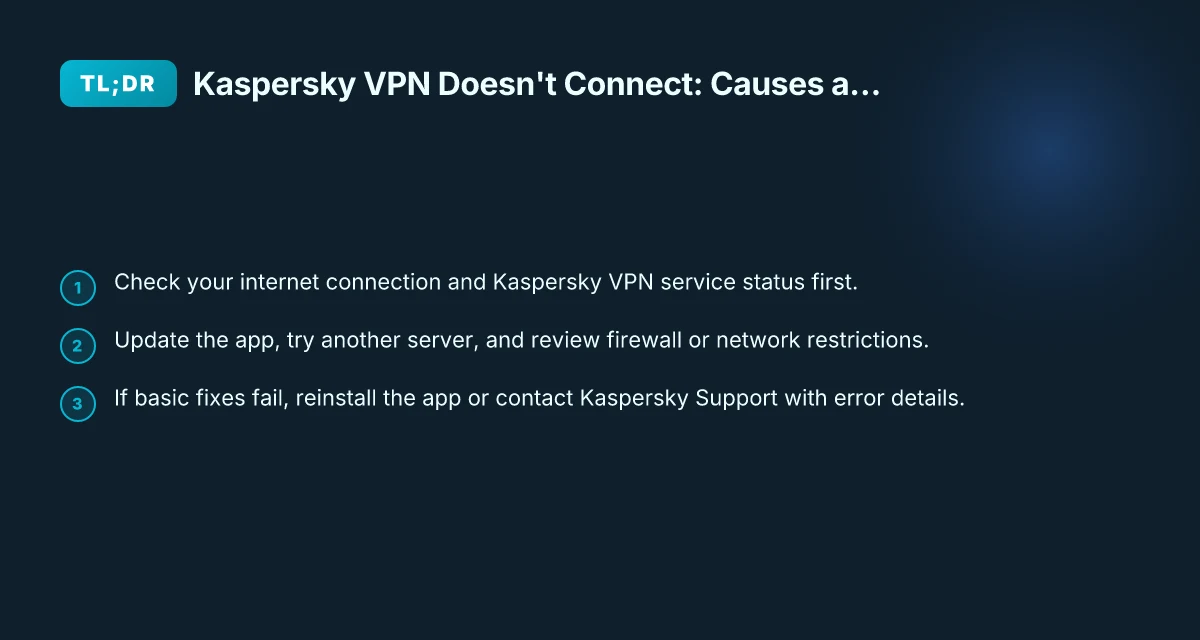
Start by confirming that the internet works with Kaspersky VPN turned off. Then restart the app, try another server, and test a different network. If the connection still fails after updating the app and checking your account and device settings, reinstall it or contact Kaspersky Support with the error details. How to Use NordVPN on iPhone: A Step-by-Step Guide