What Is an.ovpn File? How to Use and Troubleshoot It
Learn what an.ovpn file contains, how to import it into a VPN client, and how to handle it safely.
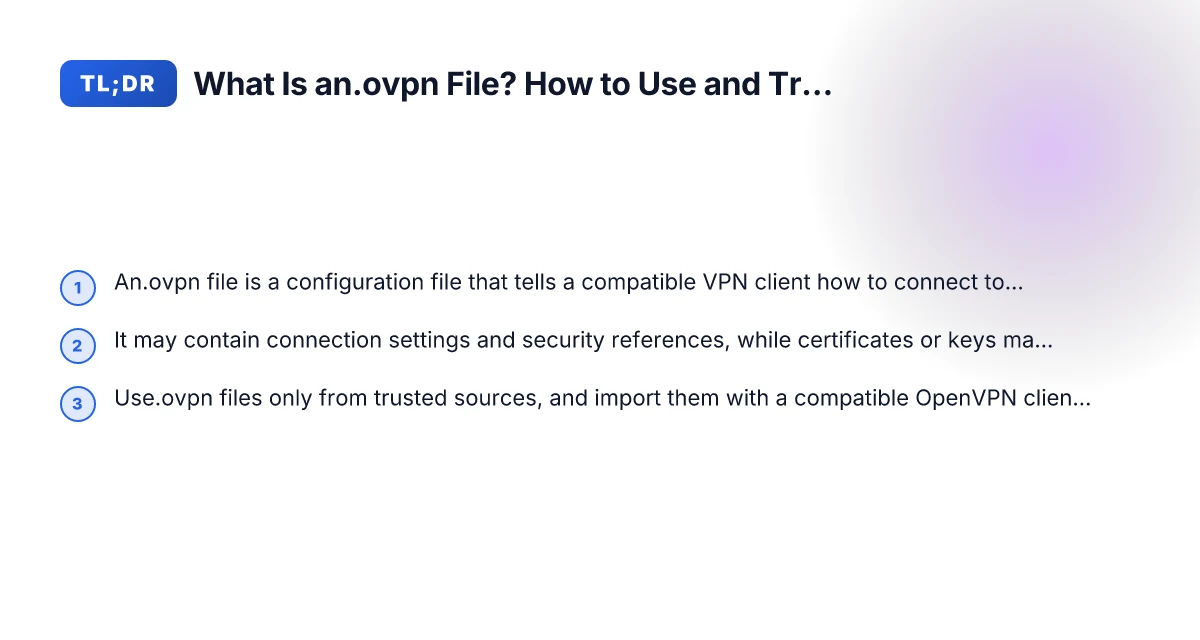
An.ovpn file is a text-based configuration file used by OpenVPN-compatible software. It provides the settings a VPN client needs to connect to a particular VPN server, such as the server address, connection protocol, port, and authentication method. To use one, get it from a trusted VPN provider or network administrator, then import it into a compatible client and connect.

Editor's pick: NordVPN — fast, secure VPN — Strong encryption, a no-logs policy and apps for every device. 30-day money-back guarantee. Get NordVPN →
Compare common ways to use an .ovpn file
| Option | What you need | How it works | Best for | Main limitation |
|---|---|---|---|---|
| OpenVPN Connect | OpenVPN Connect app and a profile | Import the file, then connect | Straightforward setup | Requires a compatible profile |
| OpenVPN Community client | OpenVPN client software and a profile | Load the profile and start a connection | Users comfortable with client software | Setup varies by platform |
| Router with OpenVPN support | Compatible router and profile | Add the profile in router settings | Connecting multiple devices | Router features vary |
| VPN provider app | Provider account and its app | Sign in and choose a server | Users who want provider-managed setup | May not accept imported profiles |
| Text editor | Any editor that can read plain text | Inspect or edit configuration text | Checking profile contents | Does not establish a VPN connection |
| File manager | Access to the downloaded file | Locate and share the profile with a client | Finding or importing a profile | Does not validate whether it is safe |
Compiled November 2026; check the provider's site for current details.
| VPN | Obfuscation | From / month | Plan | Free plan | Refund | Alipay | UnionPay | Crypto | Website opens in China | Trustpilot | |
|---|---|---|---|---|---|---|---|---|---|---|---|
 ZoogVPN | Turn on manually Shadow | $2.49/mo | 27 months: $59.99 | Yes | 7 days | ✓ | ✓ | ✓ | ✓ | Official site blocked; our special link opens (4.4 s) | 4.2/5 (195 reviews) |
 NordVPN | Turn on manually Obfuscated Servers / NordWhisper | $3.49/mo | 27 months: $94.23 | No | 30 days | ? | ✗ | ✓ | ✓ | ✗ Blocked | 4.2/5 (51,628 reviews) |
 ExpressVPN | ✓ On by default all servers | $3.00/mo | 28 months: $84 | No | 30 days | ✗ | ✗ | ✓ | ✗ | ✗ Blocked | 4.4/5 (29,706 reviews) |
 Surfshark | ✓ On by default Camouflage, with OpenVPN | See site | See site | No | 30 days | ✗ | ✗ | ✗ | ✓ | ✗ Blocked | 4.3/5 (31,823 reviews) |
 Proton VPN | Turn on manually Stealth, free plan too | $2.99/mo | 12 months: $35.88 | Yes | 30 days | ✗ | ✗ | ✗ | ✓ | ✗ Blocked | 2.1/5 (1,040 reviews) |
 Astrill VPN | Turn on manually StealthVPN / OpenWeb | $12.50/mo | 24 months: $300 | No | See site | ✗ | ✗ | ✗ | ✓ | ✗ Blocked | 1.3/5 (110 reviews) |
 Private Internet Access | Turn on manually Shadowsocks, OpenVPN only | $2.03/mo | 40 months: $81.2 | No | 30 days | ✗ | ✗ | ✗ | ✗ | ✗ Blocked | 4.2/5 (11,033 reviews) |
 CyberGhost | Turn on manually selected servers | $2.19/mo | 28 months: $61.32 | No | 45 days | ✗ | ✗ | ✗ | ✓ | ✗ Blocked | 4.0/5 (24,178 reviews) |
 PureVPN | Turn on manually switch to OpenVPN | $1.69/mo | 60 months: $101.55 | No | 31 days | ? | ? | ✗ | ✓ | ✗ Blocked | 4.4/5 (17,994 reviews) |
 AdGuard VPN | ✓ On by default TrustTunnel | $2.99/mo | 24 months: $71.76 | Yes | 30 days | ✓ | ✗ | ✓ | ✓ | Official site blocked; our special link opens (3.7 s) | 4.3/5 (290 reviews) |
 Mullvad | Turn on manually QUIC / Shadowsocks / LWO | $5.61/mo | €5/mo | No | 14 days | ✗ | ✗ | ✗ | ✓ | ✗ Blocked | 3.2/5 (192 reviews) |
 Windscribe | Turn on manually Stealth / WStunnel | $5.75/mo | 12 months: $69 | Yes | See site | ✗ | ✗ | ✗ | ✓ | ✗ Blocked | 4.7/5 (13,355 reviews) |
 StrongVPN | Turn on manually Scramble, OpenVPN TCP | See site | See site | No | 30 days | ✓ | ✗ | ✗ | ✗ | ✗ Blocked | 4.4/5 (2,695 reviews) |
 LightXtreme 闪连 | Not listed | $7.08/mo | 12 months: $84.99 | Yes | 30 days | ✓ | ✓ | ✓ | ✓ | ✓ Yes (3.5 s) | No page |
Prices checked 2026-11-10 on each vendor's pricing page (cheapest long plan, USD). Check the vendor's checkout for the final price.
Obfuscation checked 2026-11-14 on each vendor's site and help center: "on by default" = nothing to set; "turn on manually" = switch protocol or mode in settings; "not listed" = the vendor describes no obfuscation.
Payment methods checked 2026-11-10 on each vendor's payment pages: all 14 take cards and PayPal; ✗ = not listed, ? = the vendor's own pages disagree.
China access: whether the official website opens from mainland China networks (tests the website only, not the VPN connection). Last checked 2026-11-18 01:02 Beijing time.
Trustpilot score and review count checked 2026-11-10.
What an.ovpn file contains
An.ovpn file is not usually an application or a VPN connection by itself. It is a set of instructions that a client reads when establishing a connection. The exact contents vary by provider and setup.
Common settings may include:
- The VPN server’s hostname or IP address
- Whether to use UDP or TCP, and which port to connect through
- The network device and tunnel type
- Encryption and authentication parameters
- DNS or routing instructions
- References to certificates, keys, or other authentication files
Some configurations include certificates or keys directly inside the.ovpn file. Others refer to separate files that must be kept in the same folder or imported as part of a package. A provider may also require a username and password, multi-factor authentication, or a separate account login.
Because the file is plain text, it can often be opened in a text editor. However, editing unfamiliar options can prevent the VPN from connecting or change how traffic is routed. Avoid changing the contents unless your provider or administrator tells you what to modify. What VPN Should I Use? A Practical Guide to Choosing the Right VPN
How to open and use an.ovpn file
You need an OpenVPN-compatible client. The available client and import steps depend on your device and VPN provider.
- Download the configuration from a trusted source, such as your VPN provider’s official website or your organization’s IT team.
- Install a compatible OpenVPN client from an official app store or software source.
- Open the client and choose its option to import or add a profile.
- Select the.ovpn file. If the provider supplied a bundle of files, follow its instructions and keep the related files together.
- Enter any requested login details, then connect.
- Check the client’s status to confirm that the connection is active.
On some devices, you may be able to tap the file and choose an installed VPN app. On others, you must first save the configuration to a location the app can access. Consult the client’s current documentation for device-specific steps.
| File or item | What it does | Is it always needed? |
|---|---|---|
| .ovpn file | Provides connection settings and authentication instructions | Yes, when using a profile-based OpenVPN setup |
| Certificate or key files | Verify identity or support secure authentication | No; they may be embedded in the profile |
| Username and password | Authenticate the user or account | Depends on the provider’s setup |
| OpenVPN client | Reads the profile and creates the VPN connection | Yes |
##.ovpn files and other VPN files
An.ovpn file is associated with OpenVPN, an open-source VPN protocol and software ecosystem. It is different from a VPN app: the app handles the connection, while the.ovpn profile supplies details for a particular server or service. Best Free VPN for Microsoft Edge: Safe, Practical Options
Other VPN technologies may use different profile formats or connection methods. For example, a provider’s app may configure its own connections without asking you to handle an.ovpn file. A file extension alone does not mean the file will work with every VPN client.
If a provider gives you several.ovpn files, they may correspond to different server locations, connection protocols, or configurations. Choose the one recommended for your needs. A nearby server can offer lower latency, while a specific organization may require a particular server or profile.
Check safety and privacy before using an .ovpn file
| Check | What to look for | If it checks out | If it does not |
|---|---|---|---|
| Source | A provider or administrator you trust | Continue with cautious setup | Do not import it |
| File contents | Expected server and connection settings | Use the intended profile | Ask the source to verify it |
| Embedded credentials | Passwords, keys, or certificates | Keep the file private | Treat it as sensitive |
| Unexpected settings | Unfamiliar directives or destinations | Confirm their purpose | Do not connect until clarified |
| File transfer | A trusted download or secure handoff | Store it securely | Request a fresh copy |
| Permissions | Access limited to people who need it | Keep using the profile | Restrict access or remove copies |
| Profile updates | A current file from the trusted source | Use the updated settings | Confirm whether the old file is still valid |
Compiled November 2026; check the provider's site for current details. Why Doesn’t ThisVid Work With VPN? Common Causes and Fixes
Safety and privacy
Treat an.ovpn file as configuration data from a source you trust. A profile can direct your device to a particular server and may include sensitive authentication material. A malicious or altered configuration could connect to an untrusted server or change network settings.
For safer handling:
- Download profiles only from the provider’s official site or a verified administrator.
- Do not import files sent unexpectedly by email or found on unfamiliar websites.
- Check the provider’s guidance for the correct server and profile.
- Keep any separate certificates, keys, and login details private.
- Remove old profiles you no longer use, especially on shared devices.
- If a file contains credentials or private keys, avoid posting it publicly or sending it through insecure channels.
A VPN connection does not automatically make every online activity private or safe. The VPN provider or network operator may still be able to see some connection information, and websites can collect data independently. Review the provider’s privacy and security policies.
Common.ovpn problems
If a profile will not connect, start with basic checks: What Is an Obfuscated VPN? How It Works and When to Use One
- The client cannot import the file: Confirm that you installed an OpenVPN-compatible app and selected the correct file. Make sure the download is complete and has the.ovpn extension.
- The connection reports missing files: The profile may depend on certificates or keys supplied separately. Download the complete package and follow the provider’s import instructions.
- Login fails: Check your username and password, and confirm whether the provider requires a special VPN password or multi-factor authentication.
- The server cannot be reached: Check your internet connection and verify that the server address and port are current. A different profile may be required if a server is unavailable.
- The connection works, but browsing does not: Check the client’s logs and DNS settings, then contact the provider or administrator. Avoid changing routing or security options without guidance.
- The file appears invalid: Confirm that it came from a trusted source and has not been altered. Request a fresh profile if necessary.
Connection logs can help identify the issue, but they may contain server addresses, usernames, or other sensitive details. Remove private information before sharing logs with support.
Troubleshoot common .ovpn problems
| Problem | Likely cause | What to try | When to ask for help |
|---|---|---|---|
| File will not import | Unsupported app or invalid format | Use a compatible OpenVPN client | The file still fails to load |
| Connection cannot start | Incorrect settings or unavailable server | Check the profile and server status | Settings appear correct |
| Authentication fails | Wrong credentials or expired access | Verify login details with the provider | Credentials are rejected again |
| Certificate or key error | Missing, invalid, or outdated certificate | Request a complete, current profile | The error persists |
| DNS does not work | DNS settings or network conflict | Reconnect and check network settings | Sites remain unreachable |
| Connection drops | Unstable network or server issue | Try a stable network or another approved server | Drops continue across networks |
| Internet stops after disconnect | Routes or DNS settings remain applied | Reconnect, then disconnect cleanly | Normal access does not return |
| Profile appears suspicious | Untrusted source or unexpected settings | Do not connect; verify the file | The source cannot confirm its contents |
Compiled November 2026; check the provider's site for current details.
Recommendation
Use an.ovpn file when a trusted VPN provider or administrator supplies it for an OpenVPN-compatible client. Import the file as provided, keep any related credentials secure, and use the provider’s instructions if you encounter problems. Best Free VPN Extension for Edge Browser: Top Picks and What to Know