What Is a Proxy vs VPN? Key Differences and How to Choose
Learn how proxies and VPNs differ in privacy, encryption, speed, and use cases, and find out which option suits your needs.
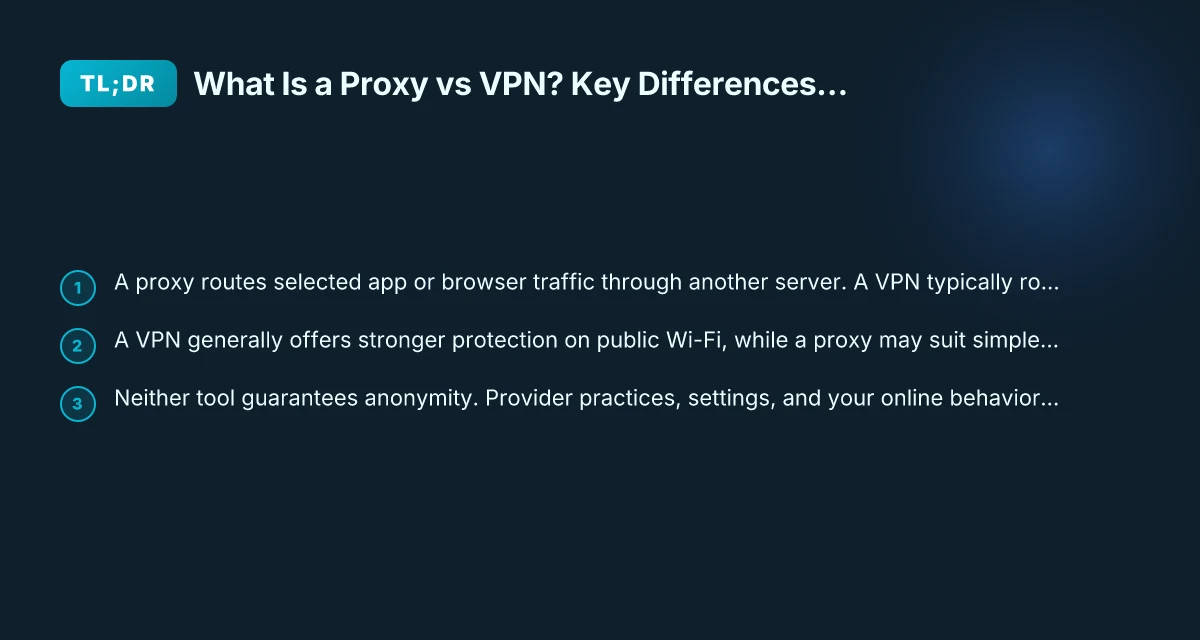
A proxy forwards traffic between an app and the internet, while a VPN (virtual private network) creates an encrypted connection between your device and a VPN server. Both can make websites see the server’s IP address instead of your own, but they differ in how much traffic they handle and whether they encrypt it. If you are asking what is a proxy vs VPN, the short answer is that a proxy is usually a narrower routing tool, while a VPN is generally a broader privacy and security tool.

Editor's pick: NordVPN — fast, secure VPN — Strong encryption, a no-logs policy and apps for every device. 30-day money-back guarantee. Get NordVPN →
Proxy vs VPN: the key differences
| Feature | Proxy | VPN |
|---|---|---|
| What it does | Routes selected traffic through another server | Routes traffic through an encrypted tunnel |
| IP address | Can mask your IP for configured traffic | Masks your IP for traffic covered by the VPN |
| Encryption | Usually not included | Typically encrypts traffic between your device and VPN server |
| Traffic coverage | Often app- or browser-specific | Often covers device traffic, depending on settings |
| Setup | Configure a proxy for an app or browser | Install or configure a VPN app or connection |
| Typical use | Access a service through a different IP | Add privacy and protection on untrusted networks |
| Main limitation | May leave other traffic unaffected | Provider can see some connection information |
| Speed impact | Depends on proxy and route | Depends on provider, server, and encryption |
Compiled November 2026; check the provider's site for current details.
| VPN | Obfuscation | From / month | Plan | Free plan | Refund | Alipay | UnionPay | Crypto | Website opens in China | Trustpilot | |
|---|---|---|---|---|---|---|---|---|---|---|---|
 ZoogVPN | Turn on manually Shadow | $2.49/mo | 27 months: $59.99 | Yes | 7 days | ✓ | ✓ | ✓ | ✓ | Official site blocked; our special link opens (4.4 s) | 4.2/5 (195 reviews) |
 NordVPN | Turn on manually Obfuscated Servers / NordWhisper | $3.49/mo | 27 months: $94.23 | No | 30 days | ? | ✗ | ✓ | ✓ | ✗ Blocked | 4.2/5 (51,628 reviews) |
 ExpressVPN | ✓ On by default all servers | $3.00/mo | 28 months: $84 | No | 30 days | ✗ | ✗ | ✓ | ✗ | ✗ Blocked | 4.4/5 (29,706 reviews) |
 Surfshark | ✓ On by default Camouflage, with OpenVPN | See site | See site | No | 30 days | ✗ | ✗ | ✗ | ✓ | ✗ Blocked | 4.3/5 (31,823 reviews) |
 Proton VPN | Turn on manually Stealth, free plan too | $2.99/mo | 12 months: $35.88 | Yes | 30 days | ✗ | ✗ | ✗ | ✓ | ✗ Blocked | 2.1/5 (1,040 reviews) |
 Astrill VPN | Turn on manually StealthVPN / OpenWeb | $12.50/mo | 24 months: $300 | No | See site | ✗ | ✗ | ✗ | ✓ | ✗ Blocked | 1.3/5 (110 reviews) |
 Private Internet Access | Turn on manually Shadowsocks, OpenVPN only | $2.03/mo | 40 months: $81.2 | No | 30 days | ✗ | ✗ | ✗ | ✗ | ✗ Blocked | 4.2/5 (11,033 reviews) |
 CyberGhost | Turn on manually selected servers | $2.19/mo | 28 months: $61.32 | No | 45 days | ✗ | ✗ | ✗ | ✓ | ✗ Blocked | 4.0/5 (24,178 reviews) |
 PureVPN | Turn on manually switch to OpenVPN | $1.69/mo | 60 months: $101.55 | No | 31 days | ? | ? | ✗ | ✓ | ✗ Blocked | 4.4/5 (17,994 reviews) |
 AdGuard VPN | ✓ On by default TrustTunnel | $2.99/mo | 24 months: $71.76 | Yes | 30 days | ✓ | ✗ | ✓ | ✓ | Official site blocked; our special link opens (3.7 s) | 4.3/5 (290 reviews) |
 Mullvad | Turn on manually QUIC / Shadowsocks / LWO | $5.61/mo | €5/mo | No | 14 days | ✗ | ✗ | ✗ | ✓ | ✗ Blocked | 3.2/5 (192 reviews) |
 Windscribe | Turn on manually Stealth / WStunnel | $5.75/mo | 12 months: $69 | Yes | See site | ✗ | ✗ | ✗ | ✓ | ✗ Blocked | 4.7/5 (13,355 reviews) |
 StrongVPN | Turn on manually Scramble, OpenVPN TCP | See site | See site | No | 30 days | ✓ | ✗ | ✗ | ✗ | ✗ Blocked | 4.4/5 (2,695 reviews) |
 LightXtreme 闪连 | Not listed | $7.08/mo | 12 months: $84.99 | Yes | 30 days | ✓ | ✓ | ✓ | ✓ | ✓ Yes (3.5 s) | No page |
Prices checked 2026-11-10 on each vendor's pricing page (cheapest long plan, USD). Check the vendor's checkout for the final price.
Obfuscation checked 2026-11-14 on each vendor's site and help center: "on by default" = nothing to set; "turn on manually" = switch protocol or mode in settings; "not listed" = the vendor describes no obfuscation.
Payment methods checked 2026-11-10 on each vendor's payment pages: all 14 take cards and PayPal; ✗ = not listed, ? = the vendor's own pages disagree.
China access: whether the official website opens from mainland China networks (tests the website only, not the VPN connection). Last checked 2026-11-18 01:02 Beijing time.
Trustpilot score and review count checked 2026-11-10.
What is a proxy?
A proxy server acts as an intermediary. Your browser or another configured app sends a request to the proxy, which then forwards it to the destination website. The site sees the proxy’s IP address rather than your device’s IP address.
Proxies are often configured for a specific browser, app, or type of traffic. For example, you might set a proxy in a browser to access a service through a different region. Other apps on the device may continue connecting directly to the internet.
There are different kinds of proxies:
- HTTP proxies handle web traffic, typically for websites.
- HTTPS proxies support connections to secure websites. HTTPS protects data between your browser and the site, but this is not the same as a proxy encrypting all your device’s traffic.
- SOCKS proxies can handle several kinds of traffic, depending on the app and configuration.
A proxy may or may not encrypt the connection between your device and the proxy server. That distinction matters: hiding your IP address from a destination does not, by itself, make your connection private or secure. Edge Extensions VPN: How to Choose and Use One Safely
What is a VPN?
A VPN app creates a connection, often called a tunnel, between your device and a VPN server. Traffic routed through that tunnel is encrypted between your device and the VPN server. Websites and online services generally see the VPN server’s IP address.
Many commercial VPNs can route traffic from most or all of a device, although the exact coverage depends on the operating system, app settings, and features such as split tunneling. A VPN can also help protect data from people monitoring the same local network, such as an unsecured public Wi-Fi hotspot.
Encryption does not make a VPN an invisibility tool. The VPN provider can usually see connection details, and websites may still identify you through account logins, cookies, browser fingerprinting, or other information. The connection from the VPN server to a website is not automatically encrypted by the VPN, though HTTPS encrypts it for secure sites.
Proxy vs VPN: the key differences
| Feature | Proxy | VPN |
|---|---|---|
| How it routes traffic | Usually routes traffic from a configured app or browser | Commonly routes traffic from much or all of the device |
| Encryption | May not encrypt the connection to the proxy | Typically encrypts traffic between your device and the VPN server |
| IP address shown to websites | Usually the proxy’s IP for traffic sent through it | Usually the VPN server’s IP for traffic sent through it |
| Setup | Often configured per app or browser | Usually managed through an app or device settings |
| Common uses | App-specific routing or straightforward IP changes | Broader traffic routing and added protection on untrusted networks |
| Main privacy consideration | The proxy operator may see unencrypted traffic and connection data | The VPN provider can see some connection data and becomes a party you must trust |
The table describes common setups, not every product. Some proxies offer encryption, and VPNs vary in their features, logging policies, and technical design. Check what a service actually protects rather than relying on its label. Urban VPN for Microsoft Edge: Setup, Features, and Privacy Considerations
Which tool fits your needs?
| Need | Proxy may fit | VPN may fit | Check before choosing |
|---|---|---|---|
| Change IP for one app | Yes | Possible, but may be broader | App support |
| Cover several apps | May require separate setup | Often supported | Device and app coverage |
| Protect public Wi-Fi traffic | Not usually by itself | Yes, with a trustworthy VPN | Encryption and connection settings |
| Access a region-specific service | May help | May help | Service rules and availability |
| Keep other device traffic unchanged | Often easier | Depends on split tunneling | Traffic routing controls |
| Avoid relying on a provider | Neither guarantees this | Neither guarantees this | Provider policies and trust |
| Keep setup simple | Can be simple for one app | Can be simple with an app | Compatibility and configuration |
Compiled November 2026; check the provider's site for current details.
Which should you use?
Choose based on what you want to do, not just whether you want to change your apparent IP address.
A proxy may be enough when you want to route a particular browser or app through another server and do not need device-wide protection. It can be convenient for a limited task, but a basic proxy should not be treated as a secure privacy tool. F5 VPN Download: How to Get the Right Client
A VPN is usually the better fit when you want encrypted traffic between your device and a remote server, particularly when using public Wi-Fi. It can also simplify routing traffic from multiple apps, though you should check whether the VPN covers all traffic and whether features such as split tunneling are enabled.
Neither option guarantees that you can access a particular website or service. Sites may block known proxy or VPN addresses, and using either tool does not override a service’s terms or local laws.
Privacy, security, and speed
With either tool, your traffic passes through an intermediary. That means the provider matters. Before choosing a service, look for clear information about:
- What data it collects and how long it keeps it
- Whether it records browsing activity, connection timestamps, or IP addresses
- How it secures its servers and handles security incidents
- Who operates the service and how it is funded
- Whether its privacy claims have been independently reviewed
Speed depends on the server, network conditions, distance, congestion, and the service’s design. A proxy can feel faster for a limited task because it may handle only one app and may not encrypt traffic. A VPN’s encryption can add overhead, but modern devices and services can often handle it with little noticeable impact. A distant or crowded server can slow either one. Cisco VPN Client: What It Is, How to Connect, and What to Use Today
Free services deserve particular scrutiny. Some may impose data limits, show ads, collect more information than expected, or offer unreliable security. Read the privacy policy and understand the trade-offs before sending sensitive traffic through any provider.
Privacy, security, and speed checklist
| Factor | Proxy | VPN | What to verify |
|---|---|---|---|
| Encryption | Often absent | Typically supported | What traffic is encrypted |
| IP masking | For configured traffic | For covered traffic | Which apps use the service |
| Provider visibility | Proxy may see routed traffic | VPN provider may see connection data | Logging and privacy policies |
| Uncovered traffic | May use your regular connection | May bypass the VPN by design or failure | Leak protection and routing |
| Speed | Depends on server and route | Depends on server, route, and encryption | Performance for your location |
| Reliability | Depends on proxy service | Depends on VPN service and connection | Uptime and support |
| Best fit | Narrow, app-specific routing | Broader traffic protection | Your actual use case |
Compiled November 2026; check the provider's site for current details.
Recommendation: choose the right tool for the job
For general privacy and safer use of public Wi-Fi, choose a reputable VPN and review its privacy policy, security features, and traffic-routing settings. For simple, app-specific routing, a proxy may be more convenient, but do not assume it encrypts your connection. In either case, keep using HTTPS, secure your accounts, and remember that the provider you choose becomes part of your trust boundary. Free VPN to Change Location: How to Choose and Use One