What Is a Proxy Server? How It Works, Types, and When to Use One
Learn what a proxy server does, how it handles internet traffic, and how to choose the right type for privacy, access, or security.
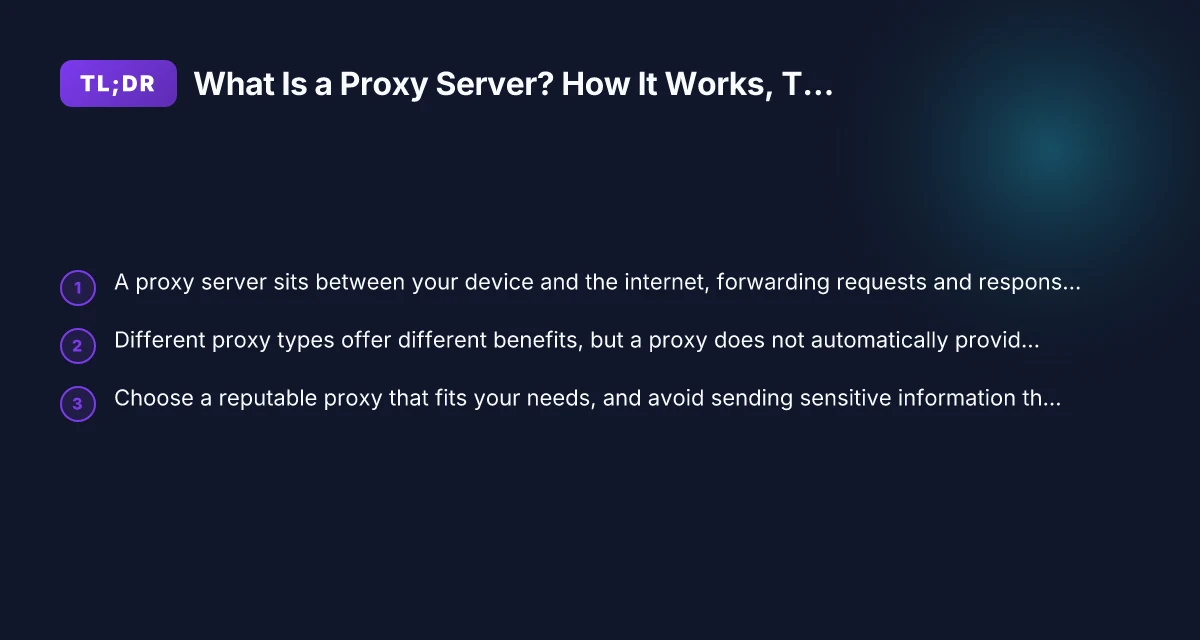
A proxy server is an intermediary between your device and the internet. When you use one, your request goes to the proxy first. The proxy forwards it to the destination and returns the response. Depending on its configuration, a proxy can hide your device’s IP address from a website, filter traffic, cache content, or control access to online services.
Proxies are used by individuals, businesses, and network administrators for different reasons. Understanding how they work, and what they do not do, helps you decide whether one is appropriate for your situation.

Editor's pick: NordVPN — fast, secure VPN — Strong encryption, a no-logs policy and apps for every device. 30-day money-back guarantee. Get NordVPN →
How proxy servers, VPNs, and direct connections compare
| Option | Routes traffic through an intermediary | Encrypts traffic by default | Hides your IP from destination | Typical use |
|---|---|---|---|---|
| Direct connection | No | No | No | Ordinary browsing |
| HTTP proxy | Yes | No | Yes | Web requests |
| HTTPS proxy | Yes | Protects connection to proxy | Yes | Secure web browsing |
| SOCKS proxy | Yes | No | Yes | Apps and varied traffic |
| Residential proxy | Yes | Depends on service | Yes | Requests using residential IPs |
| Datacenter proxy | Yes | Depends on service | Yes | High-volume requests |
| Transparent proxy | Yes | No | Not always | Network filtering |
| VPN | Yes | Yes, typically | Yes | Protecting traffic across apps |
Compiled November 2026; check the provider's site for current details.
How a proxy server works
Without a proxy, your device usually connects directly to a website or online service. The site can receive information about the connection, including your public IP address. With a proxy enabled, your device connects to the proxy server, which makes a separate request to the destination on your behalf.
The basic process is:
- Your browser or app sends a request to the proxy.
- The proxy applies its rules, which may include checking, filtering, or logging the request.
- The proxy sends the request to the destination website.
- The website sends its response to the proxy.
- The proxy passes the response back to your device.
The destination typically sees the proxy’s IP address rather than your device’s public IP address. However, this does not mean you are anonymous. Websites can use other signals, such as account details, cookies, browser settings, and device characteristics, to identify or track visitors.
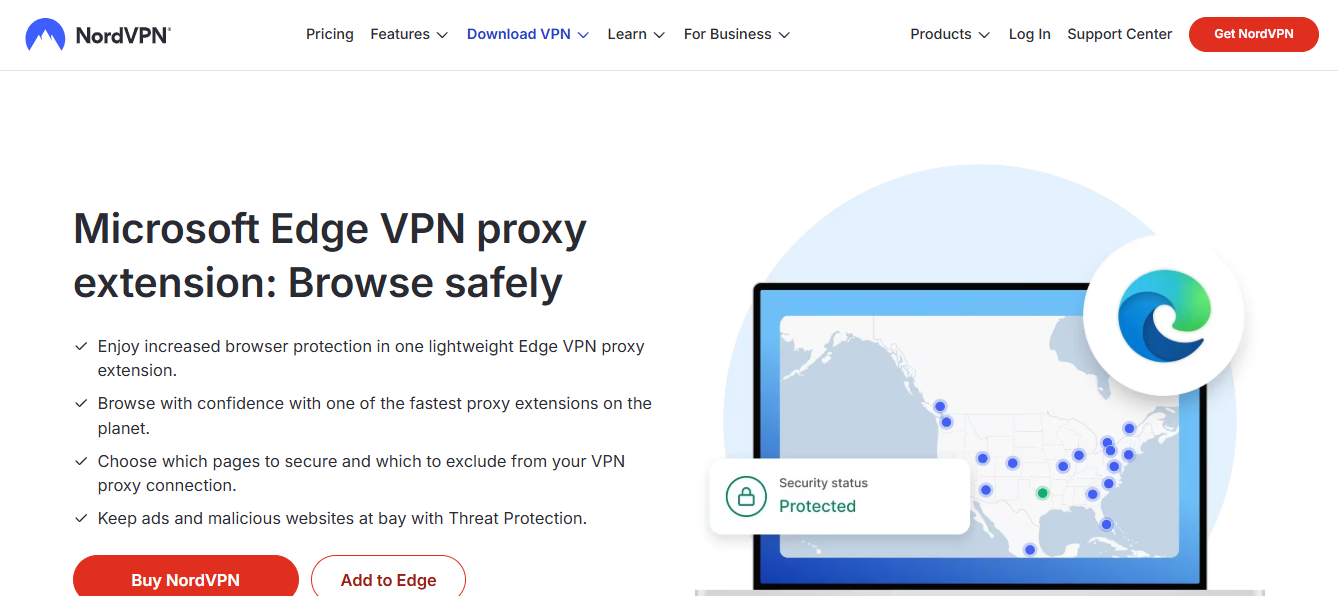
A proxy may be configured for a specific browser, application, device, or entire network. Some services require you to enter connection details manually, while others provide an app or browser extension. How Can I Tell If a VPN Is Blocking My Internet?
Common types of proxy servers
“Proxy” is a broad term. The right type depends on what you need the server to do.
- Forward proxy: Sits between users and the internet. Companies and schools often use it to manage outbound traffic, enforce browsing rules, or restrict access to certain sites.
- Reverse proxy: Sits in front of web servers and handles incoming requests. Website operators use reverse proxies to distribute traffic, improve performance, and add a layer of protection.
- Transparent proxy: Handles traffic without requiring users to configure their devices. It may be used for network filtering or caching, but it generally does not conceal the fact that a proxy is involved.
- HTTP proxy: Handles web traffic using the HTTP protocol. Depending on its setup, it may not be suitable for other kinds of internet traffic.
- HTTPS proxy: Supports connections to secure websites. HTTPS encrypts traffic between your browser and the website, although the proxy may still see connection details and could inspect content if your device or network is configured to allow that.
- SOCKS proxy: Can handle a wider range of traffic than a basic HTTP proxy, depending on the application and configuration. SOCKS itself does not encrypt your traffic.
These categories can overlap. For example, a forward proxy can be an HTTP proxy, while a reverse proxy may handle HTTPS connections for a website.
Proxy server vs. VPN
Proxies and virtual private networks (VPNs) both route traffic through an intermediary, but they are not identical. A proxy is often configured for selected applications or types of traffic. A VPN typically creates an encrypted connection between your device and the VPN provider, routing more of your device’s network traffic through that connection.
| Feature | Proxy server | VPN |
|---|---|---|
| Typical coverage | One app, browser, or selected traffic | Often most or all device traffic |
| Encryption | Not guaranteed; depends on the connection and setup | Usually encrypts traffic between your device and the VPN server |
| IP address shown to destination | Often the proxy’s IP address | Usually the VPN server’s IP address |
| Common uses | Filtering, caching, access control, or routing specific traffic | Protecting traffic on untrusted networks and routing device traffic |
| Main consideration | Features and privacy vary widely | The VPN provider can still have access to certain connection information |
Neither option guarantees total anonymity. A VPN also cannot prevent tracking through account logins or browser fingerprinting, and it shifts trust to the VPN provider. Choose based on the specific protection or network function you need rather than assuming one tool solves every privacy concern. NordVPN Windows: How to Download, Install, and Use It
Proxy types and common uses
| Proxy type | What it routes | IP address presented to destination | Common use | Key consideration |
|---|---|---|---|---|
| HTTP | Web traffic | Proxy IP | Web access and filtering | Usually unencrypted |
| HTTPS | Web traffic | Proxy IP | Secure web access | Check proxy-provider trust |
| SOCKS | Various app traffic | Proxy IP | Apps beyond web browsers | Encryption is not inherent |
| Residential | Routed requests | Residential IP | Location-specific access | Provider practices vary |
| Datacenter | Routed requests | Datacenter IP | Scale and speed | Easier to identify in some cases |
| Transparent | Selected network traffic | May reveal original IP | Organization-wide filtering | User may not configure it |
| Reverse | Incoming server requests | Server’s public endpoint | Load balancing and protection | Serves a different role from forward proxies |
Compiled November 2026; check the provider's site for current details.
Why people and organizations use proxies
A proxy can be useful for managing how internet traffic reaches online services.
Common uses include: Free VPN Extension for Microsoft Edge: What to Know Before You Install
- Access control: Organizations can allow or block websites according to network policies.
- Content filtering: Schools and businesses may restrict access to categories of websites or potentially harmful content.
- Caching: A proxy can save copies of frequently requested content and provide them more quickly, where caching is supported and appropriate.
- Load distribution: Reverse proxies can direct incoming requests across multiple servers, helping a website handle traffic.
- IP address routing: A proxy can make a request appear to come from the proxy’s network, which may help with legitimate testing or region-specific service checks.
- Monitoring and administration: Network teams may use proxies to apply security rules, review traffic patterns, or troubleshoot connections.
Whether a proxy can access a particular website or service depends on the proxy’s location, configuration, the destination’s policies, and applicable laws. A proxy should not be treated as permission to bypass rules or access content without authorization.
Limitations and safety considerations
A proxy is not automatically secure or private. Some free or poorly managed proxies may record browsing activity, insert advertisements, redirect traffic, or expose users to security risks. The proxy operator may be able to see connection metadata, such as the sites you connect to, and unencrypted traffic may be readable along the route.
Keep these points in mind:
- Check the provider. Look for clear information about ownership, logging, security practices, and how the service is funded.
- Use HTTPS. Secure connections encrypt content between your browser and a website, but they do not make an untrusted proxy trustworthy.
- Avoid sensitive activity on unknown proxies. Do not enter passwords, payment details, or confidential information through a service you do not trust.
- Understand what is routed. A browser proxy may not affect other apps, and an app-specific proxy may cover only that app.
- Review workplace or school rules. A managed network may log traffic or apply policies regardless of your personal settings.
- Keep software updated. Updates help address vulnerabilities in browsers, proxy clients, and operating systems.
Choose the right option for your needs Microsoft Edge Secure Network VPN Reviews: Is It Safe and Worth Using?
| Need | Proxy may fit? | VPN may fit? | Check before choosing |
|---|---|---|---|
| Route browser traffic through another server | Yes | Yes | App and browser support |
| Protect traffic on public Wi-Fi | Not by itself | Yes | Encryption and provider policy |
| Route traffic from multiple apps | SOCKS may support it | Yes | Which apps are covered |
| Filter traffic on a managed network | Yes | Sometimes | Admin controls and logging |
| Present a different IP to a website | Yes | Yes | Location and IP type |
| Avoid sharing activity with a provider | No guarantee | No guarantee | Logging and privacy terms |
| Improve anonymity | Limited | Limited | Neither guarantees anonymity |
Compiled November 2026; check the provider's site for current details.
Recommendation
Use a proxy when you need a specific function, such as network filtering, caching, or routing traffic from one application, and choose a reputable provider or administrator. If your main goal is to encrypt traffic from your device across an untrusted network, consider a trustworthy VPN instead. In either case, review the service’s privacy practices and do not assume that changing your IP address makes you anonymous.