WatchGuard SSLVPN: How It Works, How to Set It Up, and How to Troubleshoot It
Learn what WatchGuard SSLVPN does, how users connect, and how administrators can configure and troubleshoot secure remote access.
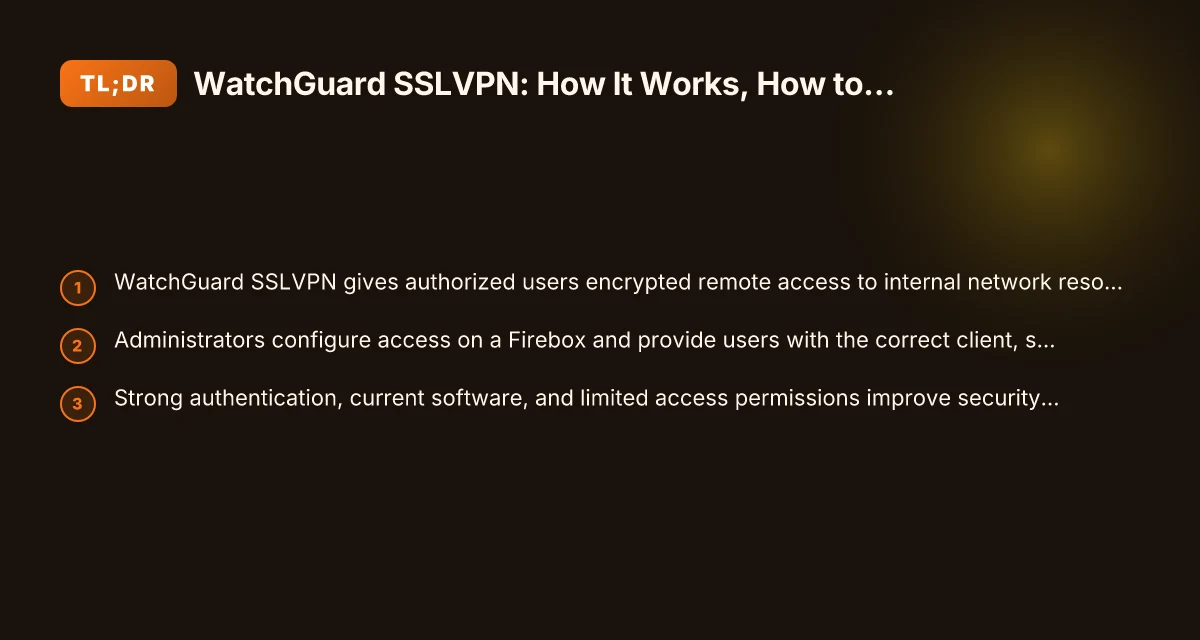
WatchGuard SSLVPN is a remote-access VPN service on compatible WatchGuard Firebox appliances. It lets authorized users connect securely to a company network over the internet, typically using the WatchGuard Mobile VPN with SSL client. If you are looking for how to use it, the essentials are to install the approved client, enter your organization’s VPN address, authenticate, and follow your administrator’s access instructions.
The exact setup depends on the Firebox model, Fireware version, and organization policy. Users should get connection details from their IT team. Administrators should consult current WatchGuard documentation for version-specific configuration steps.
| VPN | Obfuscation | From / month | Plan | Free plan | Refund | Alipay | UnionPay | Crypto | Website opens in China | Trustpilot | |
|---|---|---|---|---|---|---|---|---|---|---|---|
 ZoogVPN | Turn on manually Shadow | $2.49/mo | 27 months: $59.99 | Yes | 7 days | ✓ | ✓ | ✓ | ✓ | Official site blocked; our special link opens (4.4 s) | 4.2/5 (195 reviews) |
 NordVPN | Turn on manually Obfuscated Servers / NordWhisper | $3.49/mo | 27 months: $94.23 | No | 30 days | ? | ✗ | ✓ | ✓ | ✗ Blocked | 4.2/5 (51,628 reviews) |
 ExpressVPN | ✓ On by default all servers | $3.00/mo | 28 months: $84 | No | 30 days | ✗ | ✗ | ✓ | ✗ | ✗ Blocked | 4.4/5 (29,706 reviews) |
 Surfshark | ✓ On by default Camouflage, with OpenVPN | See site | See site | No | 30 days | ✗ | ✗ | ✗ | ✓ | ✗ Blocked | 4.3/5 (31,823 reviews) |
 Proton VPN | Turn on manually Stealth, free plan too | $2.99/mo | 12 months: $35.88 | Yes | 30 days | ✗ | ✗ | ✗ | ✓ | ✗ Blocked | 2.1/5 (1,040 reviews) |
 Astrill VPN | Turn on manually StealthVPN / OpenWeb | $12.50/mo | 24 months: $300 | No | See site | ✗ | ✗ | ✗ | ✓ | ✗ Blocked | 1.3/5 (110 reviews) |
 Private Internet Access | Turn on manually Shadowsocks, OpenVPN only | $2.03/mo | 40 months: $81.2 | No | 30 days | ✗ | ✗ | ✗ | ✗ | ✗ Blocked | 4.2/5 (11,033 reviews) |
 CyberGhost | Turn on manually selected servers | $2.19/mo | 28 months: $61.32 | No | 45 days | ✗ | ✗ | ✗ | ✓ | ✗ Blocked | 4.0/5 (24,178 reviews) |
 PureVPN | Turn on manually switch to OpenVPN | $1.69/mo | 60 months: $101.55 | No | 31 days | ? | ? | ✗ | ✓ | ✗ Blocked | 4.4/5 (17,994 reviews) |
 AdGuard VPN | ✓ On by default TrustTunnel | $2.99/mo | 24 months: $71.76 | Yes | 30 days | ✓ | ✗ | ✓ | ✓ | Official site blocked; our special link opens (3.7 s) | 4.3/5 (290 reviews) |
 Mullvad | Turn on manually QUIC / Shadowsocks / LWO | $5.61/mo | €5/mo | No | 14 days | ✗ | ✗ | ✗ | ✓ | ✗ Blocked | 3.2/5 (192 reviews) |
 Windscribe | Turn on manually Stealth / WStunnel | $5.75/mo | 12 months: $69 | Yes | See site | ✗ | ✗ | ✗ | ✓ | ✗ Blocked | 4.7/5 (13,355 reviews) |
 StrongVPN | Turn on manually Scramble, OpenVPN TCP | See site | See site | No | 30 days | ✓ | ✗ | ✗ | ✗ | ✗ Blocked | 4.4/5 (2,695 reviews) |
 LightXtreme 闪连 | Not listed | $7.08/mo | 12 months: $84.99 | Yes | 30 days | ✓ | ✓ | ✓ | ✓ | ✓ Yes (3.5 s) | No page |
Prices checked 2026-11-10 on each vendor's pricing page (cheapest long plan, USD). Check the vendor's checkout for the final price.
Obfuscation checked 2026-11-14 on each vendor's site and help center: "on by default" = nothing to set; "turn on manually" = switch protocol or mode in settings; "not listed" = the vendor describes no obfuscation.
Payment methods checked 2026-11-10 on each vendor's payment pages: all 14 take cards and PayPal; ✗ = not listed, ? = the vendor's own pages disagree.
China access: whether the official website opens from mainland China networks (tests the website only, not the VPN connection). Last checked 2026-11-18 01:02 Beijing time.
Trustpilot score and review count checked 2026-11-10.

Editor's pick: NordVPN — fast, secure VPN — Strong encryption, a no-logs policy and apps for every device. 30-day money-back guarantee. Get NordVPN →
Compare WatchGuard SSLVPN with other remote-access options
| Option | How it connects | Client required | Best suited for | Main trade-off |
|---|---|---|---|---|
| WatchGuard SSLVPN | Encrypted tunnel over SSL/TLS | Mobile VPN with SSL client | Remote access to protected networks | Requires firewall configuration |
| IPsec VPN | Encrypted IPsec tunnel | VPN client or built-in OS support | Site-to-site or remote access | Can be harder to configure |
| WireGuard VPN | Encrypted WireGuard tunnel | WireGuard client | Lightweight, fast remote access | Requires compatible setup |
| OpenVPN | Encrypted VPN tunnel | OpenVPN client | Flexible remote access | Requires server and client configuration |
| Remote desktop gateway | Remote desktop session | Remote desktop client | Access to specific desktops or apps | Does not provide broad network access |
| Zero-trust network access | App-specific access | Often an agent or browser | Access limited to approved applications | Depends on provider and integration |
| Site-to-site VPN | Network-to-network tunnel | No end-user client | Connecting fixed office networks | Not designed for individual users |
Compiled November 2026; check the provider's site for current details.
What WatchGuard SSLVPN does
SSLVPN creates an encrypted connection between a remote device and a Firebox. Once authenticated, a user may be able to reach permitted internal systems, such as file servers, business applications, or remote desktops. The firewall’s rules and the user’s account determine what is accessible.
The connection is commonly called Mobile VPN with SSL in WatchGuard materials. It uses TLS-based encryption to protect traffic in transit. This is especially useful when employees work away from the office or need access to resources that are not exposed directly to the public internet.
SSLVPN does not automatically grant access to every device on the network. Administrators can control which users or groups may connect and what traffic is allowed. The organization may also require multifactor authentication or other security checks.
How users connect
The steps below describe the typical process. Your company’s instructions take priority, because it may use a custom portal, a specific client version, or additional authentication requirements. Nord VPN in China: Does It Work and How to Prepare
- Get the connection details. Ask your IT administrator for the VPN server address, approved client, username format, and any required authentication method. Do not guess the server address or download software from an unofficial source.
- Install the client. Use the client and version approved by your organization. Depending on the setup, the client may be available through an organization-provided download page or another managed software channel.
- Enter the server address. Add the hostname or address supplied by IT. A company may use a DNS name rather than a numeric IP address.
- Authenticate. Sign in with the account provided by your organization. If multifactor authentication is enabled, complete the prompt using the approved method.
- Confirm access. Check the client’s connection status, then open the internal service you need. Some organizations require you to disconnect from the VPN when you are finished.
A successful VPN connection does not guarantee that every internal application will work. The application may require a separate account, or the administrator may not have included its network in your allowed access.
Compare common WatchGuard SSLVPN issues and checks
| Symptom | Likely area | What to check | Possible next step |
|---|---|---|---|
| Cannot reach the VPN portal | Network or firewall | Public address and firewall availability | Confirm the correct address |
| Login is rejected | Credentials or authentication | Username, password, and account status | Verify credentials with an administrator |
| Client cannot connect | Client or configuration | Client version and connection profile | Reinstall or update the client |
| Connection times out | Network path | Internet access and firewall rules | Try another network |
| Connects but cannot reach resources | Access policy or routing | User permissions and allowed networks | Ask an administrator to review policy |
| DNS names do not resolve | DNS configuration | VPN DNS settings and assigned servers | Check DNS settings with an administrator |
| Connection drops repeatedly | Network stability | Local connection and firewall logs | Test a more stable network |
| Certificate warning appears | Certificate configuration | Certificate validity and server identity | Confirm the certificate with an administrator |
Compiled November 2026; check the provider's site for current details.
Administrator configuration and security
Administrators configure Mobile VPN with SSL on the Firebox and decide how users authenticate and what resources they can reach. Menu names and available options can vary by Fireware release, so use the documentation that matches the appliance’s installed version. NordVPN Windows VPN: Setup, Features, and How to Use It
A sound deployment usually includes these steps:
- Enable the service on the Firebox. Select the appropriate settings for the organization’s network and remote-access needs.
- Choose authentication sources. Use supported local or external authentication and define which users or groups are allowed to connect.
- Set access policies. Permit only the networks, hosts, and services remote users need. Avoid broad access when narrower rules will work.
- Distribute approved client settings. Provide the correct server name, client version, and login guidance through a secure, managed channel.
- Test from outside the office. Confirm that a user can establish a connection and reach only the resources allowed by policy.
- Maintain the deployment. Keep Fireware, client software, certificates, and authentication integrations current according to WatchGuard guidance and organizational change controls.
Treat remote access as an extension of the internal network. Use unique accounts, strong passwords, and multifactor authentication where available. Review access when employees change roles or leave, and monitor relevant firewall and authentication logs.
SSLVPN compared with other remote-access options
The right VPN method depends on the device, network design, and use case. The names and capabilities available can vary by WatchGuard product and software version.
| Option | Typical use | What to consider |
|---|---|---|
| WatchGuard Mobile VPN with SSL | User access from a computer over the internet | Requires a compatible client and Firebox configuration |
| IPsec remote-access VPN | Remote access using an IPsec-based client or configuration | May suit environments standardized on IPsec |
| Site-to-site VPN | Connecting two networks, such as branch offices | Designed for network-to-network traffic rather than individual users |
| Zero-trust or application-specific access | Access to selected applications or services | May reduce broad network access but requires compatible services and policies |
SSLVPN is often a practical choice for individual remote users, but it is not automatically the best fit for every deployment. Compare supported platforms, authentication options, management requirements, and the resources users need before choosing a method. Does Microsoft Edge Have a VPN? What Edge Secure Network Does
Administrator setup and security decision checklist
| Decision area | What to configure or verify | Security consideration | When to review |
|---|---|---|---|
| User access | Allow only required users | Limit access by role | When roles change |
| Authentication | Configure approved authentication | Use strong credentials and MFA where available | During security reviews |
| Client access | Provide the correct SSLVPN client and profile | Use trusted downloads and current software | After client updates |
| Network permissions | Define reachable networks and services | Apply least-privilege access | When applications change |
| Firewall rules | Permit required VPN traffic | Avoid unnecessary exposure | After policy changes |
| Certificates | Configure a valid server certificate | Protect private keys and verify identity | Before expiry |
| Logging | Enable relevant connection logs | Restrict access to sensitive logs | Regularly |
| Troubleshooting | Check client, firewall, and authentication logs | Avoid sharing credentials or secrets | After connection failures |
Compiled November 2026; check the provider's site for current details.
Common WatchGuard SSLVPN problems
If the client will not connect, start with basic checks before changing firewall settings.
- Incorrect server address: Verify the hostname or address with IT, including any required domain name.
- Authentication failure: Check the username format, password, account status, and multifactor prompt. Repeated failed attempts may trigger account protections.
- Connection timeout: Confirm that the device has internet access and that the VPN service is reachable from the current network. A hotel, public Wi-Fi network, or local firewall may restrict VPN traffic.
- Client or operating-system mismatch: Check that the installed client is supported for the device’s operating system and the organization’s Fireware version.
- Connected, but internal resources are unavailable: The account may lack permission, the required network route may not be included, or the destination service may be down. Ask IT to check access policies and logs.
- Certificate or trust warning: Do not bypass the warning without confirmation. Contact the administrator to verify the server identity and certificate configuration.
When reporting a problem, include the device and operating-system version, client version, time of the attempt, exact error message, and whether the issue affects one network or all networks. Never send your password or one-time authentication code. How to Check My VPN Location and Fix It
Recommendation
For users, install only the client supplied or approved by your organization and request connection details directly from IT. For administrators, configure WatchGuard SSLVPN with current software, strong authentication, narrowly scoped access rules, and regular log reviews. Test the setup with a real remote connection, then document the approved connection and troubleshooting steps for users.