How to Check My VPN Location and Fix It
Learn how to check your VPN location, understand mismatches, and troubleshoot when your apparent location is wrong.
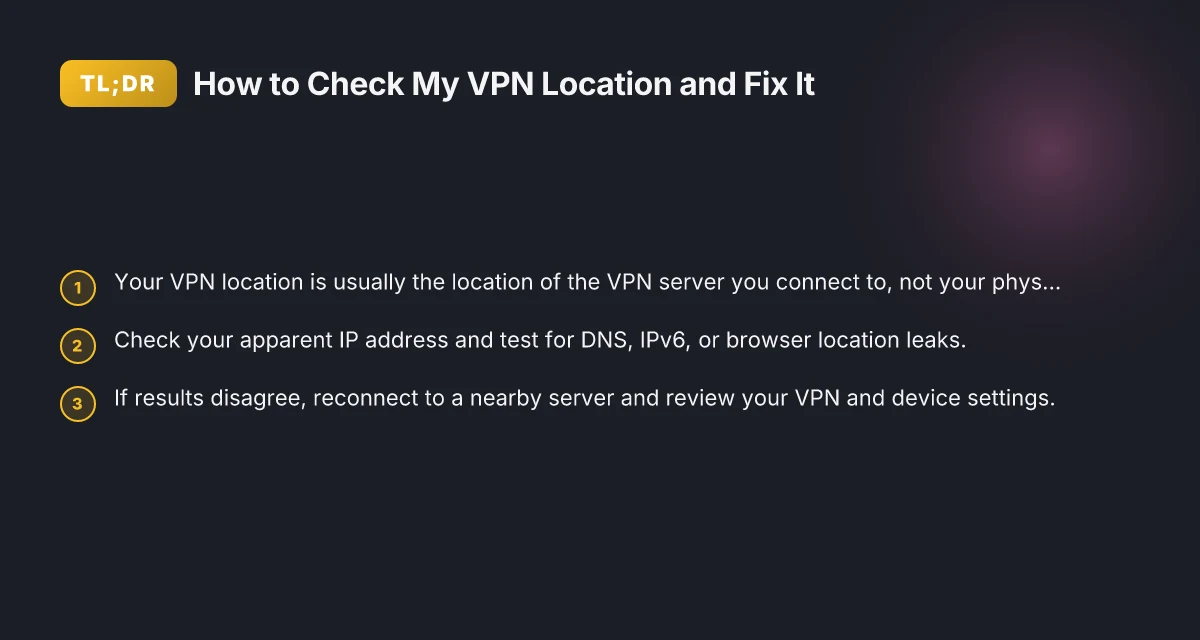
If you’re asking, “What is my VPN location?”, check your public IP address with a reputable IP lookup service while your VPN is connected. The country or city shown is generally the location associated with your VPN server, not where you are physically. Results can vary between services, though, and an IP lookup is only one part of how websites may estimate your location.

Editor's pick: NordVPN — fast, secure VPN — Strong encryption, a no-logs policy and apps for every device. 30-day money-back guarantee. Get NordVPN →
Compare the ways to check your VPN location
| Check method | What it shows | Useful for | Limitation |
|---|---|---|---|
| IP lookup website | Public IP and estimated location | Checking the VPN’s apparent location | Location is approximate |
| VPN app | Connection status and selected server | Confirming which server you chose | May not show your public IP |
| Search engine location result | Location inferred for search results | Spotting a broad location mismatch | Can reflect account or device signals |
| Map or weather service | Location used by the service | Checking location-sensitive websites | May use more than your IP |
| DNS leak test | DNS requests and their apparent route | Finding a possible DNS mismatch | Does not directly verify every location signal |
| WebRTC leak test | IP details exposed through browser features | Checking for browser-based IP exposure | Results depend on browser settings |
Compiled November 2026; check the provider's site for current details.
| VPN | Obfuscation | From / month | Plan | Free plan | Refund | Alipay | UnionPay | Crypto | Website opens in China | Trustpilot | |
|---|---|---|---|---|---|---|---|---|---|---|---|
 ZoogVPN | Turn on manually Shadow | $2.49/mo | 27 months: $59.99 | Yes | 7 days | ✓ | ✓ | ✓ | ✓ | Official site blocked; our special link opens (4.4 s) | 4.2/5 (195 reviews) |
 NordVPN | Turn on manually Obfuscated Servers / NordWhisper | $3.49/mo | 27 months: $94.23 | No | 30 days | ? | ✗ | ✓ | ✓ | ✗ Blocked | 4.2/5 (51,628 reviews) |
 ExpressVPN | ✓ On by default all servers | $3.00/mo | 28 months: $84 | No | 30 days | ✗ | ✗ | ✓ | ✗ | ✗ Blocked | 4.4/5 (29,706 reviews) |
 Surfshark | ✓ On by default Camouflage, with OpenVPN | See site | See site | No | 30 days | ✗ | ✗ | ✗ | ✓ | ✗ Blocked | 4.3/5 (31,823 reviews) |
 Proton VPN | Turn on manually Stealth, free plan too | $2.99/mo | 12 months: $35.88 | Yes | 30 days | ✗ | ✗ | ✗ | ✓ | ✗ Blocked | 2.1/5 (1,040 reviews) |
 Astrill VPN | Turn on manually StealthVPN / OpenWeb | $12.50/mo | 24 months: $300 | No | See site | ✗ | ✗ | ✗ | ✓ | ✗ Blocked | 1.3/5 (110 reviews) |
 Private Internet Access | Turn on manually Shadowsocks, OpenVPN only | $2.03/mo | 40 months: $81.2 | No | 30 days | ✗ | ✗ | ✗ | ✗ | ✗ Blocked | 4.2/5 (11,033 reviews) |
 CyberGhost | Turn on manually selected servers | $2.19/mo | 28 months: $61.32 | No | 45 days | ✗ | ✗ | ✗ | ✓ | ✗ Blocked | 4.0/5 (24,178 reviews) |
 PureVPN | Turn on manually switch to OpenVPN | $1.69/mo | 60 months: $101.55 | No | 31 days | ? | ? | ✗ | ✓ | ✗ Blocked | 4.4/5 (17,994 reviews) |
 AdGuard VPN | ✓ On by default TrustTunnel | $2.99/mo | 24 months: $71.76 | Yes | 30 days | ✓ | ✗ | ✓ | ✓ | Official site blocked; our special link opens (3.7 s) | 4.3/5 (290 reviews) |
 Mullvad | Turn on manually QUIC / Shadowsocks / LWO | $5.61/mo | €5/mo | No | 14 days | ✗ | ✗ | ✗ | ✓ | ✗ Blocked | 3.2/5 (192 reviews) |
 Windscribe | Turn on manually Stealth / WStunnel | $5.75/mo | 12 months: $69 | Yes | See site | ✗ | ✗ | ✗ | ✓ | ✗ Blocked | 4.7/5 (13,355 reviews) |
 StrongVPN | Turn on manually Scramble, OpenVPN TCP | See site | See site | No | 30 days | ✓ | ✗ | ✗ | ✗ | ✗ Blocked | 4.4/5 (2,695 reviews) |
 LightXtreme 闪连 | Not listed | $7.08/mo | 12 months: $84.99 | Yes | 30 days | ✓ | ✓ | ✓ | ✓ | ✓ Yes (3.5 s) | No page |
Prices checked 2026-11-10 on each vendor's pricing page (cheapest long plan, USD). Check the vendor's checkout for the final price.
Obfuscation checked 2026-11-14 on each vendor's site and help center: "on by default" = nothing to set; "turn on manually" = switch protocol or mode in settings; "not listed" = the vendor describes no obfuscation.
Payment methods checked 2026-11-10 on each vendor's payment pages: all 14 take cards and PayPal; ✗ = not listed, ? = the vendor's own pages disagree.
China access: whether the official website opens from mainland China networks (tests the website only, not the VPN connection). Last checked 2026-11-18 01:02 Beijing time.
Trustpilot score and review count checked 2026-11-10.
What “my VPN location” means
A VPN routes your internet traffic through a server operated by the VPN provider. Websites and apps that see your public IP address will usually associate you with that server’s location. For example, if you are in Toronto and connect to a VPN server in London, an IP lookup may place you in the United Kingdom.
This does not mean every service will treat you as if you are in London. Your device can reveal other location signals, and IP databases may be outdated or imprecise. An IP address may be registered to a provider in one place while the server itself is somewhere else. Some lookup tools show a country accurately but give an approximate or incorrect city.
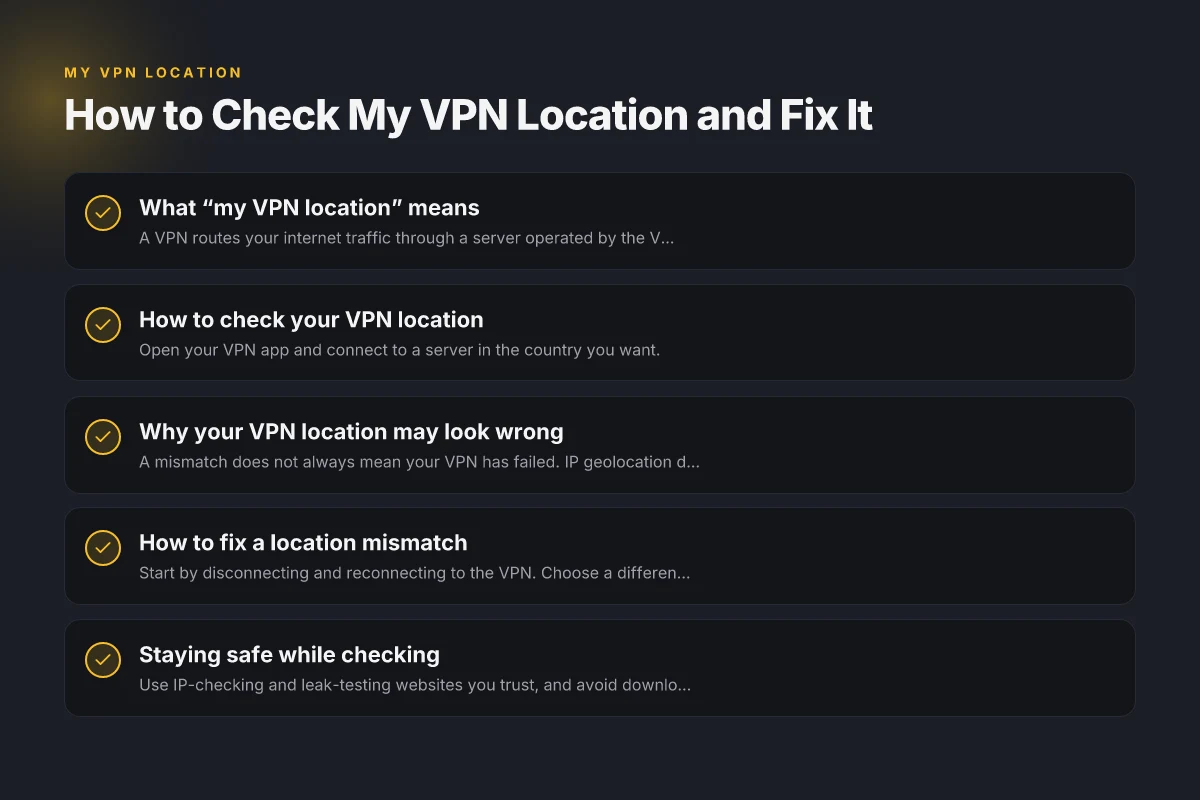
How to check your VPN location
- Open your VPN app and connect to a server in the country you want.
- Visit a reputable IP-checking website in your browser.
- Check the public IP address and the reported country. If available, note the city and the internet provider.
- Compare the result with a second IP lookup service if the details seem unexpected.
- Disconnect the VPN and check again. Your public IP and reported location should generally change.
For a useful comparison, run the check in a private browsing window or a different browser. This can help rule out cached pages, although it does not hide your location from websites by itself.
| What you check | What it can tell you | What it cannot confirm |
|---|---|---|
| Public IP lookup | The location commonly associated with your IP address | Your exact physical location or the server’s precise address |
| VPN app’s server label | Which server or region you selected | That all traffic is using that server |
| Browser location prompt | Location estimated using browser and device signals | Your VPN’s public IP location |
| DNS leak test | Which DNS resolvers may be handling requests | Whether every app is protected in every situation |
Why your VPN location may look wrong
A mismatch does not always mean your VPN has failed. IP geolocation databases are maintained by different services and may take time to update after providers change or reassign addresses. One site might identify the VPN’s country correctly, while another places the same address in a neighboring city or country. VPN Free for Edge: How to Choose and Use a Safe Extension
Your VPN app may also connect you to a server that is not physically located where its label suggests. Providers sometimes use virtual locations: the server’s IP address is registered to a selected country, even though the hardware is in another country. Check your provider’s server information or support documentation if the physical location matters to you.
Other causes include:
- A dropped connection: Your device may briefly reconnect using your regular internet connection.
- Split tunneling: Some apps or websites may bypass the VPN by design.
- DNS or IPv6 leaks: Certain requests may go outside the VPN tunnel if your setup is not handling them correctly.
- Browser location access: A site may use device location services, Wi-Fi signals, or previously granted permissions instead of relying only on your IP.
- Cached information: A website or app may retain a location from an earlier session.
Common reasons your VPN location may look wrong
| Possible cause | What you may notice | What to check | First step |
|---|---|---|---|
| VPN disconnected | Your usual location appears | VPN app status | Reconnect |
| Wrong server selected | Location differs from your choice | Selected server in the app | Choose the intended server |
| IP geolocation database is outdated | IP appears in an unexpected place | Results from another lookup site | Recheck later or contact the VPN provider |
| Browser location permission | Website uses device location | Browser site permissions | Review or disable permission |
| GPS or device location | App shows your physical area | Device location settings | Review app access |
| Cookies or account history | Results reflect past activity | Private browsing window | Clear site data or sign out |
| DNS or WebRTC leak | A test shows unexpected network details | DNS and WebRTC test results | Check VPN leak protection |
Compiled November 2026; check the provider's site for current details. How to Enable VPN in Edge: Turn On Microsoft Edge Secure Network
How to fix a location mismatch
Start by disconnecting and reconnecting to the VPN. Choose a different server in the intended country, then repeat the IP check. If the VPN offers several servers in the same city, try another one. A new server may have an IP address that geolocation services recognize more accurately.
Next, review your VPN settings. Enable features such as a kill switch and leak protection if they are available. A kill switch can block internet traffic if the VPN connection drops, while leak protection may help route DNS requests through the tunnel. If you use split tunneling, confirm that the browser or app you are testing is included in the VPN connection.
If an IP lookup shows the expected country but a website still uses your physical location, review that site’s location permission in your browser or device settings. You can deny location access, but be aware that some services need it for features such as local maps or weather. Clearing cookies or signing out and back in may also help remove stored location information.
If the VPN disconnects repeatedly, update the app, try another protocol or server, and check your internet connection. Contact the VPN provider if the issue continues. Share the server region and the results from more than one IP lookup, but avoid sending passwords or other sensitive account information. VPN IPsec: How It Works, Benefits, and When to Use It
Staying safe while checking
Use IP-checking and leak-testing websites you trust, and avoid downloading software just to see your apparent location. A basic IP check should not require your VPN password, payment details, or account credentials.
Remember that a VPN changes how your internet traffic is routed. It does not make you anonymous. Websites can still identify you through account sign-ins, cookies, browser characteristics, or information you provide. A VPN also does not automatically change your device’s GPS location. Treat the displayed VPN location as an estimate of your public IP’s geographic association, not proof that every app sees the same place.
Choose a safe way to troubleshoot a location mismatch
| Action | When to use it | Safety consideration | Recommended |
|---|---|---|---|
| Reconnect to the VPN | Connection may have dropped | Confirm the app shows connected | Yes |
| Select another VPN server | The selected location is unavailable | Use a server offered by your provider | Yes |
| Check your public IP | You need to verify the apparent location | Use a reputable lookup service | Yes |
| Run DNS or WebRTC tests | You suspect a leak | Avoid entering personal information | Yes |
| Review browser permissions | A site may use device location | Change permissions only for trusted sites | Yes |
| Clear cookies or site data | Old site data may affect results | This may sign you out | Sometimes |
| Disable the VPN on sensitive networks | You are troubleshooting connectivity | Your real IP may become visible | Only if needed |
| Install an unfamiliar “location fix” app | A tool promises to change location | It may collect data or add security risks | No |
Compiled November 2026; check the provider's site for current details. TunnelBear Extension: What It Does, How to Install It, and When to Use It
Recommendation
To confirm your VPN location, connect to a server, check your public IP on two reputable lookup services, and compare the results. If they show the wrong country or disagree sharply, try another server and check for connection drops, leaks, split tunneling, and browser location permissions. For most people, a nearby server in the desired country offers a practical balance of speed and a consistent apparent location.