VPN FortiGate: How It Works, Setup Options, and Best Practices
Learn how FortiGate VPN works, compare remote-access and site-to-site options, and review essential setup and security practices.
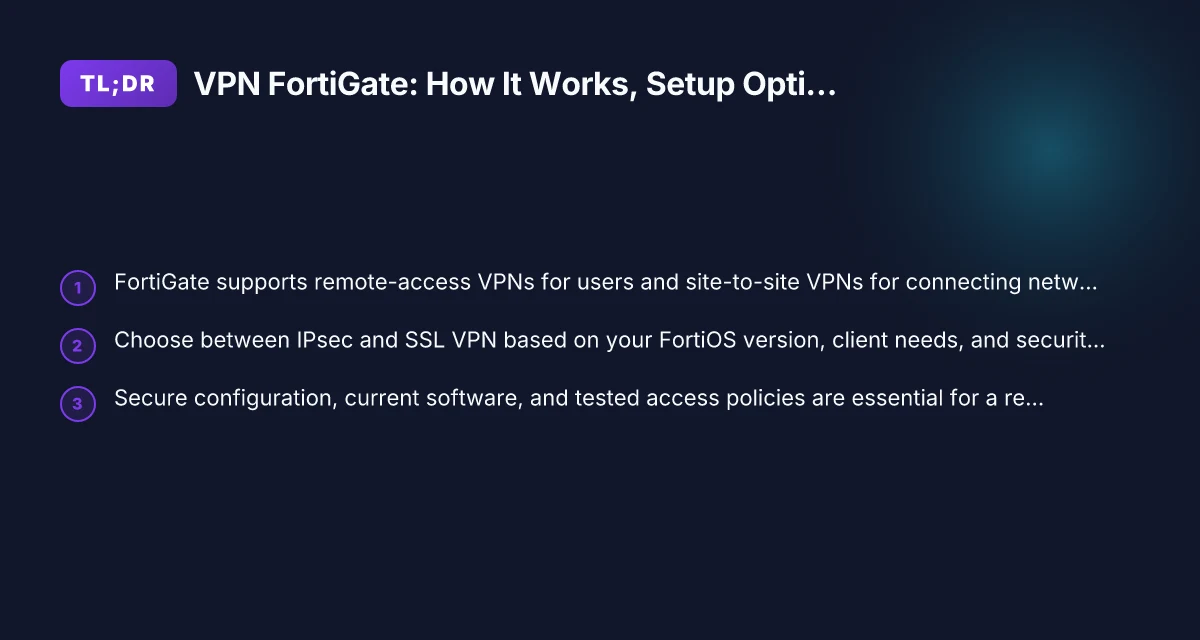
A VPN FortiGate setup uses a Fortinet FortiGate firewall to create encrypted connections for remote users or between separate networks. For individuals, a FortiGate VPN usually means remote access to an organization’s network. For businesses, it can also mean a site-to-site tunnel connecting offices or cloud environments. The right configuration depends on who needs access, what resources they need, and which VPN features your FortiOS version supports.

Editor's pick: NordVPN — fast, secure VPN — Strong encryption, a no-logs policy and apps for every device. 30-day money-back guarantee. Get NordVPN →
Compare common FortiGate VPN options
| Option | Best for | Connection pattern | Client or equipment | Main consideration |
|---|---|---|---|---|
| Remote-access VPN | Staff working away from the office | Individual device to FortiGate | VPN client or supported browser method | Configure user access and authentication |
| Site-to-site VPN | Connecting office networks | Network to network | FortiGate or compatible VPN gateway at each site | Coordinate settings at both ends |
| IPsec remote access | Secure access for remote users | Individual device to FortiGate | IPsec-compatible client | Requires matching IPsec settings |
| SSL VPN | Secure access for remote users | Individual device to FortiGate | FortiClient or supported browser method | Availability depends on FortiOS version and configuration |
| FortiClient-based access | Managed user devices | Individual device to FortiGate | FortiClient | Client settings must match the gateway |
| FortiGate-to-FortiGate IPsec | Linking sites using FortiGate devices | Network to network | FortiGate at each site | Configure routes and policies at both sites |
Compiled November 2026; check the provider's site for current details.
| VPN | Obfuscation | From / month | Plan | Free plan | Refund | Alipay | UnionPay | Crypto | Website opens in China | Trustpilot | |
|---|---|---|---|---|---|---|---|---|---|---|---|
 ZoogVPN | Turn on manually Shadow | $2.49/mo | 27 months: $59.99 | Yes | 7 days | ✓ | ✓ | ✓ | ✓ | Official site blocked; our special link opens (4.4 s) | 4.2/5 (195 reviews) |
 NordVPN | Turn on manually Obfuscated Servers / NordWhisper | $3.49/mo | 27 months: $94.23 | No | 30 days | ? | ✗ | ✓ | ✓ | ✗ Blocked | 4.2/5 (51,628 reviews) |
 ExpressVPN | ✓ On by default all servers | $3.00/mo | 28 months: $84 | No | 30 days | ✗ | ✗ | ✓ | ✗ | ✗ Blocked | 4.4/5 (29,706 reviews) |
 Surfshark | ✓ On by default Camouflage, with OpenVPN | See site | See site | No | 30 days | ✗ | ✗ | ✗ | ✓ | ✗ Blocked | 4.3/5 (31,823 reviews) |
 Proton VPN | Turn on manually Stealth, free plan too | $2.99/mo | 12 months: $35.88 | Yes | 30 days | ✗ | ✗ | ✗ | ✓ | ✗ Blocked | 2.1/5 (1,040 reviews) |
 Astrill VPN | Turn on manually StealthVPN / OpenWeb | $12.50/mo | 24 months: $300 | No | See site | ✗ | ✗ | ✗ | ✓ | ✗ Blocked | 1.3/5 (110 reviews) |
 Private Internet Access | Turn on manually Shadowsocks, OpenVPN only | $2.03/mo | 40 months: $81.2 | No | 30 days | ✗ | ✗ | ✗ | ✗ | ✗ Blocked | 4.2/5 (11,033 reviews) |
 CyberGhost | Turn on manually selected servers | $2.19/mo | 28 months: $61.32 | No | 45 days | ✗ | ✗ | ✗ | ✓ | ✗ Blocked | 4.0/5 (24,178 reviews) |
 PureVPN | Turn on manually switch to OpenVPN | $1.69/mo | 60 months: $101.55 | No | 31 days | ? | ? | ✗ | ✓ | ✗ Blocked | 4.4/5 (17,994 reviews) |
 AdGuard VPN | ✓ On by default TrustTunnel | $2.99/mo | 24 months: $71.76 | Yes | 30 days | ✓ | ✗ | ✓ | ✓ | Official site blocked; our special link opens (3.7 s) | 4.3/5 (290 reviews) |
 Mullvad | Turn on manually QUIC / Shadowsocks / LWO | $5.61/mo | €5/mo | No | 14 days | ✗ | ✗ | ✗ | ✓ | ✗ Blocked | 3.2/5 (192 reviews) |
 Windscribe | Turn on manually Stealth / WStunnel | $5.75/mo | 12 months: $69 | Yes | See site | ✗ | ✗ | ✗ | ✓ | ✗ Blocked | 4.7/5 (13,355 reviews) |
 StrongVPN | Turn on manually Scramble, OpenVPN TCP | See site | See site | No | 30 days | ✓ | ✗ | ✗ | ✗ | ✗ Blocked | 4.4/5 (2,695 reviews) |
 LightXtreme 闪连 | Not listed | $7.08/mo | 12 months: $84.99 | Yes | 30 days | ✓ | ✓ | ✓ | ✓ | ✓ Yes (3.5 s) | No page |
Prices checked 2026-11-10 on each vendor's pricing page (cheapest long plan, USD). Check the vendor's checkout for the final price.
Obfuscation checked 2026-11-14 on each vendor's site and help center: "on by default" = nothing to set; "turn on manually" = switch protocol or mode in settings; "not listed" = the vendor describes no obfuscation.
Payment methods checked 2026-11-10 on each vendor's payment pages: all 14 take cards and PayPal; ✗ = not listed, ? = the vendor's own pages disagree.
China access: whether the official website opens from mainland China networks (tests the website only, not the VPN connection). Last checked 2026-11-18 01:02 Beijing time.
Trustpilot score and review count checked 2026-11-10.
What a FortiGate VPN does
A VPN, or virtual private network, encrypts traffic as it travels across an untrusted network such as the public internet. A FortiGate appliance can authenticate VPN connections, apply firewall policies, and control which internal resources connected users can reach.
FortiGate VPNs commonly serve two purposes:
- Remote access: Individual users connect from laptops or mobile devices to approved company resources.
- Site-to-site connectivity: Two or more networks connect through encrypted tunnels, often to link offices, data centers, or cloud networks.
A VPN does not automatically make every connection safe. Access still depends on authentication, device security, firewall rules, and the way the tunnel is configured.
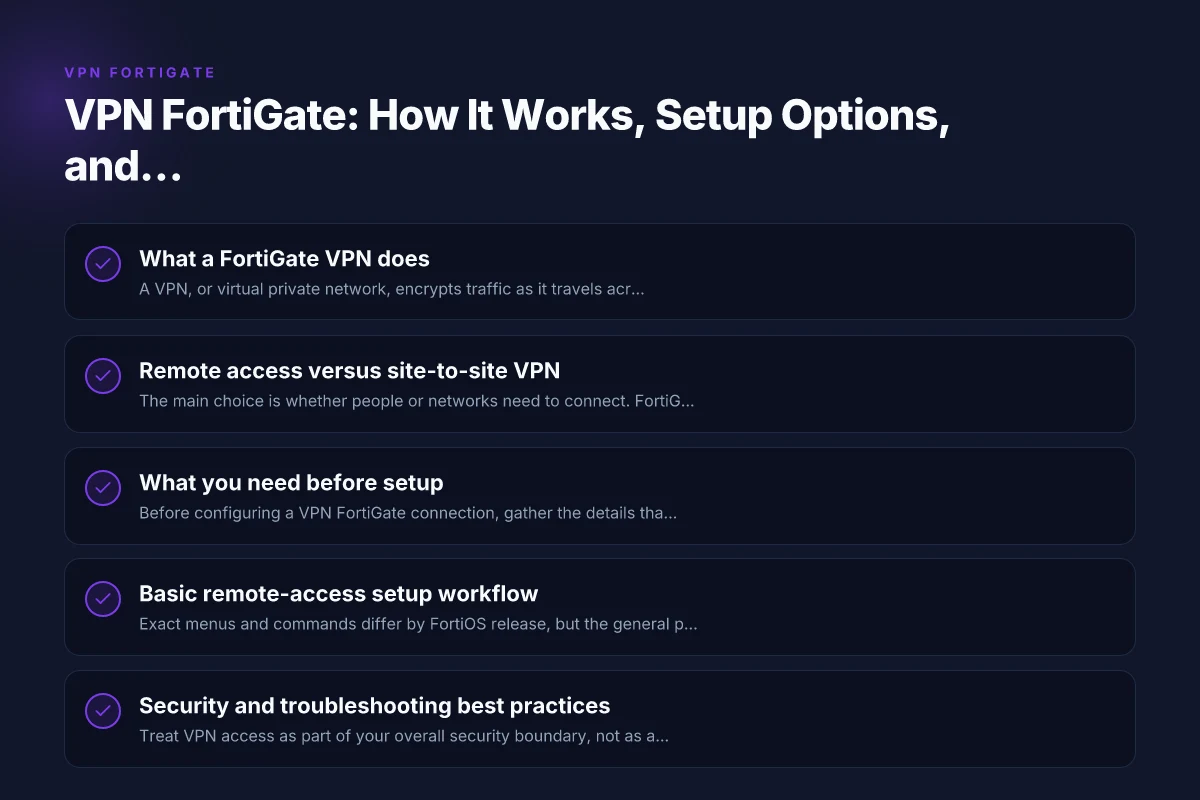
Remote access versus site-to-site VPN
The main choice is whether people or networks need to connect. FortiGate supports both patterns, but they have different setup and support needs. Does Edge Have a VPN Built In? What Microsoft Edge Secure Network Does
| VPN type | Best for | Typical connection | Main considerations |
|---|---|---|---|
| Remote access | Employees, contractors, and administrators | A user’s device connects to a FortiGate | User authentication, client setup, access controls |
| Site-to-site IPsec | Connecting offices, data centers, or cloud networks | One FortiGate or compatible gateway connects to another | Matching tunnel settings, routing, and network policies |
| SSL VPN | Remote access where supported by the FortiOS release and configuration | A user connects through a supported Fortinet client or browser-based option | Availability, client compatibility, and current security guidance |
FortiOS capabilities change over time, and options can vary by model and software release. Check the documentation for your specific FortiGate version before choosing a protocol or following an older setup guide.
IPsec or SSL VPN?
IPsec is widely used for site-to-site tunnels and can also provide remote access. It relies on coordinated settings at both ends, including authentication, encryption, routing, and network definitions.
SSL VPN has traditionally been used for remote access, with FortiClient commonly used for a full-tunnel or split-tunnel connection. However, support and recommended deployment options vary by FortiOS release. Confirm the current Fortinet guidance for your version rather than assuming a feature is available or recommended.
What you need before setup
Before configuring a VPN FortiGate connection, gather the details that affect authentication, routing, and access: What Is com.NordVPN.Android? A Guide to NordVPN for Android
- FortiGate model and FortiOS version
- Public IP address or DNS name users will connect to
- Internal network ranges users need to reach
- User accounts, directory integration, or another approved identity provider
- VPN client requirements and supported operating systems
- Firewall policies and routes for the intended traffic
- Any upstream firewall, router, or internet service restrictions
For a site-to-site VPN, you also need corresponding network ranges, gateway details, and compatible security settings for the other endpoint. Overlapping internal IP ranges can prevent correct routing, so identify them before creating the tunnel.
Check what you need before setup
| Requirement | Remote access | Site-to-site | Why it matters | Check before starting |
|---|---|---|---|---|
| FortiGate access | Yes | Yes | Needed to configure the VPN | Confirm administrator access |
| VPN type selected | Yes | Yes | Determines settings and compatible peers | Choose IPsec or supported SSL VPN |
| User accounts or peer details | User accounts | Peer gateway details | Defines who or what can connect | Gather account or gateway information |
| Authentication plan | User authentication | Peer authentication | Helps restrict access | Decide on credentials and any supported MFA |
| Addressing plan | Client address range | Network ranges at both sites | Prevents routing conflicts | Check for overlapping networks |
| Firewall policies | Allow intended user traffic | Allow intended inter-site traffic | VPN connectivity alone may not grant access | Identify required destinations and services |
| Client or peer compatibility | User device and client | VPN gateway at each site | Settings and features must be supported | Check software and device compatibility |
| Secure administration | Yes | Yes | Reduces configuration and access risk | Use trusted access and protect credentials |
Compiled November 2026; check the provider's site for current details.
Basic remote-access setup workflow
Exact menus and commands differ by FortiOS release, but the general process is similar. Use Fortinet documentation for your version and follow your organization’s change-control procedures. Cost of NordVPN: Plans, Pricing, and What You Get
- Confirm the VPN method. Select a supported remote-access option based on your FortiGate release, client devices, and security requirements.
- Configure authentication. Create or connect user accounts and groups. Use multifactor authentication where available and appropriate.
- Define the address pool. Choose a range for VPN clients that does not conflict with internal networks or other routed ranges.
- Set access scope. Decide whether users need access to all network traffic or only specified internal services.
- Create firewall policies. Permit only the required traffic from the VPN interface or user group to approved destinations.
- Configure routes and DNS. Ensure client traffic can reach the right networks and resolve internal hostnames when needed.
- Configure the client. Provide the correct server address, sign-in method, and client settings through an approved channel.
- Test and document. Verify login, access to approved services, blocked access to unrelated resources, and behavior after reconnecting.
For site-to-site VPNs, both gateways need compatible tunnel settings. After establishing the tunnel, configure routes and policies at each end, then test traffic in both directions. A tunnel that shows as connected may still fail to pass traffic if routing or firewall policies are incomplete.
Security and troubleshooting best practices
Treat VPN access as part of your overall security boundary, not as a substitute for it. Give each user only the access their role requires, and remove access promptly when it is no longer needed.
Recommended practices include:
- Use multifactor authentication for remote access wherever supported.
- Keep FortiGate firmware and client software current, following tested upgrade procedures.
- Avoid shared accounts. Use individual identities and appropriate group membership.
- Restrict administrative access and separate it from ordinary employee VPN access.
- Review VPN logs, failed logins, active sessions, and policy changes.
- Limit access by destination and service instead of granting broad network access by default.
- Maintain a documented recovery and credential-revocation process.
If a VPN does not connect, check the client’s server address and credentials first. Then review authentication logs, certificate validity if applicable, firewall and NAT rules, and whether the required service is reachable from the internet. If it connects but internal resources are unavailable, inspect routes, address overlaps, DNS settings, and firewall policies. For a site-to-site tunnel, compare settings on both endpoints and confirm that traffic is permitted in both directions. China NordVPN Guide: How Well It Works and What to Know
Choose best practices for a secure, reliable VPN
| Practice | Remote-access use | Site-to-site use | Benefit | Troubleshooting clue |
|---|---|---|---|---|
| Use strong authentication | Protect user accounts | Protect peer credentials | Reduces unauthorized access | Check credentials and authentication settings |
| Apply least-privilege policies | Limit user destinations | Limit inter-site traffic | Restricts unnecessary access | Review firewall policy matches |
| Verify routing and address ranges | Check client routes and networks | Check routes at both sites | Ensures traffic reaches its destination | Look for overlapping or missing routes |
| Confirm matching VPN settings | Match client and FortiGate settings | Match both peer configurations | Avoids negotiation failures | Compare encryption and authentication settings |
| Keep software supported and current | Update FortiGate and client | Update both gateways | Helps maintain compatibility and security | Check versions when connections fail |
| Review logs and connection status | Check user and tunnel events | Check tunnel negotiation events | Helps locate the failure point | Identify whether failure is authentication, negotiation, or traffic |
| Test access after changes | Test intended user resources | Test intended remote networks | Confirms policies and routing work | Verify both tunnel status and permitted traffic |
Compiled November 2026; check the provider's site for current details.
Recommendation
For a VPN FortiGate deployment, start by defining whether you need remote-user access or a network-to-network tunnel. Choose a method supported by your FortiOS release, apply strong authentication and least-privilege policies, and test access before rollout. When the configuration affects business-critical systems, use Fortinet’s version-specific documentation or a qualified network administrator.