UniFi VPN Client Windows: How to Connect and Troubleshoot
Learn how to set up a UniFi VPN client on Windows, choose a protocol, and fix common connection problems.
If you’re looking for a UniFi VPN client for Windows, the right setup depends on the VPN server enabled on your UniFi gateway. Windows can connect using its built-in VPN settings for supported protocols, or with a dedicated app such as the WireGuard client when your UniFi configuration uses WireGuard. First enable and configure the VPN server in UniFi Network, then import or enter its connection details on the Windows PC.

Editor's pick: NordVPN — fast, secure VPN — Strong encryption, a no-logs policy and apps for every device. 30-day money-back guarantee. Get NordVPN →
Compare VPN protocol options for a UniFi remote-access connection
| Protocol | Windows setup | UniFi configuration | Credentials or files | Best fit |
|---|---|---|---|---|
| WireGuard | Use a compatible Windows client | Create a WireGuard server and peer | Peer configuration | Modern, efficient connections |
| OpenVPN | Use an OpenVPN-compatible client | Configure an OpenVPN server | Client profile and credentials | Broad client compatibility |
| L2TP/IPsec | Use Windows’ built-in VPN settings | Configure L2TP/IPsec remote access | Username, password, and IPsec key | Native Windows setup |
| IKEv2/IPsec | Use a compatible Windows VPN client | Enable a compatible IKEv2 server | Account details and IPsec settings | Supported clients and networks |
| UniFi Teleport | Use the supported Teleport app or workflow | Enable Teleport on a compatible UniFi gateway | UniFi account or invite | Simple app-based access |
Compiled November 2026; check the provider's site for current details.
| VPN | Obfuscation | From / month | Plan | Free plan | Refund | Alipay | UnionPay | Crypto | Website opens in China | Trustpilot | |
|---|---|---|---|---|---|---|---|---|---|---|---|
 ZoogVPN | Turn on manually Shadow | $2.49/mo | 27 months: $59.99 | Yes | 7 days | ✓ | ✓ | ✓ | ✓ | Official site blocked; our special link opens (4.4 s) | 4.2/5 (195 reviews) |
 NordVPN | Turn on manually Obfuscated Servers / NordWhisper | $3.49/mo | 27 months: $94.23 | No | 30 days | ? | ✗ | ✓ | ✓ | ✗ Blocked | 4.2/5 (51,628 reviews) |
 ExpressVPN | ✓ On by default all servers | $3.00/mo | 28 months: $84 | No | 30 days | ✗ | ✗ | ✓ | ✗ | ✗ Blocked | 4.4/5 (29,706 reviews) |
 Surfshark | ✓ On by default Camouflage, with OpenVPN | See site | See site | No | 30 days | ✗ | ✗ | ✗ | ✓ | ✗ Blocked | 4.3/5 (31,823 reviews) |
 Proton VPN | Turn on manually Stealth, free plan too | $2.99/mo | 12 months: $35.88 | Yes | 30 days | ✗ | ✗ | ✗ | ✓ | ✗ Blocked | 2.1/5 (1,040 reviews) |
 Astrill VPN | Turn on manually StealthVPN / OpenWeb | $12.50/mo | 24 months: $300 | No | See site | ✗ | ✗ | ✗ | ✓ | ✗ Blocked | 1.3/5 (110 reviews) |
 Private Internet Access | Turn on manually Shadowsocks, OpenVPN only | $2.03/mo | 40 months: $81.2 | No | 30 days | ✗ | ✗ | ✗ | ✗ | ✗ Blocked | 4.2/5 (11,033 reviews) |
 CyberGhost | Turn on manually selected servers | $2.19/mo | 28 months: $61.32 | No | 45 days | ✗ | ✗ | ✗ | ✓ | ✗ Blocked | 4.0/5 (24,178 reviews) |
 PureVPN | Turn on manually switch to OpenVPN | $1.69/mo | 60 months: $101.55 | No | 31 days | ? | ? | ✗ | ✓ | ✗ Blocked | 4.4/5 (17,994 reviews) |
 AdGuard VPN | ✓ On by default TrustTunnel | $2.99/mo | 24 months: $71.76 | Yes | 30 days | ✓ | ✗ | ✓ | ✓ | Official site blocked; our special link opens (3.7 s) | 4.3/5 (290 reviews) |
 Mullvad | Turn on manually QUIC / Shadowsocks / LWO | $5.61/mo | €5/mo | No | 14 days | ✗ | ✗ | ✗ | ✓ | ✗ Blocked | 3.2/5 (192 reviews) |
 Windscribe | Turn on manually Stealth / WStunnel | $5.75/mo | 12 months: $69 | Yes | See site | ✗ | ✗ | ✗ | ✓ | ✗ Blocked | 4.7/5 (13,355 reviews) |
 StrongVPN | Turn on manually Scramble, OpenVPN TCP | See site | See site | No | 30 days | ✓ | ✗ | ✗ | ✗ | ✗ Blocked | 4.4/5 (2,695 reviews) |
 LightXtreme 闪连 | Not listed | $7.08/mo | 12 months: $84.99 | Yes | 30 days | ✓ | ✓ | ✓ | ✓ | ✓ Yes (3.5 s) | No page |
Prices checked 2026-11-10 on each vendor's pricing page (cheapest long plan, USD). Check the vendor's checkout for the final price.
Obfuscation checked 2026-11-14 on each vendor's site and help center: "on by default" = nothing to set; "turn on manually" = switch protocol or mode in settings; "not listed" = the vendor describes no obfuscation.
Payment methods checked 2026-11-10 on each vendor's payment pages: all 14 take cards and PayPal; ✗ = not listed, ? = the vendor's own pages disagree.
China access: whether the official website opens from mainland China networks (tests the website only, not the VPN connection). Last checked 2026-11-18 01:02 Beijing time.
Trustpilot score and review count checked 2026-11-10.
What a UniFi VPN client does
A VPN client creates an encrypted connection from your Windows computer to a VPN server. In this case, the server is typically a UniFi gateway at home or at work. Once connected, your PC may be able to access internal resources such as file shares, printers, cameras, or management interfaces.
A remote-access VPN is different from a UniFi VPN Client configuration used to route traffic from one network to another. The latter is generally for site-to-site or outbound connections, not for connecting an individual Windows laptop to your own network. For a Windows computer that needs remote access, look for the remote-access VPN settings in UniFi Network.
Available protocols and menu names can vary by gateway model and UniFi Network version. Check your gateway’s documentation and current interface rather than assuming every UniFi device offers the same options.
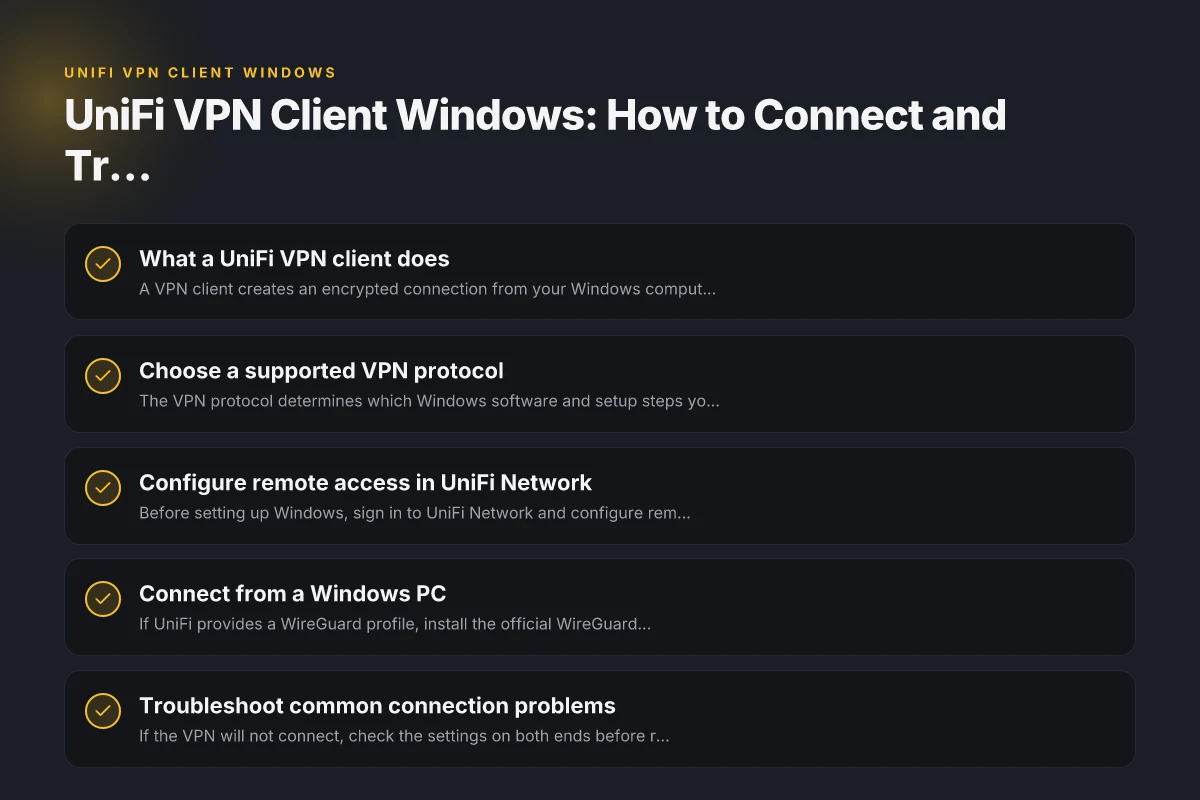
Choose a supported VPN protocol
The VPN protocol determines which Windows software and setup steps you need. Use the protocol configured on the UniFi gateway. A Windows client cannot connect if its protocol does not match the server. Microsoft Edge VPN Extension: How It Works and Which One to Choose
| Protocol or setup | Windows connection method | Best suited for |
|---|---|---|
| WireGuard | WireGuard app with an exported or generated profile | A straightforward setup when supported by the gateway |
| L2TP/IPsec | Windows built-in VPN settings | Systems configured to provide L2TP/IPsec details |
| OpenVPN | OpenVPN-compatible client with a profile | Networks that provide OpenVPN configuration files |
| IKEv2 or another option | Windows built-in settings or a compatible client | Setups where the gateway and Windows configuration support it |
Do not select a protocol based only on its name in a guide. Confirm that your specific gateway supports it and that it is enabled. If the UniFi interface provides a downloadable profile or QR code, use the instructions shown there.
Compare connection methods for a Windows PC
| Method | Windows client | Setup on the PC | Setup in UniFi Network | Consider when |
|---|---|---|---|---|
| WireGuard | WireGuard client | Import peer configuration | Create server and peer | You want a lightweight client |
| OpenVPN | OpenVPN client | Import client profile | Configure OpenVPN remote access | You need profile-based setup |
| L2TP/IPsec | Windows built-in VPN | Enter server and account details | Configure L2TP/IPsec | You prefer Windows settings |
| IKEv2/IPsec | Compatible VPN client | Add server and account details | Configure compatible IKEv2 access | Your client supports IKEv2 |
| Teleport | Supported Teleport app or workflow | Follow the app’s connection steps | Enable and invite the user | You want guided access |
Compiled November 2026; check the provider's site for current details.
Configure remote access in UniFi Network
Before setting up Windows, sign in to UniFi Network and configure remote access on the gateway. NordVPN PC: How to Install, Set Up, and Use It
- Open the VPN or remote-access settings for your gateway. The exact location and label depend on your UniFi Network version.
- Select a remote-access VPN option supported by your gateway.
- Create a VPN user or authorize the account that will connect.
- Set the network or resources the remote user is allowed to reach.
- Save the configuration and generate the client profile or connection details.
- Make sure the gateway can be reached from outside the local network.
You may need a public IP address or a hostname that points to your network. If the gateway is behind another router, that router may need appropriate port forwarding. Avoid forwarding ports unnecessarily, and follow the security guidance for the selected protocol.
Use strong, unique credentials. Treat exported VPN profiles, private keys, and configuration QR codes as secrets: anyone who obtains them may be able to connect as that user. If a profile is exposed, revoke it and generate a new one.
Connect from a Windows PC
Using WireGuard
If UniFi provides a WireGuard profile, install the official WireGuard client for Windows from a trusted source. Then:
- Open WireGuard and choose the option to import a tunnel from a file.
- Select the profile downloaded from UniFi.
- Review the tunnel name and settings, then activate it.
- Test access to a resource on your home or office network.
Some setups provide profile details in another format. Use the import method supported by the current WireGuard app and UniFi instructions. Do not edit cryptographic keys or network addresses unless you understand the configuration. Nord VPN China 2026: Does It Work, and Is It Worth Trying?
Using Windows built-in VPN settings
For a protocol supported by Windows, open Settings > Network & internet > VPN, then select Add VPN. Choose Windows as the VPN provider and enter the server address, VPN type, and sign-in details supplied by UniFi or your administrator.
Save the connection and select Connect. The available fields and authentication options depend on the protocol. If Windows asks for a pre-shared key, certificate, or other security information, obtain it from the UniFi configuration or administrator rather than guessing.
Once connected, check that Windows shows an active VPN connection and try a known internal address. A successful connection does not automatically mean all internet traffic is routed through the VPN. That depends on the profile and routing settings.
Troubleshoot common connection problems
If the VPN will not connect, check the settings on both ends before reinstalling software. Urban VPN Extension for Chrome: Features, Safety, and Setup
- Confirm the protocol: The Windows client and UniFi server must use the same protocol and compatible settings.
- Recheck the server address: Use the correct public IP or hostname, and verify that it resolves to the network.
- Check the profile and credentials: A revoked, outdated, or incorrectly imported profile can prevent authentication.
- Review gateway reachability: Confirm that the gateway is online and that any required upstream firewall or router rules are in place.
- Check the local network: Some hotel, office, or public Wi-Fi networks block VPN traffic. Try another connection to narrow down the cause.
- Inspect routing and DNS: The VPN may connect while internal names or addresses remain inaccessible because routes or DNS settings are missing.
- Update software: Install current UniFi gateway firmware, UniFi Network updates, and Windows client software, following a planned maintenance process.
If several devices fail in the same way, investigate the gateway, profile, or internet connection. If only one Windows PC has trouble, focus on that PC’s client configuration, firewall, and network settings. Avoid disabling security protections as a permanent fix.
Match common connection symptoms to troubleshooting steps
| Symptom | Check on Windows | Check in UniFi Network | Likely issue | Next step |
|---|---|---|---|---|
| Cannot reach VPN server | Confirm internet access | Check server status and address | Server or network reachability | Verify gateway and public address |
| Authentication fails | Re-enter username and password | Check user and VPN credentials | Incorrect or outdated credentials | Confirm account details |
| VPN connects, but no internet | Review VPN adapter and routes | Check routing and DNS settings | Routing or DNS configuration | Verify assigned routes and DNS |
| VPN connects, but LAN is unreachable | Check the destination and firewall | Check remote-access network rules | Missing route or blocked traffic | Review allowed networks and rules |
| Connection times out | Check local firewall and network | Check VPN protocol and port settings | Protocol or port blocked | Confirm protocol settings and access |
| Client profile fails | Re-import the correct profile | Check peer or client configuration | Mismatched or stale profile | Generate and import an updated profile |
Compiled November 2026; check the provider's site for current details.
Recommendation
For most Windows users, start with the remote-access protocol your UniFi gateway supports and follow its generated profile instructions. WireGuard is a convenient choice when available. Otherwise, use Windows’ built-in VPN settings or a compatible client for the configured protocol. Test access to the specific internal resources you need, and keep VPN profiles private and up to date. Best Android VPN Reddit Users Recommend: A Practical 2026 Guide