F5_vpn_edge client.exe: What It Is and How to Check It Safely
Learn what f5_vpn_edge client.exe does, how to verify it, and what to do if it causes problems.
f5_vpn_edge client.exe is typically a Windows component associated with F5 BIG-IP Edge Client, software organizations use to provide secure remote access to internal networks and applications. If you see it running, it may be part of a VPN session or a configured remote-access service. The filename alone cannot confirm that a particular file is legitimate, so check its location and digital signature before taking action.

Editor's pick: NordVPN — fast, secure VPN — Strong encryption, a no-logs policy and apps for every device. 30-day money-back guarantee. Get NordVPN →
Quick checks for whether f5_vpn_edge client.exe is legitimate
| Check | More reassuring | Needs investigation | What to do |
|---|---|---|---|
| File location | In an F5 VPN installation folder | In a temporary or unfamiliar folder | Check the path in Task Manager |
| Digital signature | Valid signature identifying F5 | Missing, invalid, or unexpected signer | Open file properties and check the signature |
| Installation source | Installed with your organization’s F5 VPN client | Appeared without a known VPN installation | Ask your IT team |
| VPN use | Running during an expected VPN session | Running when no VPN use is expected | Check the VPN client and connection status |
| File name | Matches the expected client file | Similar name with unusual spelling | Verify the exact filename and path |
| Security scan | No detection from a reputable security tool | Detection or suspicious behavior | Scan the file and follow security guidance |
Compiled November 2026; check the provider's site for current details.
| VPN | Obfuscation | From / month | Plan | Free plan | Refund | Alipay | UnionPay | Crypto | Website opens in China | Trustpilot | |
|---|---|---|---|---|---|---|---|---|---|---|---|
 ZoogVPN | Turn on manually Shadow | $2.49/mo | 27 months: $59.99 | Yes | 7 days | ✓ | ✓ | ✓ | ✓ | Official site blocked; our special link opens (4.4 s) | 4.2/5 (195 reviews) |
 NordVPN | Turn on manually Obfuscated Servers / NordWhisper | $3.49/mo | 27 months: $94.23 | No | 30 days | ? | ✗ | ✓ | ✓ | ✗ Blocked | 4.2/5 (51,628 reviews) |
 ExpressVPN | ✓ On by default all servers | $3.00/mo | 28 months: $84 | No | 30 days | ✗ | ✗ | ✓ | ✗ | ✗ Blocked | 4.4/5 (29,706 reviews) |
 Surfshark | ✓ On by default Camouflage, with OpenVPN | See site | See site | No | 30 days | ✗ | ✗ | ✗ | ✓ | ✗ Blocked | 4.3/5 (31,823 reviews) |
 Proton VPN | Turn on manually Stealth, free plan too | $2.99/mo | 12 months: $35.88 | Yes | 30 days | ✗ | ✗ | ✗ | ✓ | ✗ Blocked | 2.1/5 (1,040 reviews) |
 Astrill VPN | Turn on manually StealthVPN / OpenWeb | $12.50/mo | 24 months: $300 | No | See site | ✗ | ✗ | ✗ | ✓ | ✗ Blocked | 1.3/5 (110 reviews) |
 Private Internet Access | Turn on manually Shadowsocks, OpenVPN only | $2.03/mo | 40 months: $81.2 | No | 30 days | ✗ | ✗ | ✗ | ✗ | ✗ Blocked | 4.2/5 (11,033 reviews) |
 CyberGhost | Turn on manually selected servers | $2.19/mo | 28 months: $61.32 | No | 45 days | ✗ | ✗ | ✗ | ✓ | ✗ Blocked | 4.0/5 (24,178 reviews) |
 PureVPN | Turn on manually switch to OpenVPN | $1.69/mo | 60 months: $101.55 | No | 31 days | ? | ? | ✗ | ✓ | ✗ Blocked | 4.4/5 (17,994 reviews) |
 AdGuard VPN | ✓ On by default TrustTunnel | $2.99/mo | 24 months: $71.76 | Yes | 30 days | ✓ | ✗ | ✓ | ✓ | Official site blocked; our special link opens (3.7 s) | 4.3/5 (290 reviews) |
 Mullvad | Turn on manually QUIC / Shadowsocks / LWO | $5.61/mo | €5/mo | No | 14 days | ✗ | ✗ | ✗ | ✓ | ✗ Blocked | 3.2/5 (192 reviews) |
 Windscribe | Turn on manually Stealth / WStunnel | $5.75/mo | 12 months: $69 | Yes | See site | ✗ | ✗ | ✗ | ✓ | ✗ Blocked | 4.7/5 (13,355 reviews) |
 StrongVPN | Turn on manually Scramble, OpenVPN TCP | See site | See site | No | 30 days | ✓ | ✗ | ✗ | ✗ | ✗ Blocked | 4.4/5 (2,695 reviews) |
 LightXtreme 闪连 | Not listed | $7.08/mo | 12 months: $84.99 | Yes | 30 days | ✓ | ✓ | ✓ | ✓ | ✓ Yes (3.5 s) | No page |
Prices checked 2026-11-10 on each vendor's pricing page (cheapest long plan, USD). Check the vendor's checkout for the final price.
Obfuscation checked 2026-11-14 on each vendor's site and help center: "on by default" = nothing to set; "turn on manually" = switch protocol or mode in settings; "not listed" = the vendor describes no obfuscation.
Payment methods checked 2026-11-10 on each vendor's payment pages: all 14 take cards and PayPal; ✗ = not listed, ? = the vendor's own pages disagree.
China access: whether the official website opens from mainland China networks (tests the website only, not the VPN connection). Last checked 2026-11-18 01:02 Beijing time.
Trustpilot score and review count checked 2026-11-10.
What does f5_vpn_edge client.exe do?
F5 BIG-IP Edge Client is a remote-access application deployed by some employers, schools, and other organizations. Depending on how the organization has configured it, the client may establish a VPN connection, enforce access policies, or help a device reach protected resources.
The process name may appear in Task Manager while the client is installed or in use. Its exact behavior can vary by software version and organizational setup. A legitimate client may start automatically, run in the background, or launch when you connect to a work or school network.
If you have never installed F5 software, that does not automatically mean the file is malicious. An organization’s IT team may have installed it as part of device management. However, an unfamiliar executable deserves verification.
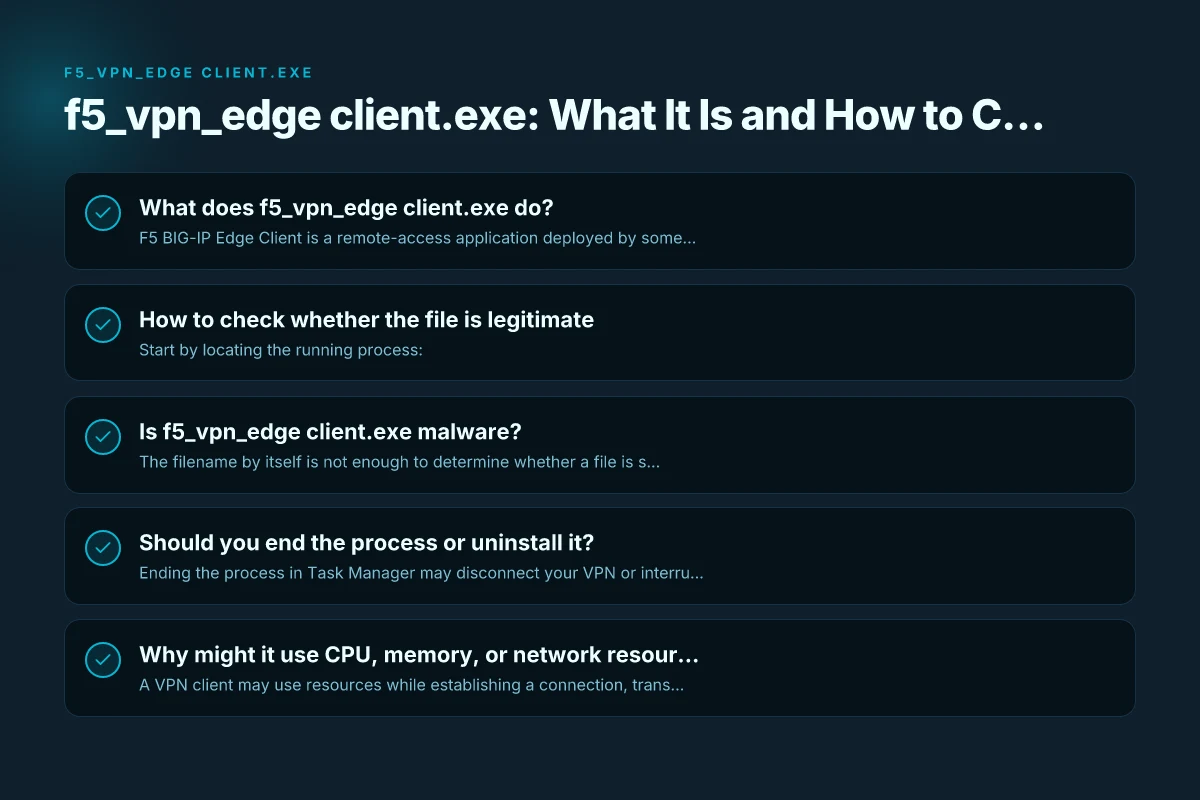
How to check whether the file is legitimate
Start by locating the running process: Big IP f5 VPN download Windows: Safe Download and Setup Guide
- Press Ctrl+Shift+Esc to open Task Manager.
- Find the process, right-click it, and choose “Open file location,” if that option is available.
- In File Explorer, right-click the executable and select “Properties.”
- Check the Details and Digital Signatures tabs for the product name and publisher.
A genuine installation is usually located in a folder associated with F5 or BIG-IP Edge Client under Program Files or another standard software-installation directory. The exact path can vary by release and deployment, so do not treat one location as a universal rule.
Pay attention to the signature’s status and publisher. A valid signature from the expected software publisher is a useful indicator, but it is not an absolute guarantee. If the file is unsigned, stored in an unusual location such as a temporary folder, or named similarly to, but not exactly like, a known process, investigate further.
| Check | More reassuring sign | Reason to investigate |
|---|---|---|
| File location | Installed under a recognizable F5 or application directory | Found in a temporary, Downloads, or unrelated system folder |
| Digital signature | Valid signature from the expected publisher | Missing, invalid, or unexpected publisher |
| Installation history | Installed by your employer, school, or IT team | No known reason for the software to be on the device |
| Security scan | No detection from trusted security software | Repeated alerts or suspicious activity |
For additional confidence, scan the file with your installed antivirus or Microsoft Defender. You can also ask your organization’s IT support team to confirm the approved client version and installation path.
What to do when f5_vpn_edge client.exe is running F5 BIG-IP Edge VPN Client Download: Safe, Official Options
| Situation | First step | End the process? | Uninstall? |
|---|---|---|---|
| Connected to a work VPN | Leave it running | Usually no | No |
| VPN is disconnected, but the client is installed | Check the client’s status | Not without a reason | No |
| Resource use seems unusually high | Check for updates or a stuck connection | Only if it is unresponsive | Usually no |
| File location or signature looks suspicious | Verify with IT or security support | Avoid acting before verification | Do not uninstall as a substitute for a scan |
| VPN is no longer needed | Confirm with the device owner or IT | Close the client first | Use the approved uninstall method |
| Security software flags the file | Follow the security team’s instructions | Isolate or end only as directed | Follow incident-response guidance |
Compiled November 2026; check the provider's site for current details.
Is f5_vpn_edge client.exe malware?
The filename by itself is not enough to determine whether a file is safe. Malware can use names that resemble legitimate programs, while real enterprise software may be unfamiliar to a personal computer user.
Treat the process as suspicious if several warning signs appear together, such as:
- The executable is in a random or user-writable folder.
- Its digital signature is missing, invalid, or unrelated to F5.
- Your security software identifies it as a threat.
- It appeared after downloading an unofficial installer or opening an unexpected attachment.
- It runs alongside other unexplained processes or causes unusual network activity.
Do not upload confidential work software to public scanning services without checking your organization’s security policy. If this is a managed work or school device, report the concern to IT rather than trying to investigate by disabling corporate security tools. VPN for PC: How to Choose and Set Up the Right One
Should you end the process or uninstall it?
Ending the process in Task Manager may disconnect your VPN or interrupt access to internal systems. It usually does not uninstall the application, and the client or a management service may start it again.
If you no longer need the software, first confirm that it is not required by your employer, school, or network administrator. On a personal device, use Windows Settings to review installed applications and uninstall the client through the normal Windows process. Avoid deleting the executable or its folders manually: doing so can leave behind services, drivers, or other components and may make the software difficult to remove cleanly.
If you suspect the file is malicious:
- Disconnect from networks if your security software or IT team recommends doing so.
- Run a full scan with a trusted, up-to-date security product.
- Follow the security product’s quarantine or removal guidance.
- Contact your organization’s IT or security team if the device is managed or the file is work-related.
Do not disable antivirus protection just to see whether the process behaves differently. OpenVPN Connect Windows: Install, Import a Profile, and Connect
Possible causes of f5_vpn_edge client.exe resource use
| Possible cause | CPU or memory impact | Network impact | Suggested check |
|---|---|---|---|
| Active VPN connection | Client remains active | VPN traffic is expected | Check VPN connection status |
| Connection setup or reconnection | Activity may increase temporarily | Connection attempts may occur | Check whether the VPN is reconnecting |
| Large transfers over VPN | Usually depends on client activity | More traffic may be expected | Check for downloads or work transfers |
| Client update or maintenance | Activity may be temporary | May contact update services | Check the client’s update status |
| Unresponsive or stuck client | Use may remain elevated | Traffic may continue unexpectedly | Restart through the approved client controls |
| Unknown file or behavior | Cannot be judged from use alone | Cannot be judged from use alone | Verify path, signature, and security scan |
Compiled November 2026; check the provider's site for current details.
Why might it use CPU, memory, or network resources?
A VPN client may use resources while establishing a connection, transferring data, checking policies, or maintaining a secure session. Temporary activity during connection or file transfers is not necessarily a problem.
If resource use stays unusually high, check whether the VPN is connected and whether the client is updating or reconnecting repeatedly. Restarting the computer may resolve a temporary issue. If the problem returns, note when it happens and contact IT support. Organizational settings or a client update may be involved. Avoid changing VPN configuration files or firewall rules unless instructed by an administrator. Proton VPN Free: What You Get and Whether It’s Worth Using
Recommendation
If f5_vpn_edge client.exe has a valid signature, is installed in a plausible F5 client folder, and your organization uses BIG-IP Edge Client, it is likely a normal VPN component. Keep it installed if you need that access. If the file’s location or publisher looks wrong, or security software raises an alert, scan it and ask your IT team or a trusted security professional to review it before deleting or disabling anything.