How to Change Proxy Settings in Edge Browser

Learn how to configure, verify, and troubleshoot proxy settings in Microsoft Edge on Windows and macOS.
To change proxy settings in Edge browser, open Microsoft Edge, select the three-dot menu, and go to Settings > System and performance > Open your computer’s proxy settings. Edge will take you to your operating system’s network settings, where you can configure a proxy or automatic setup. The exact screens vary by operating system, and changes may affect other apps that use the same system connection.

Editor's pick: NordVPN — fast, secure VPN — Strong encryption, a no-logs policy and apps for every device. 30-day money-back guarantee. Get NordVPN →
Compare how proxy settings are configured on Windows and macOS
| Option | Windows | macOS | Where Edge sends you | Best for |
|---|---|---|---|---|
| Open settings | Edge Settings > System and performance | Edge Settings > System and performance | Operating-system network settings | Finding the system proxy controls |
| Configure automatically | Use a setup script or automatic detection | Use automatic proxy discovery or a proxy configuration URL | Windows proxy settings | Networks that provide automatic configuration |
| Configure manually | Enter a proxy address and port | Choose a proxy protocol and enter its server details | Windows proxy settings | A specific proxy server |
| Bypass proxy | Add exceptions in Windows proxy settings | Set proxy bypass domains in macOS network settings | Operating-system settings | Accessing selected sites directly |
| Apply changes | Save or apply in Windows settings | Apply changes in network settings | Operating-system settings | Making the configuration take effect |
| Browser scope | Uses the system proxy configuration | Uses the system proxy configuration | System-wide network settings | Understanding which apps may be affected |
Compiled November 2026; check the provider's site for current details.
Open the proxy settings from Edge
- Open Microsoft Edge.
- Select the Settings and more menu (the three dots in the upper-right corner).
- Select Settings.
- Open System and performance.
- Select Open your computer’s proxy settings.
The operating system’s proxy page should open. In some Edge versions, the link may appear under a slightly different System section. If you do not see it, search your computer’s Settings for “proxy.”
Edge typically relies on the operating system’s proxy configuration. That means you usually won’t find a separate proxy address and port field in Edge itself. A proxy configured for the device may also be used by other applications, depending on how each app handles network settings.
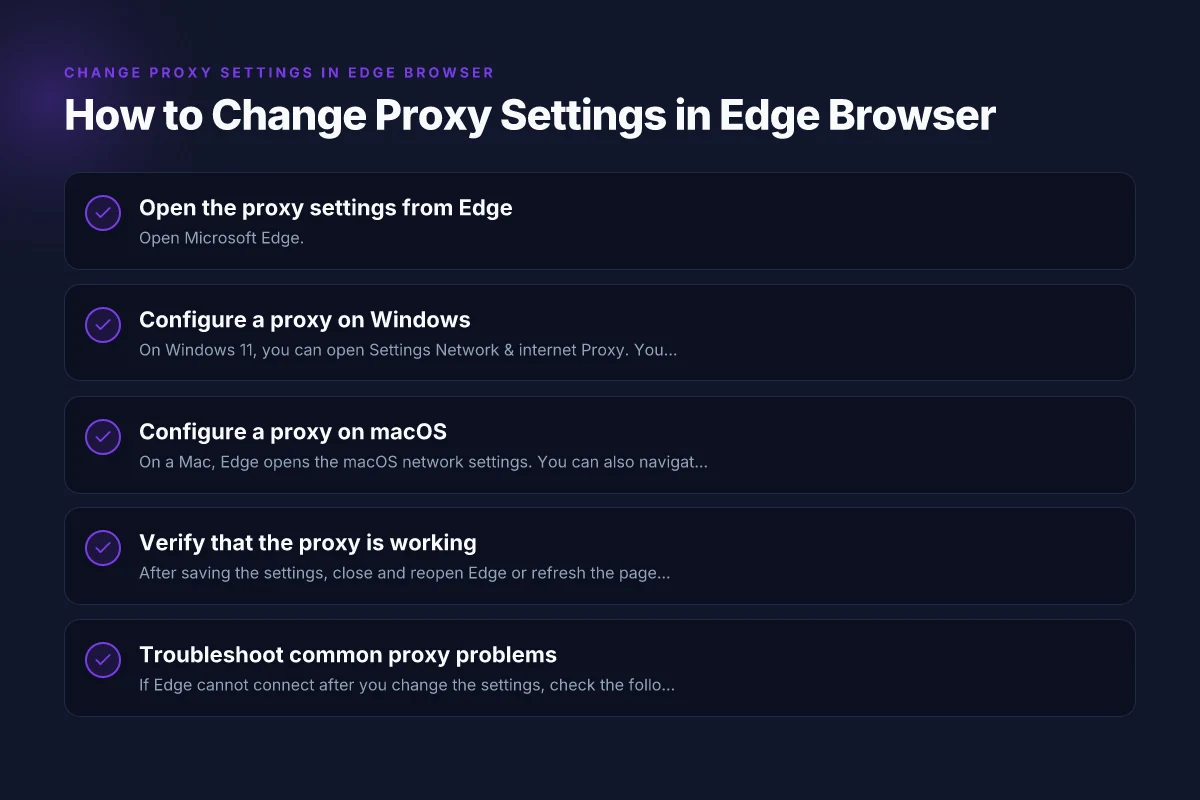
Configure a proxy on Windows
On Windows 11, you can open Settings > Network & internet > Proxy. You can also reach this page using the Edge shortcut described above. Windows offers automatic and manual proxy options.
Automatic proxy setup
Choose an automatic option if your organization or provider gave you a setup script or uses automatic detection: How to Change Proxy Settings in Edge: A Step-by-Step Guide
- Automatically detect settings: Lets Windows detect proxy settings on the network.
- Use setup script: Turn this on and enter the script address, also called a PAC URL, provided by your administrator or proxy service.
Only enter a setup script URL you trust. A proxy script can direct network traffic through specific servers.
Manual proxy setup
If you received a proxy server address and port, find Manual proxy setup and select Set up or turn on Use a proxy server, depending on your Windows version. Enter the information exactly as provided, then save the changes.
You may also see an option to bypass the proxy for local addresses. Enable it only if it matches your network requirements. If Windows provides a field for exceptions, enter only the domains or addresses your administrator has specified.
| Setting | What it does | Use it when |
|---|---|---|
| Automatic detection | Lets Windows look for proxy settings | Your network is configured to provide them |
| Setup script (PAC URL) | Applies rules from a script | Your organization or provider supplied a script address |
| Manual proxy | Sends eligible traffic to a specified server and port | You were given a proxy address and port |
| No proxy | Connects without a configured proxy | Your network does not require one |
Proxy services can require sign-in or additional configuration. Don’t guess the server, port, or authentication details. Request the correct information from your network administrator or provider. VPN Pricing Comparison and Deals in India: Plans, Costs and Best Value
Configure a proxy on macOS
On a Mac, Edge opens the macOS network settings. You can also navigate there yourself:
- Open Apple menu > System Settings > Network.
- Select the network connection you use, such as Wi-Fi or Ethernet.
- Select Details or Advanced, then open Proxies. The labels can vary by macOS version.
- Select the proxy type your administrator or provider specified.
- Enter the required server address, port, and any other requested information.
- Select OK or Done, then apply the changes.
macOS offers several proxy types, including web proxies and automatic proxy configuration. Choose only the type and values you were instructed to use. If the setting is managed by your workplace or school, you may need an administrator to change it.
Choose a proxy configuration method
| Method | What you provide | Setup location | Best suited to | Check before choosing |
|---|---|---|---|---|
| Automatic detection | No manual server details | Windows proxy settings | Networks that advertise proxy settings | Whether the network supports discovery |
| Setup script | A script URL | Windows proxy settings | Organization-managed proxy rules | Obtain the correct URL from your administrator |
| Manual HTTP proxy | Server address and port | Windows proxy settings | HTTP proxy services | Confirm the server supports your traffic |
| Manual HTTPS proxy | Server address and port | Windows proxy settings | HTTPS proxy services | Confirm protocol and connection details |
| Manual SOCKS proxy | Server address and port | macOS network settings | SOCKS proxy services | Confirm the SOCKS version and server details |
| Proxy bypass list | Domains or addresses to exclude | Operating-system network settings | Sites that should connect directly | Use only the intended exceptions |
Compiled November 2026; check the provider's site for current details. VPN in Italy: How to Choose and Use One
Verify that the proxy is working
After saving the settings, close and reopen Edge or refresh the page you were trying to access. Check that the expected websites load and that you can sign in to any required service.
If your provider or administrator offers a specific test page, use it. Otherwise, compare the result with the instructions you received. A proxy may be configured successfully but still block certain websites or require authentication.
To remove a manual proxy on Windows, return to Settings > Network & internet > Proxy and turn off the manual proxy option. To remove an automatic setup, disable automatic detection or remove the setup script URL if you no longer need it. On macOS, return to the selected network’s Proxies settings and deselect the configured proxy option. Follow your organization’s guidance before changing managed settings.
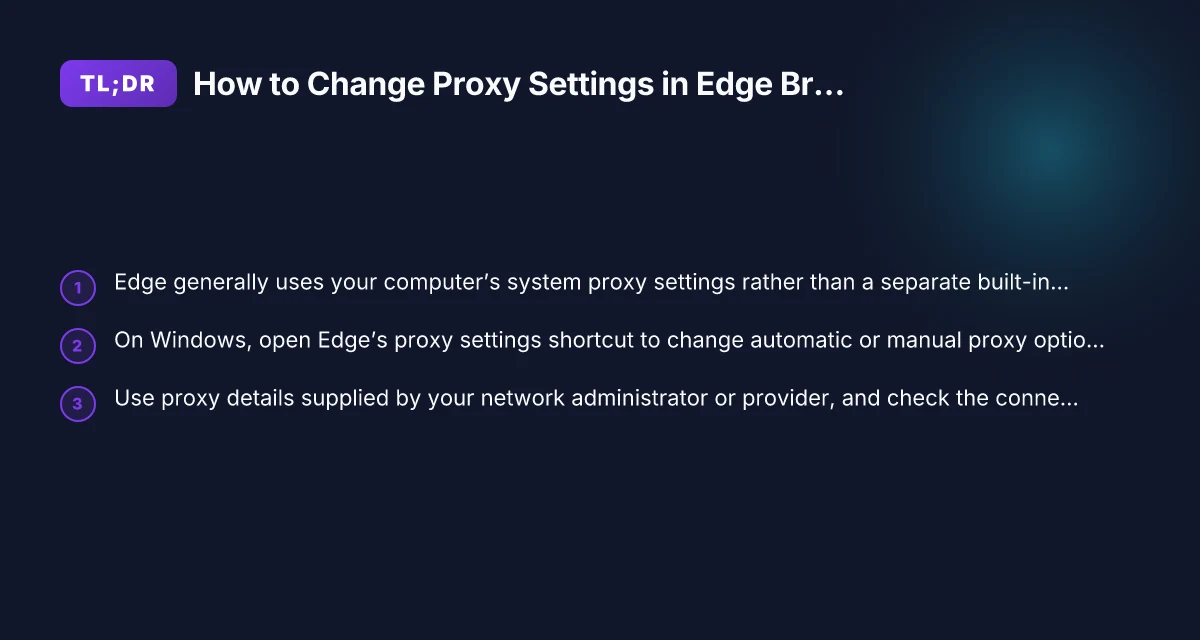
Troubleshoot common proxy problems
If Edge cannot connect after you change the settings, check the following: VPN in Germany: Privacy, Streaming, and How to Choose
- Confirm the details: Recheck the server address, port, script URL, and proxy type for typos.
- Check the network: Connect to the network the proxy is intended for, such as a company network or VPN, if required.
- Review authentication: Some proxies require a username, password, or organization sign-in. Use the approved sign-in method.
- Check for conflicting settings: A manual proxy and a setup script may not be intended to run together. Follow the configuration instructions you were given.
- Test another app or browser: This can help determine whether the issue affects the system connection or only Edge.
- Check management policies: A work or school device may enforce proxy settings. Contact its administrator rather than trying to override them.
If a setting appears to switch back after you change it, it may be controlled by your organization, device-management software, or a network configuration tool. Ask the administrator responsible for the device.
Diagnose common proxy problems
| Symptom | Likely cause | What to check | Suggested action | Verify the result |
|---|---|---|---|---|
| Edge cannot load pages | Proxy address or port is incorrect | Server details | Correct them using the provider’s information | Reload a page |
| Proxy connection is refused | Proxy server is unavailable | Server status and network access | Contact the proxy provider or administrator | Retry after service is restored |
| Some sites bypass the proxy | A bypass rule matches the site | Exception list | Review or remove the relevant exception | Recheck the site |
| No sites connect through proxy | Wrong configuration method or protocol | Proxy type and settings | Select the supported method and enter its details | Visit a test site |
| Settings appear unchanged | Changes were not applied | Operating-system proxy settings | Save or apply the configuration | Reopen settings and confirm |
| Proxy works in one app only | Apps handle proxy settings differently | Whether the app uses system settings | Check that app’s proxy configuration | Test in Edge again |
Compiled November 2026; check the provider's site for current details.
Recommendation
Use the proxy address, port, or setup script supplied by a trusted administrator or provider, and configure it through your operating system’s proxy settings opened from Edge. If you don’t need a proxy, leave the settings off rather than entering unverified details. VPN Free Trial Windows: How to Test a VPN on Your PC