Windows OVPN Profile Storage: Where OpenVPN Saves Profiles

Find out where Windows OpenVPN profiles are stored, how storage differs by client, and how to import or manage an.ovpn file.
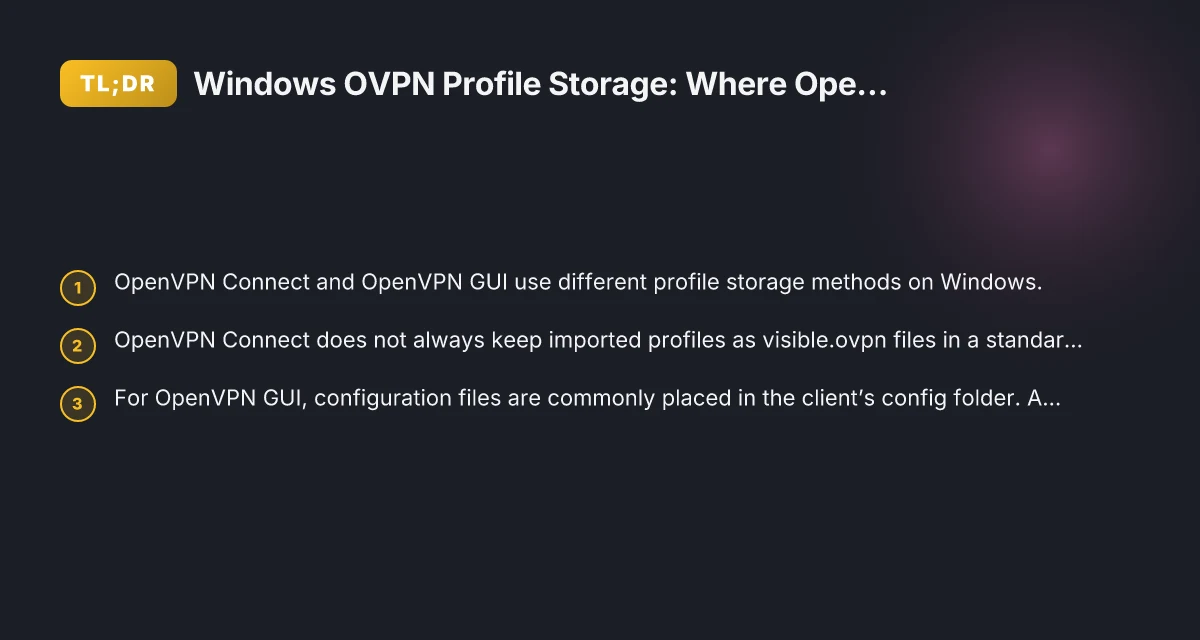
If you’re looking for Windows OVPN profile storage, the answer depends on which OpenVPN client you use. OpenVPN Connect manages imported profiles within the app, while OpenVPN GUI typically reads configuration files from a folder on the computer. So an imported profile may not be easy to find as a standalone .ovpn file afterward. The steps below help you identify the client, locate or manage its profiles, and import a configuration safely.

Editor's pick: NordVPN — fast, secure VPN — Strong encryption, a no-logs policy and apps for every device. 30-day money-back guarantee. Get NordVPN →
OpenVPN client comparison: identify the app before looking for profiles
| Client | Typical interface | Profile format | Where to look first | Storage clue |
|---|---|---|---|---|
| OpenVPN Connect | Modern app window | `.ovpn` | App’s profile list | App-managed storage |
| OpenVPN GUI | System tray icon | `.ovpn` | Configuration folder | Files are usually visible |
| Unknown client | Check app name | Varies | Start menu or installed apps | Storage depends on client |
| Connect on Windows | Windows desktop app | `.ovpn` | Connect profile list | Import through the app |
| GUI on Windows | Windows desktop app | `.ovpn` | GUI configuration folder | Folder may be user-specific |
| Multiple clients | Separate apps | `.ovpn` may be shared | Check each client | One app’s profiles may not appear in another |
Compiled November 2026; check the provider's site for current details.
| VPN | Obfuscation | From / month | Plan | Free plan | Refund | Alipay | UnionPay | Crypto | Website opens in China | Trustpilot | |
|---|---|---|---|---|---|---|---|---|---|---|---|
 ZoogVPN | Turn on manually Shadow | $2.49/mo | 27 months: $59.99 | Yes | 7 days | ✓ | ✓ | ✓ | ✓ | Official site blocked; our special link opens (4.4 s) | 4.2/5 (195 reviews) |
 NordVPN | Turn on manually Obfuscated Servers / NordWhisper | $3.49/mo | 27 months: $94.23 | No | 30 days | ? | ✗ | ✓ | ✓ | ✗ Blocked | 4.2/5 (51,628 reviews) |
 ExpressVPN | ✓ On by default all servers | $3.00/mo | 28 months: $84 | No | 30 days | ✗ | ✗ | ✓ | ✗ | ✗ Blocked | 4.4/5 (29,706 reviews) |
 Surfshark | ✓ On by default Camouflage, with OpenVPN | See site | See site | No | 30 days | ✗ | ✗ | ✗ | ✓ | ✗ Blocked | 4.3/5 (31,823 reviews) |
 Proton VPN | Turn on manually Stealth, free plan too | $2.99/mo | 12 months: $35.88 | Yes | 30 days | ✗ | ✗ | ✗ | ✓ | ✗ Blocked | 2.1/5 (1,040 reviews) |
 Astrill VPN | Turn on manually StealthVPN / OpenWeb | $12.50/mo | 24 months: $300 | No | See site | ✗ | ✗ | ✗ | ✓ | ✗ Blocked | 1.3/5 (110 reviews) |
 Private Internet Access | Turn on manually Shadowsocks, OpenVPN only | $2.03/mo | 40 months: $81.2 | No | 30 days | ✗ | ✗ | ✗ | ✗ | ✗ Blocked | 4.2/5 (11,033 reviews) |
 CyberGhost | Turn on manually selected servers | $2.19/mo | 28 months: $61.32 | No | 45 days | ✗ | ✗ | ✗ | ✓ | ✗ Blocked | 4.0/5 (24,178 reviews) |
 PureVPN | Turn on manually switch to OpenVPN | $1.69/mo | 60 months: $101.55 | No | 31 days | ? | ? | ✗ | ✓ | ✗ Blocked | 4.4/5 (17,994 reviews) |
 AdGuard VPN | ✓ On by default TrustTunnel | $2.99/mo | 24 months: $71.76 | Yes | 30 days | ✓ | ✗ | ✓ | ✓ | Official site blocked; our special link opens (3.7 s) | 4.3/5 (290 reviews) |
 Mullvad | Turn on manually QUIC / Shadowsocks / LWO | $5.61/mo | €5/mo | No | 14 days | ✗ | ✗ | ✗ | ✓ | ✗ Blocked | 3.2/5 (192 reviews) |
 Windscribe | Turn on manually Stealth / WStunnel | $5.75/mo | 12 months: $69 | Yes | See site | ✗ | ✗ | ✗ | ✓ | ✗ Blocked | 4.7/5 (13,355 reviews) |
 StrongVPN | Turn on manually Scramble, OpenVPN TCP | See site | See site | No | 30 days | ✓ | ✗ | ✗ | ✗ | ✗ Blocked | 4.4/5 (2,695 reviews) |
 LightXtreme 闪连 | Not listed | $7.08/mo | 12 months: $84.99 | Yes | 30 days | ✓ | ✓ | ✓ | ✓ | ✓ Yes (3.5 s) | No page |
Prices checked 2026-11-10 on each vendor's pricing page (cheapest long plan, USD). Check the vendor's checkout for the final price.
Obfuscation checked 2026-11-14 on each vendor's site and help center: "on by default" = nothing to set; "turn on manually" = switch protocol or mode in settings; "not listed" = the vendor describes no obfuscation.
Payment methods checked 2026-11-10 on each vendor's payment pages: all 14 take cards and PayPal; ✗ = not listed, ? = the vendor's own pages disagree.
China access: whether the official website opens from mainland China networks (tests the website only, not the VPN connection). Last checked 2026-11-18 01:02 Beijing time.
Trustpilot score and review count checked 2026-11-10.
First, identify your OpenVPN client
Windows users may have OpenVPN Connect, OpenVPN GUI, or both installed. They are separate clients, and their profile storage does not work the same way.
- OpenVPN Connect is the official app with an interface for importing and managing connection profiles.
- OpenVPN GUI uses configuration files stored in a folder that the application can access.
- A VPN provider or workplace may supply a
.ovpnfile, a bundle of configuration files, or a profile URL.
Check the app name in the Windows Start menu or in the open application before looking for a storage location. Instructions for one client may not apply to the other.
| Client | How profiles are managed | What to expect when looking for a file |
|---|---|---|
| OpenVPN Connect | Imported and managed in the app | The profile may not appear as a readily accessible .ovpn file in a standard folder |
| OpenVPN GUI | Reads configuration files from a client configuration folder | You can usually manage the original configuration file directly |
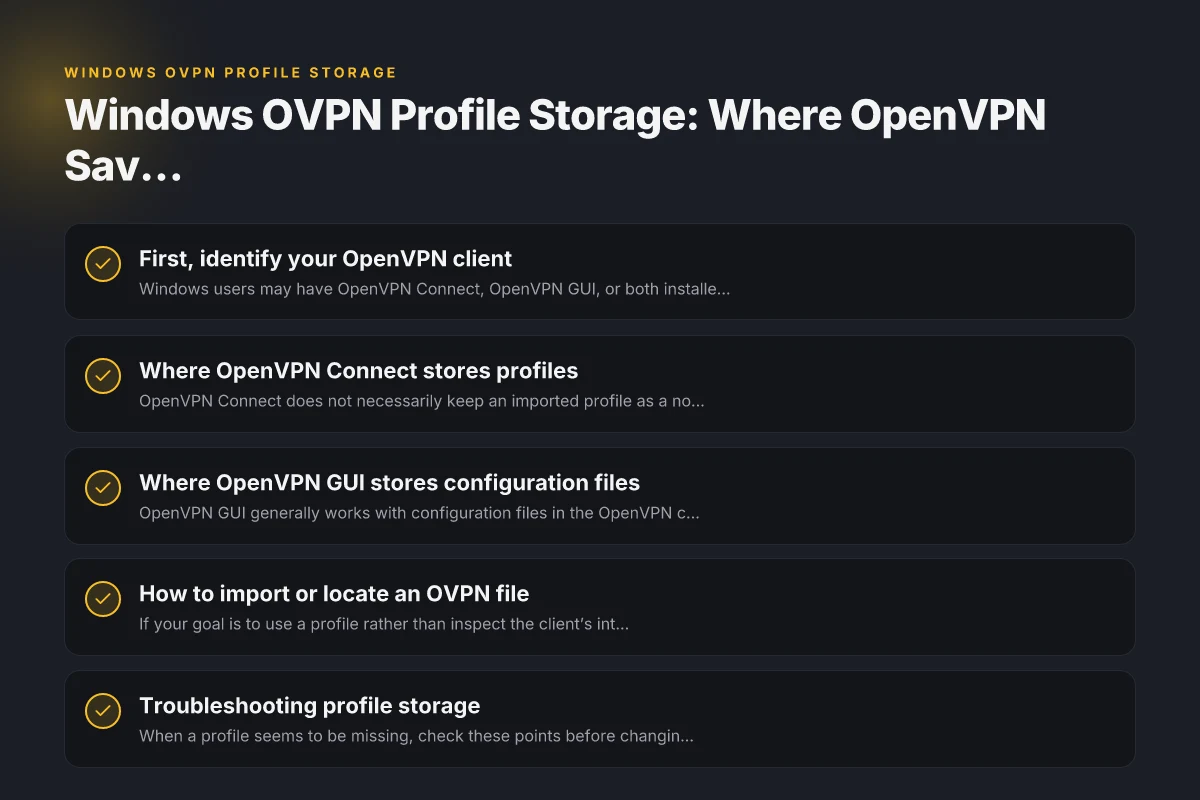
Where OpenVPN Connect stores profiles
OpenVPN Connect does not necessarily keep an imported profile as a normal .ovpn file in a folder you can browse. The app manages imported profiles internally, and the storage approach can vary between versions. That is why searching File Explorer for the profile name may not reveal the file you imported.
To check whether a profile is available, open OpenVPN Connect and look in the app’s profile list. From there, you can connect using the imported configuration or remove the profile if you no longer need it. If you need to modify or reuse the original configuration, look for the source .ovpn file instead, for example, in Downloads, an email attachment folder, or the location where your administrator saved it. How to Cancel Proton VPN Subscription: A Step-by-Step Guide
A profile shown in OpenVPN Connect is not necessarily exportable as a standalone file. If you need a fresh copy, request the configuration from the VPN provider or workplace administrator. Do not assume that copying app data or searching hidden Windows folders is the right way to obtain a reusable profile.
OpenVPN Connect and OpenVPN GUI profile storage
| Client | What it stores | Where to locate profiles | Visible as ordinary files? | Best way to manage profiles |
|---|---|---|---|---|
| OpenVPN Connect | Imported profiles | Connect app’s profile list | Not always | Use the app |
| OpenVPN GUI | Configuration files | Its configuration folder | Usually | Browse the folder |
| Connect profile | Imported `.ovpn` content | App-managed storage | May not be | Import or remove in Connect |
| GUI profile | `.ovpn` configuration | Configuration folder | Yes, if accessible | Add or remove the file |
| Connect troubleshooting | App-managed profile | Connect profile list | May be hidden from browsing | Check the app first |
| GUI troubleshooting | File-based profile | Configuration folder | Usually visible | Check the folder and filename |
Compiled November 2026; check the provider's site for current details.
Where OpenVPN GUI stores configuration files
OpenVPN GUI generally works with configuration files in the OpenVPN client’s config folder. A common location is: VPN for Microsoft Edge Free: What to Know Before Choosing One
C:\Program Files\OpenVPN\config
Depending on the installation and setup, a configuration folder may instead be under the Windows user’s profile. If you do not find a config folder in the Program Files location, check the installation directory and any instructions provided with your client.
An .ovpn file placed in the relevant configuration folder can then be made available to OpenVPN GUI. Some configurations also rely on separate certificate or key files, so keep any supplied companion files together and preserve the file references in the configuration.
You may need administrator permission to add or change files under C:\Program Files. If Windows blocks the change, use an administrator account or ask your IT administrator rather than weakening folder permissions. The Agenda Setters Won’t Play with VPN: How to Troubleshoot Streaming
How to import or locate an OVPN file
If your goal is to use a profile rather than inspect the client’s internal storage, start with the original file.
Import into OpenVPN Connect
- Obtain the
.ovpnfile or profile details from your VPN provider or administrator. - Open OpenVPN Connect.
- Choose the app’s option to import a profile, then select the file or supported import method.
- Review the imported profile in the app before connecting.
The exact labels can differ by app version. If the profile includes certificates or other supporting files, follow the provider’s instructions for importing them.
Use a file with OpenVPN GUI
- Find the OpenVPN GUI installation and its configuration folder.
- Copy the supplied
.ovpnfile and any required companion files into the appropriate folder. - Open or restart OpenVPN GUI, then check its menu for the profile.
- Connect using the profile and follow any authentication prompts.
If the profile does not appear, confirm that the file is in the folder used by that installation, that its extension is correct, and that required certificates or keys are present.
Choose an OVPN import or troubleshooting route How to Cancel Proton VPN: A Step-by-Step Guide
| Situation | OpenVPN Connect | OpenVPN GUI | First check |
|---|---|---|---|
| You have an `.ovpn` file | Import it in the app | Place it in the configuration folder | Confirm the file is accessible |
| A profile is missing | Check the profile list | Check the configuration folder | Verify the client |
| You cannot find a profile file | App storage may not be browseable | Look for the original `.ovpn` file | Check Downloads and Desktop |
| The wrong app opens the file | Import from the intended client | Open or place it for GUI | Confirm the installed client |
| A profile will not import | Check file access and format | Check folder and filename | Recheck the `.ovpn` file |
| You use more than one client | Import separately if needed | Add the file to GUI’s folder | Profiles may not sync |
| You want to remove a profile | Remove it in Connect | Remove its configuration file | Use the matching client |
| You are unsure where to start | Open Connect and check profiles | Open GUI and inspect its folder | Identify the client first |
Compiled November 2026; check the provider's site for current details.
Troubleshooting profile storage
When a profile seems to be missing, check these points before changing Windows settings:
- Confirm the app. OpenVPN Connect and OpenVPN GUI do not share one universal profile folder.
- Search for the source file. Look in Downloads, Desktop, email attachments, or the folder where your provider saved it.
- Check permissions. Windows may prevent changes to a configuration folder under Program Files.
- Verify the file set. Some profiles require separate certificate or key files.
- Ask the profile issuer. A workplace or provider may use a managed setup, and its instructions take precedence over generic folder guidance.
Avoid deleting unfamiliar files from OpenVPN’s folders. They may be needed for the application, another profile, or a managed connection.
Recommendation
For OpenVPN Connect, manage profiles inside the app and keep a separate copy of the original configuration in a secure, known location. For OpenVPN GUI, use the client’s configuration folder and retain any related certificate or key files. If you cannot find the profile or need an exportable copy, request a fresh configuration from its provider or your administrator. How Do I Cancel My Proton VPN Subscription? A Step-by-Step Guide