V2Ray QR Code: How to Create, Scan, and Use One Safely
Learn what a V2Ray QR code contains, how to import it into a compatible app, and how to protect your connection details.
A V2Ray QR code is a scannable way to share a proxy connection configuration with a compatible client. Instead of entering server details by hand, you scan the code or import an image, then review and save the settings in your app. The code does not provide a connection by itself: you still need a working server, a supported client, and an internet connection.

What a V2Ray QR code contains and how it compares with other setup methods
| Method | What you provide | How it is added | Ease of sharing | Main consideration |
|---|---|---|---|---|
| QR code | Encoded configuration link or data | Scan with a compatible client | High | Anyone who sees it may access its contents |
| Configuration link | Link containing configuration data | Open or paste into a client | High | Treat the link like a credential |
| Manual setup | Server and connection details | Enter settings by hand | Low | Requires accurate values |
| QR code from a trusted provider | Provider-supplied configuration | Scan with a compatible client | High | Confirm the source before importing |
| QR code from an unknown source | Unverified configuration | Scan only if you trust the source | High | Could point to an unsafe server |
| Client import | QR code, link, or configuration file | Use the client’s import option | Varies | Client support differs |
| Manual troubleshooting | Configuration details | Check or re-enter settings | Low | Useful when scanning fails |
Compiled November 2026; check the provider's site for current details.
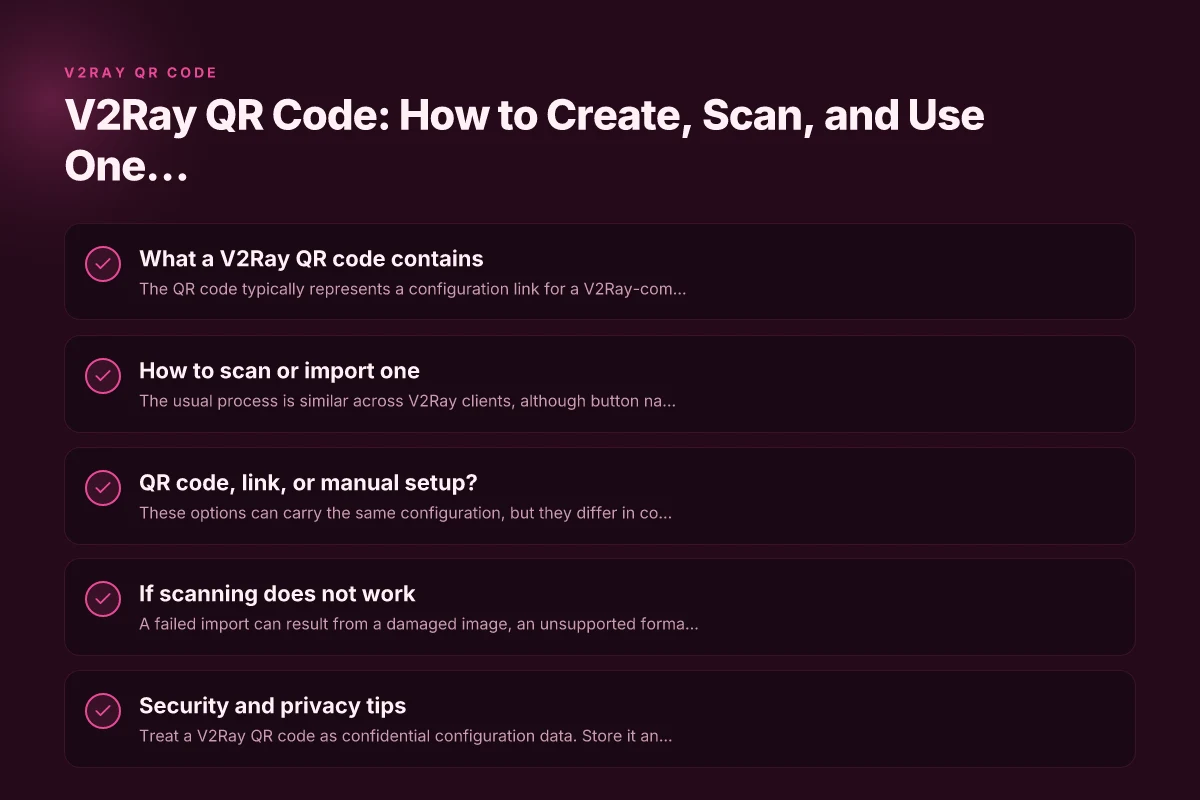
What a V2Ray QR code contains
The QR code typically represents a configuration link for a V2Ray-compatible protocol, such as VMess or VLESS. Depending on the format and client, the encoded information can include:
- A server address and port
- A user ID or other authentication value
- A transport method, such as WebSocket or TCP
- Security and encryption settings
- A server name or label for identifying the profile
The exact fields vary by protocol and configuration. Some links may also include options related to TLS, network paths, or other connection behavior. A QR code is simply a convenient container for this information. It does not verify that the server is trustworthy or that the settings are correct.
Because the link may contain credentials, anyone who can read or copy the code may be able to use the profile. Avoid posting configuration QR codes publicly or sharing them in screenshots.
How to scan or import one
The usual process is similar across V2Ray clients, although button names differ: How to Turn Off Microsoft Edge VPN: Disable Secure Network
- Install a reputable client that supports the protocol used by the configuration.
- Open the client and choose an option such as “Scan QR code,” “Import from QR code,” or “Add profile.”
- Point your camera at the code, or select an image if the code was sent as a picture.
- Review the imported server and protocol details.
- Save the profile, select it, and connect.
If the QR code is displayed on the same device where the client is installed, direct camera scanning may not be practical. Look for an image-import option, open the code on another screen, or ask the provider for a text configuration link instead.
Only grant camera or file access when it is needed for importing. If an app requests unrelated permissions, check its documentation and reputation before proceeding.
Compare ways to scan or import a V2Ray configuration
| Option | What you need | Typical action | When it may suit you | Limitation |
|---|---|---|---|---|
| Scan with the client | Compatible client and visible QR code | Open its scanner and scan | Code is on another screen | Requires camera access |
| Import from an image | Compatible client and saved QR image | Choose the image import option | Code is on the same device | Feature availability varies |
| Open a configuration link | Compatible client and link | Open or paste the link | Link is easy to access | Links can expose configuration data |
| Import a configuration file | Compatible client and file | Select the file in the client | A file was provided | File support varies |
| Enter details manually | Server and configuration details | Fill in the client’s fields | QR and link imports are unavailable | More chances for entry errors |
| Try another compatible client | A trusted alternative client | Repeat the import | Current client cannot scan or import | Confirm the new client is trustworthy |
Compiled November 2026; check the provider's site for current details. VPN That Changes Location Free: What Works and What to Check
QR code, link, or manual setup?
These options can carry the same configuration, but they differ in convenience and visibility.
| Method | Best for | Main consideration |
|---|---|---|
| QR code | Fast setup on another device | Easy to scan, but credentials may be exposed in an image |
| Configuration link | Copying or opening a profile | Convenient, but the link can also reveal connection details |
| Manual entry | Careful setup or troubleshooting | Takes longer and increases the chance of typing errors |
A QR code is not inherently more secure than a link. Both can contain the same sensitive information. Manual entry can help you inspect each field, but it does not make an untrusted server safe.
If scanning does not work
A failed import can result from a damaged image, an unsupported format, or a mismatch between the client and the configuration. Try these checks:
- Make sure the entire QR code is visible, sharp, and not cropped.
- Increase the display brightness or enlarge the code.
- Confirm that the app supports the protocol and link format.
- Update the client using its official distribution channel.
- Ask the provider to generate a fresh code or send the configuration link.
- Check that the device’s date and time are correct if the profile imports but cannot connect.
If scanning succeeds but the connection fails, inspect the profile for typos or missing settings only if you know what values should be present. A server may also be offline, credentials may have expired, or the network may block the connection. Contact the configuration provider rather than changing security options at random. Urban VPN for Edge: How to Install and What to Know
Do not trust a QR code from an unknown source just because it scans successfully. A valid import only means the app could read the data. It does not prove that the server is safe or reliable.
Security and privacy tips
Treat a V2Ray QR code as confidential configuration data. Store it and share it with care.
- Get profiles from a provider or administrator you trust.
- Avoid uploading the code to public QR-scanning websites.
- Do not post it in forums, social media, or public support channels.
- Remove screenshots or downloaded images when they are no longer needed.
- Revoke or replace a profile if you think its link or credentials were exposed.
- Check the provider’s privacy practices and the permissions requested by the client.
A proxy configuration can route some or all of your traffic through a remote server, depending on the client’s routing settings. That means choosing a trustworthy provider matters. Review the client’s routing mode and understand which traffic uses the profile before relying on it for sensitive activity.
Choose a safe next step when a V2Ray QR code does not work FortiGate VPN: How It Works, Setup Options, and What to Know
| Situation | Check first | Safer next step | Avoid | When to seek help |
|---|---|---|---|---|
| Camera will not open | Client camera permission | Enable permission if appropriate | Granting access to an untrusted app | Permission is missing or unclear |
| Code will not scan | Lighting, focus, and full code visibility | Try the client’s image import | Sharing the code publicly | Repeated scans fail |
| Code is on the same device | Client import options | Select the saved image if supported | Taking screenshots in shared spaces | No image import is available |
| Link will not import | Link completeness and client support | Request a fresh link from its source | Editing unknown link contents | The source cannot verify it |
| Import reports invalid data | Code or link source and completeness | Ask the provider for a corrected configuration | Repeatedly importing unknown data | Provider confirms an issue |
| Connection does not work | Imported settings and client status | Recheck configuration with the provider | Posting credentials in public forums | Settings appear correct but fail |
| Source is unfamiliar | Who supplied the code or link | Verify it before importing | Connecting to an unknown server | You cannot establish its origin |
Compiled November 2026; check the provider's site for current details.
Recommendation
Use a V2Ray QR code for quick setup when it comes from a trusted source and your client supports its format. Scan or import it through the client, verify the profile, and protect the original code as you would a password. If the import fails, request a fresh code or link rather than weakening security settings or using an unfamiliar scanning service.