Proxy Server: What It Is, How It Works, and When to Use One

Learn how a proxy server works, compare common types, and choose one for privacy, security, or network control.
A proxy server is an intermediary that sends requests between your device and the websites or services you access. Instead of connecting directly, your device sends a request to the proxy, which forwards it to the destination and relays the response back. Depending on its configuration, a proxy can filter traffic, record activity, cache content, or make the destination see the proxy’s IP address rather than yours.

Editor's pick: NordVPN — fast, secure VPN — Strong encryption, a no-logs policy and apps for every device. 30-day money-back guarantee. Get NordVPN →
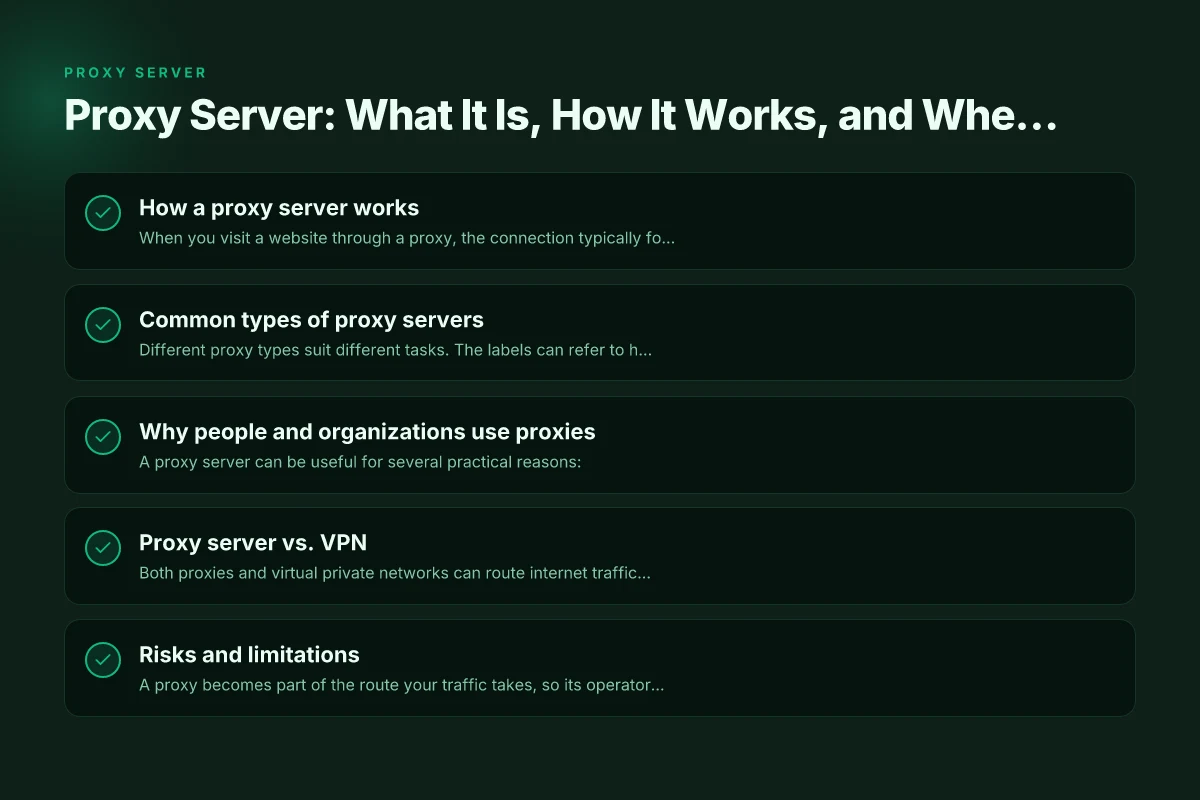
How a proxy server works
When you visit a website through a proxy, the connection typically follows this path:
- Your device sends a request to the proxy server.
- The proxy processes the request according to its rules.
- It forwards the request to the destination server.
- The destination sends a response to the proxy.
- The proxy returns the response to your device.
A proxy may operate at different levels. Some handle specific applications, such as a web browser, while others are configured for most or all traffic from a device or network. The setup determines which requests pass through it.
A proxy can also modify or inspect requests. For example, a company proxy might block access to certain sites, while a caching proxy might provide a stored copy of frequently requested content.
Common types of proxy servers
Different proxy types suit different tasks. The labels can refer to how a proxy is used, where it sits, or how it handles traffic. Windows VPN: How to Set One Up and Choose the Right Option
| Type | Typical use | What to know |
|---|---|---|
| Forward proxy | Represents users or devices accessing external services | Often used for organizational filtering and access policies |
| Reverse proxy | Sits in front of servers and receives incoming requests | Can help distribute traffic, protect servers, and manage connections |
| Transparent proxy | Intercepts or handles traffic without requiring much user setup | May not conceal the user’s IP address from the destination |
| HTTP or HTTPS proxy | Handles web traffic | Support for encryption depends on the connection and configuration |
| SOCKS proxy | Relays a wider range of network traffic | Usually offers flexible routing but may not inspect or filter content itself |
| Residential or datacenter proxy | Describes the IP network or infrastructure used | Performance, reputation, and suitability vary by provider |
A forward proxy and a reverse proxy serve opposite sides of a connection. A forward proxy acts on behalf of clients. A reverse proxy acts on behalf of servers, receiving requests from users before passing them to the appropriate backend.
Why people and organizations use proxies
A proxy server can be useful for several practical reasons:
- Network access control: Organizations can allow or block specific sites, services, or categories of traffic.
- Traffic monitoring: Administrators can review network activity for security, troubleshooting, or policy enforcement, subject to applicable laws and internal rules.
- IP address routing: A destination may see the proxy’s IP address instead of the connecting device’s IP address.
- Performance: Caching proxies can reuse stored content and reduce repeated requests, especially on managed networks.
- Server protection and distribution: Reverse proxies can direct requests across multiple servers and help handle spikes in demand.
- Testing: Developers and network teams can check how applications behave from different network locations or under particular routing conditions.
A proxy is not a universal solution. Its benefits depend on the type of proxy, the traffic it handles, and who operates it.
Proxy server vs. VPN
Both proxies and virtual private networks can route internet traffic through another server, but their coverage and security features differ. The exact behavior depends on the service and setup. NordVPN Download: How to Get and Install the Official App
| Feature | Proxy server | VPN |
|---|---|---|
| Typical coverage | Often one application or selected traffic | Commonly routes most device traffic |
| Encryption | Not guaranteed by the proxy itself | Typically encrypts traffic between the device and VPN server |
| Setup | May require browser or application configuration | Usually uses a dedicated app or system settings |
| Common uses | Filtering, routing, caching, or application-specific access | Protecting traffic on untrusted networks and routing device traffic |
| Privacy | Depends heavily on the proxy operator and configuration | Depends heavily on the VPN provider and configuration |
A proxy does not automatically make a connection private or secure. For instance, an HTTPS connection encrypts data between the browser and the website, but the proxy may still see connection details such as the destination domain. If traffic is unencrypted, the proxy may be able to inspect or alter its contents.
Risks and limitations
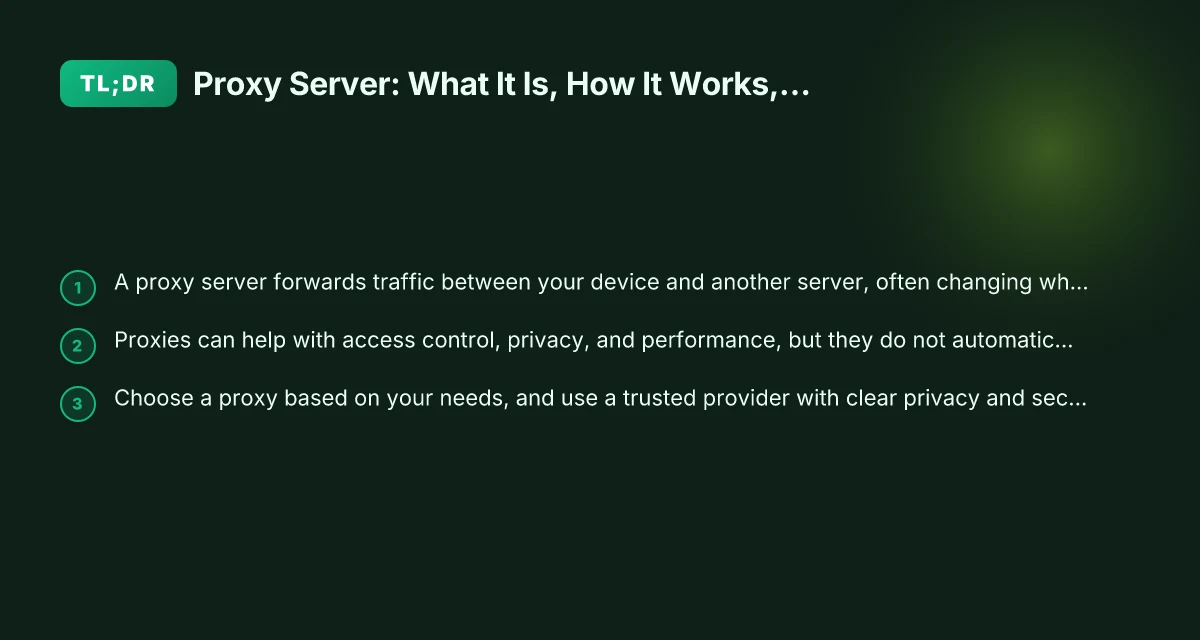
A proxy becomes part of the route your traffic takes, so its operator matters. An untrustworthy service could log activity, expose data, inject content, or provide unreliable routing. Free services may have limits or unclear practices, though cost alone does not determine whether a provider is safe.
Keep these points in mind:
- An IP change is not full anonymity. Websites may still identify users through account logins, browser settings, cookies, or other signals.
- Encryption is separate from proxying. Check whether the connection is protected, and look for HTTPS on websites.
- Logs may be retained. Review the provider’s privacy policy and understand what information it collects.
- Some services block proxy traffic. Websites may restrict access from known proxy addresses.
- Misconfiguration can expose traffic. Check which applications use the proxy and what happens if the connection fails.
- Rules still apply. Follow your organization’s policies and the laws and terms that govern the services you access.
For business use, administrators should define who can access proxy logs, how long records are retained, and how the proxy is secured and updated. Free VPN for Microsoft Edge: What Works and What to Know
How to choose a proxy server
Start with the task, rather than choosing a proxy based only on speed or price. A company managing employee web access has different requirements from a developer testing an application or a user routing traffic from one browser.
Before choosing a service or setup, consider:
- Purpose: Do you need filtering, caching, application-specific routing, or a reverse proxy for a website?
- Coverage: Will it handle one app, selected traffic, or requests to your own servers?
- Security: Does it support the protocols and encryption your use case requires?
- Privacy: Is the operator clear about collection, logging, sharing, and retention?
- Reliability: Are uptime, support, and performance suitable for the task?
- Administration: Can you configure access rules, monitoring, and updates appropriately?
Avoid entering sensitive information through a proxy you do not trust. For managed networks, use the proxy provided or approved by the organization.
Recommendation
Use a proxy server when you need a specific function such as traffic filtering, caching, application-level routing, or reverse-proxy protection. For broader device-level traffic protection, consider whether a properly configured VPN is a better fit. In either case, choose a reputable provider or maintain the server securely, understand what traffic it can see, and do not treat an IP address change as a guarantee of privacy. Edge Secure Network VPN Review: What It Does and What It Doesn’t