Locate OpenVPN Files on Windows: Configurations, Profiles, and App Folders

Find OpenVPN configuration files on Windows, with separate locations for OpenVPN GUI and OpenVPN Connect.
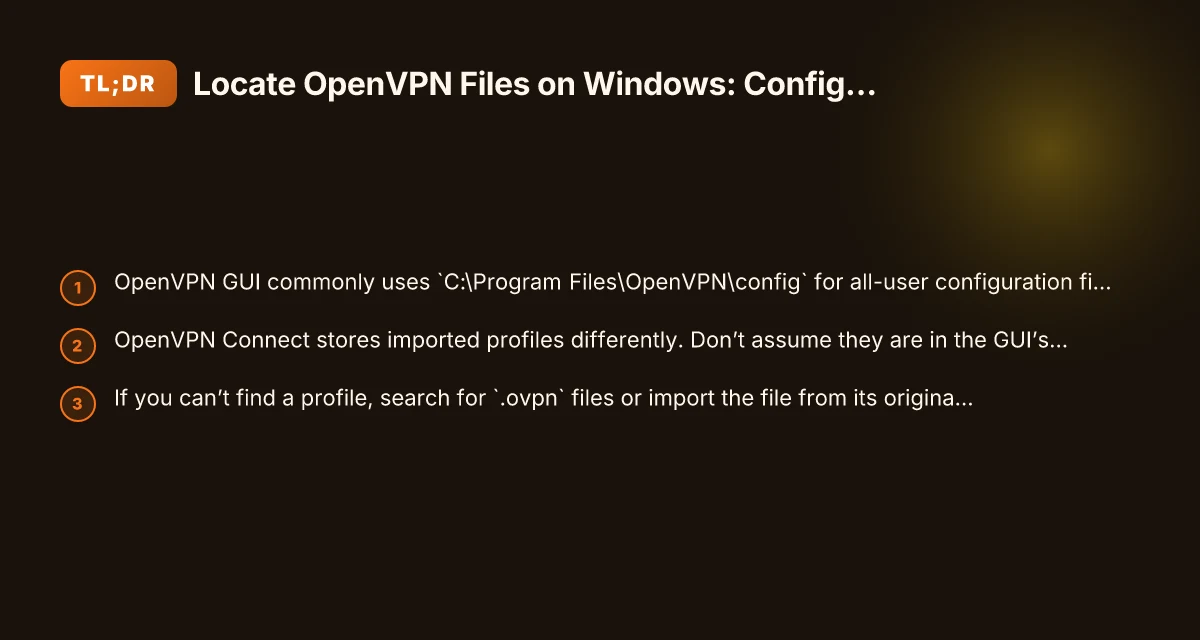
If you’re trying to locate OpenVPN files on Windows, start by checking C:\Program Files\OpenVPN\config. This is the common location for configuration files used by OpenVPN GUI when they’re available to all users. The exact location depends on which OpenVPN app you installed and how its profile was added: OpenVPN GUI and OpenVPN Connect handle files differently.

Editor's pick: NordVPN — fast, secure VPN — Strong encryption, a no-logs policy and apps for every device. 30-day money-back guarantee. Get NordVPN →
Common OpenVPN file locations and what they contain
| Location or source | Typically contains | Used by | How to check | Important note |
|---|---|---|---|---|
| `C:\Program Files\OpenVPN\config` | OpenVPN GUI profiles | OpenVPN GUI | Open the folder in File Explorer | May require administrator access |
| `C:\Program Files (x86)\OpenVPN\config` | Profiles for some 32-bit installs | OpenVPN GUI | Check if the other folder is absent | Install location can vary |
| `C:\Users\<user>\OpenVPN\config` | User-specific profiles | OpenVPN GUI | Replace `<user>` with your Windows account name | Not present on every setup |
| OpenVPN Connect app storage | Profiles imported into the app | OpenVPN Connect | Check the app’s profile list | Separate from the GUI config folder |
| Downloads folder | Files saved from a provider or website | Either app, after import or setup | Search for `.ovpn` | A downloaded file may not be installed |
| Provider account or support page | Downloadable configuration profiles | Either app, depending on profile | Sign in and check setup instructions | Provider requirements may differ |
Compiled November 2026; check the provider's site for current details.
| VPN | Obfuscation | From / month | Plan | Free plan | Refund | Alipay | UnionPay | Crypto | Website opens in China | Trustpilot | |
|---|---|---|---|---|---|---|---|---|---|---|---|
 ZoogVPN | Turn on manually Shadow | $2.49/mo | 27 months: $59.99 | Yes | 7 days | ✓ | ✓ | ✓ | ✓ | Official site blocked; our special link opens (4.4 s) | 4.2/5 (195 reviews) |
 NordVPN | Turn on manually Obfuscated Servers / NordWhisper | $3.49/mo | 27 months: $94.23 | No | 30 days | ? | ✗ | ✓ | ✓ | ✗ Blocked | 4.2/5 (51,628 reviews) |
 ExpressVPN | ✓ On by default all servers | $3.00/mo | 28 months: $84 | No | 30 days | ✗ | ✗ | ✓ | ✗ | ✗ Blocked | 4.4/5 (29,706 reviews) |
 Surfshark | ✓ On by default Camouflage, with OpenVPN | See site | See site | No | 30 days | ✗ | ✗ | ✗ | ✓ | ✗ Blocked | 4.3/5 (31,823 reviews) |
 Proton VPN | Turn on manually Stealth, free plan too | $2.99/mo | 12 months: $35.88 | Yes | 30 days | ✗ | ✗ | ✗ | ✓ | ✗ Blocked | 2.1/5 (1,040 reviews) |
 Astrill VPN | Turn on manually StealthVPN / OpenWeb | $12.50/mo | 24 months: $300 | No | See site | ✗ | ✗ | ✗ | ✓ | ✗ Blocked | 1.3/5 (110 reviews) |
 Private Internet Access | Turn on manually Shadowsocks, OpenVPN only | $2.03/mo | 40 months: $81.2 | No | 30 days | ✗ | ✗ | ✗ | ✗ | ✗ Blocked | 4.2/5 (11,033 reviews) |
 CyberGhost | Turn on manually selected servers | $2.19/mo | 28 months: $61.32 | No | 45 days | ✗ | ✗ | ✗ | ✓ | ✗ Blocked | 4.0/5 (24,178 reviews) |
 PureVPN | Turn on manually switch to OpenVPN | $1.69/mo | 60 months: $101.55 | No | 31 days | ? | ? | ✗ | ✓ | ✗ Blocked | 4.4/5 (17,994 reviews) |
 AdGuard VPN | ✓ On by default TrustTunnel | $2.99/mo | 24 months: $71.76 | Yes | 30 days | ✓ | ✗ | ✓ | ✓ | Official site blocked; our special link opens (3.7 s) | 4.3/5 (290 reviews) |
 Mullvad | Turn on manually QUIC / Shadowsocks / LWO | $5.61/mo | €5/mo | No | 14 days | ✗ | ✗ | ✗ | ✓ | ✗ Blocked | 3.2/5 (192 reviews) |
 Windscribe | Turn on manually Stealth / WStunnel | $5.75/mo | 12 months: $69 | Yes | See site | ✗ | ✗ | ✗ | ✓ | ✗ Blocked | 4.7/5 (13,355 reviews) |
 StrongVPN | Turn on manually Scramble, OpenVPN TCP | See site | See site | No | 30 days | ✓ | ✗ | ✗ | ✗ | ✗ Blocked | 4.4/5 (2,695 reviews) |
 LightXtreme 闪连 | Not listed | $7.08/mo | 12 months: $84.99 | Yes | 30 days | ✓ | ✓ | ✓ | ✓ | ✓ Yes (3.5 s) | No page |
Prices checked 2026-11-10 on each vendor's pricing page (cheapest long plan, USD). Check the vendor's checkout for the final price.
Obfuscation checked 2026-11-14 on each vendor's site and help center: "on by default" = nothing to set; "turn on manually" = switch protocol or mode in settings; "not listed" = the vendor describes no obfuscation.
Payment methods checked 2026-11-10 on each vendor's payment pages: all 14 take cards and PayPal; ✗ = not listed, ? = the vendor's own pages disagree.
China access: whether the official website opens from mainland China networks (tests the website only, not the VPN connection). Last checked 2026-11-18 01:02 Beijing time.
Trustpilot score and review count checked 2026-11-10.
Check the OpenVPN GUI configuration folder
For OpenVPN GUI, open File Explorer and enter this path in the address bar:
C:\Program Files\OpenVPN\config
This folder is commonly used for configuration files shared across Windows user accounts. Files may have an .ovpn extension, or they may use related certificate and key files that the configuration references.
Some installations also use a user-specific configuration folder under your Windows profile. Check the OpenVPN folder inside your user directory, then look for a config subfolder. The exact path can vary with the app version and installation setup. How to quit NordVPN: Cancel Your Subscription and Close Your Account
To check both locations:
- Open File Explorer.
- Paste
C:\Program Files\OpenVPN\configinto the address bar and press Enter. - If your profile isn’t there, check your user profile for an OpenVPN
configfolder. - Look for
.ovpnfiles and any accompanying certificate or key files.
If Windows says you don’t have permission to open or change a folder, you may need an administrator account. Avoid moving or editing configuration files unless you know which app or connection uses them.
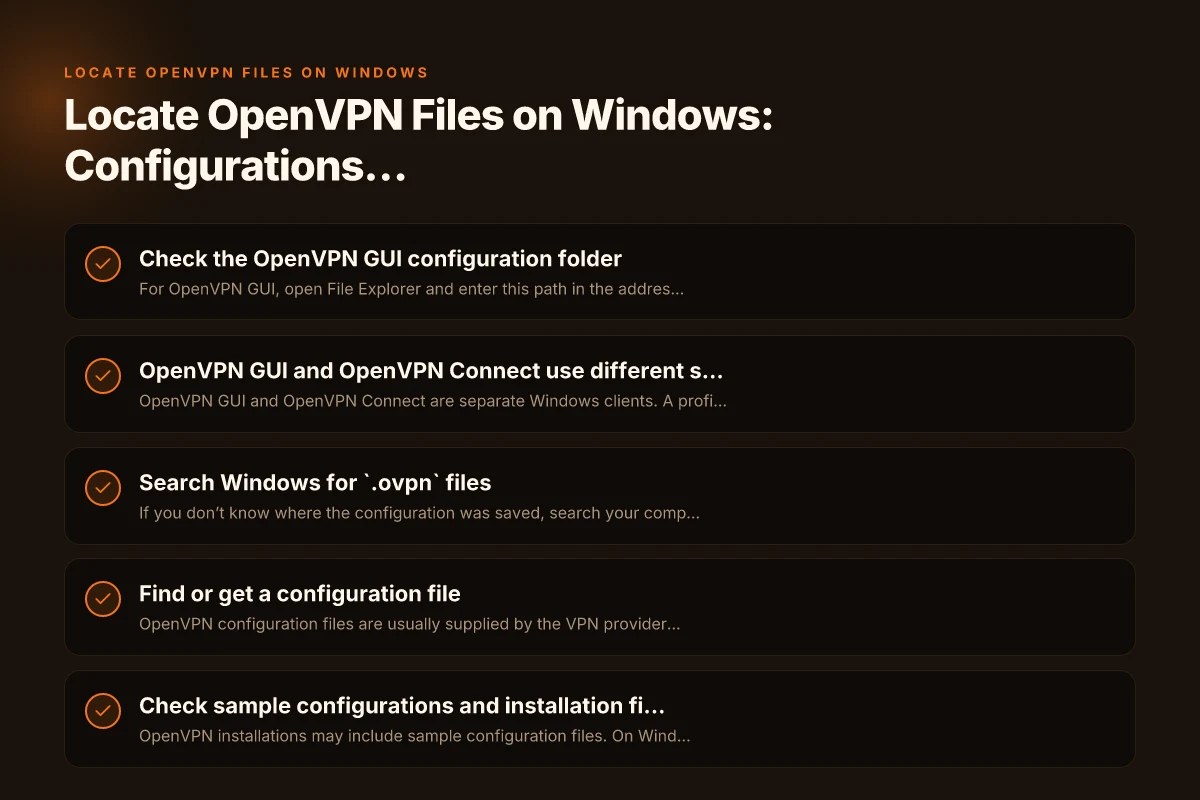
OpenVPN GUI and OpenVPN Connect use different storage
OpenVPN GUI and OpenVPN Connect are separate Windows clients. A profile imported into one may not appear in the other, and the familiar config folder may not show profiles managed by OpenVPN Connect.
| Client or file type | Where to look | What to expect |
|---|---|---|
| OpenVPN GUI, all-user configurations | C:\Program Files\OpenVPN\config |
Configuration files used by the GUI |
| OpenVPN GUI, user-specific configurations | OpenVPN config folder within your Windows user profile |
Files associated with an individual account |
| OpenVPN Connect profile | OpenVPN Connect app | Imported profiles may be managed by the app rather than stored in the GUI folder |
| Provider’s original configuration | The folder where you downloaded or saved it | A .ovpn file and, sometimes, supporting files |
If you use OpenVPN Connect, open the app and check its profile list first. The profile may be available to connect even if you can’t find a plainly named configuration file in the GUI folder. OpenVPN Connect supports importing a profile from a saved .ovpn file, so the original file’s location and the app’s managed profile storage are not necessarily the same thing. How to Get a NordVPN Token: Safe, Official Methods
Search Windows for .ovpn files
If you don’t know where the configuration was saved, search your computer for its file extension.
- Open File Explorer.
- Select This PC in the navigation pane.
- Enter
*.ovpnin the search box. - Wait for Windows to finish searching the locations you want to check.
You can also search likely places where downloaded files are kept, such as Downloads, Documents, or a folder you selected when saving the profile. If the provider gave you a ZIP archive, locate and extract the archive before searching for the .ovpn file.
A configuration might rely on separate certificate or key files. If you find the .ovpn file but the connection does not work after moving it, the profile may still refer to files in its original folder. Keep the related files together unless the configuration specifies another location.
OpenVPN GUI and OpenVPN Connect comparison Why Does My VPN Restrict Access to TrackWise?
| Comparison point | OpenVPN GUI | OpenVPN Connect |
|---|---|---|
| Profile handling | Uses configuration files | Imports profiles into the app |
| Common profile type | `.ovpn` file | `.ovpn` file or provider-supported import |
| Typical file location | OpenVPN `config` folder | App-managed storage |
| Does the GUI config folder apply? | Yes | No |
| How to find an active profile | Check the config folder | Check the app’s profile list |
| How to add a profile | Place the file in the config folder | Import the profile in the app |
| Are files always visible in File Explorer? | Usually | Not necessarily |
| Best next step if missing | Search for `.ovpn` files | Check imports and provider instructions |
Compiled November 2026; check the provider's site for current details.
Find or get a configuration file
OpenVPN configuration files are usually supplied by the VPN provider or administrator who set up the server. If you need the original file, check the provider’s account portal or ask the network administrator for the correct client profile.
Some providers offer downloadable configuration files through an account page. For example, a provider may have a section labeled OpenVPN or Configuration files. The exact steps depend on the provider, so use its current instructions rather than assuming every service uses the same portal.
When you have a profile: How to End Proton VPN Subscription: A Step-by-Step Guide
- Save or extract the
.ovpnfile to a folder you can find again. - Keep any accompanying certificates or keys with it when required.
- For OpenVPN Connect, import the profile using the app’s import option, or drag and drop the file into the app.
- For OpenVPN GUI, place the configuration in the appropriate GUI config folder if that is how your setup is managed.
Only use configuration files from a source you trust. A profile can direct your connection to a particular VPN server and may reference credentials or cryptographic files.
Check sample configurations and installation files
OpenVPN installations may include sample configuration files. On Windows, OpenVPN’s community documentation describes finding samples through Start Menu > All Programs > OpenVPN > OpenVPN Sample Configuration Files. These are examples for creating or setting up configurations. They are not necessarily the profile for your VPN provider.
Don’t confuse sample files with active connection profiles or application files. The OpenVPN program folder can contain executables and supporting components, while the config folder is the more relevant place to check for GUI configuration files. OpenVPN Connect’s imported profiles should be checked in that app rather than assumed to be in the GUI folder.
Ways to locate or obtain an `.ovpn` configuration Big IP f5 VPN download: How to Get and Install the Official Client
| Option | Best for | What to do | What you may find | Limitation |
|---|---|---|---|---|
| Check the OpenVPN GUI config folder | Profiles already set up for GUI | Open the likely `config` folder | `.ovpn` files and related files | Folder path can vary |
| Search Windows for `.ovpn` | Files stored somewhere on the PC | Search File Explorer for `.ovpn` | Downloaded or copied profiles | Search results may include duplicates |
| Check Downloads | Recently saved profiles | Sort or search by file name | Provider downloads | File may still need importing |
| Check OpenVPN Connect | Profiles already imported | Open the app and review profiles | Saved connection entries | App storage may not expose files |
| Check provider instructions | Missing or outdated profile | Sign in or open provider support | Current configuration downloads | Access may require an account |
| Check installation files | Samples or bundled examples | Review the install folder | Sample configurations | Samples may not connect to your service |
| Contact the provider | No profile or unclear setup | Ask for the Windows OpenVPN configuration | Provider-specific guidance | Availability depends on the provider |
Compiled November 2026; check the provider's site for current details.
Recommendation
First identify whether you’re using OpenVPN GUI or OpenVPN Connect. For the GUI, check C:\Program Files\OpenVPN\config and then the OpenVPN config folder in your Windows user profile. For Connect, check the app’s profile list and search Windows for the original .ovpn file if needed.