IPsec over TCP 443: How It Works, Benefits, and Limitations

Learn what IPsec over TCP 443 means, when it helps, and why it is not a universal fix for VPN connectivity.
IPsec over TCP 443 carries IPsec VPN traffic inside a TCP connection that uses port 443. It can help a VPN connect from networks that block or disrupt IPsec’s usual protocols, but it is not guaranteed to work everywhere. Network firewalls may still identify and block the connection, and TCP encapsulation can reduce performance.

Editor's pick: NordVPN — fast, secure VPN — Strong encryption, a no-logs policy and apps for every device. 30-day money-back guarantee. Get NordVPN →
Compare common VPN transport options
| Option | Typical port | Protocol | Traverses restrictive networks | Main trade-off |
|---|---|---|---|---|
| IPsec over UDP | UDP 500/4500 | IKE and IPsec | Sometimes blocked | Efficient, but UDP may be restricted |
| IPsec over TCP 443 | TCP 443 | IPsec encapsulated in TCP | Often easier through firewalls | TCP-over-TCP performance issues |
| SSL/TLS VPN | TCP 443 | TLS | Often supported | Requires compatible VPN gateway and client |
| WireGuard | UDP, configurable | WireGuard | May be blocked | Lightweight, but depends on UDP access |
| OpenVPN over UDP | UDP, configurable | TLS-based VPN | Sometimes blocked | Efficient where UDP is allowed |
| OpenVPN over TCP 443 | TCP 443 | TLS-based VPN | Often easier through firewalls | Can suffer TCP-over-TCP issues |
Compiled November 2026; check the provider's site for current details.
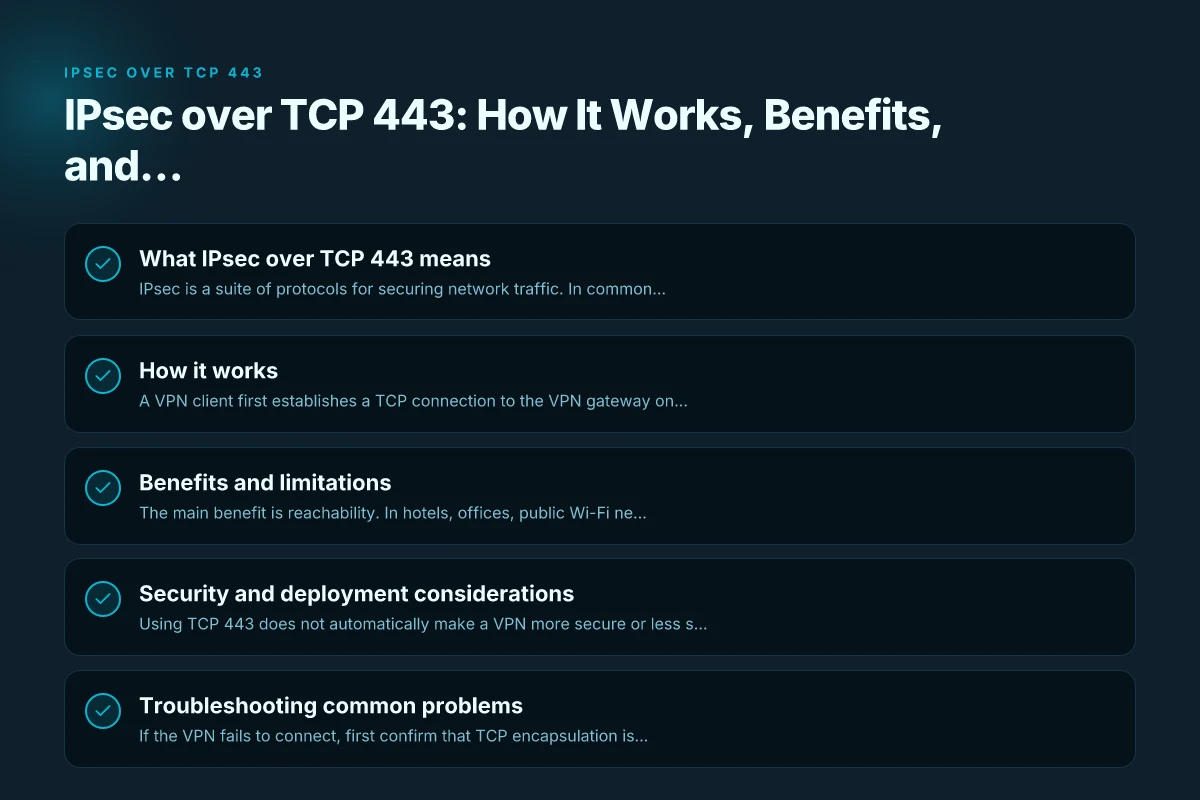
What IPsec over TCP 443 means
IPsec is a suite of protocols for securing network traffic. In common VPN deployments, IKE negotiates the connection and IPsec protects the data. Traditional IPsec commonly uses UDP port 500 for IKE and UDP port 4500 for NAT traversal. Some deployments also use ESP directly, which is IP protocol 50 rather than a TCP or UDP port.
With TCP encapsulation, IPsec packets are carried inside a TCP connection. If that connection uses port 443, it may pass through networks that allow outbound TCP traffic on that port. Port 443 is widely used for HTTPS, so it is often available where other VPN traffic is restricted.
The exact implementation matters. “IPsec over TCP 443” is not one universal standard configuration supported in the same way by every VPN client, gateway, or firewall. Some products provide a specific TCP encapsulation mode, while others use different methods, such as TLS-based VPN transport. Check the documentation for both ends of the connection.
How it works
A VPN client first establishes a TCP connection to the VPN gateway on port 443. The client and gateway then encapsulate IPsec-related traffic within that connection. Inside the tunnel, IPsec continues to provide security features such as encryption and integrity checks, depending on the negotiated configuration. VPN That Allows You to Choose Location for Free: What to Know
This differs from simply opening port 443 on a firewall. The client and gateway must both understand the encapsulation method, and the network path must allow the resulting traffic. A firewall that permits ordinary HTTPS may still block or inspect a connection that does not behave like typical web browsing.
For a working connection, administrators generally need to:
- Enable a compatible TCP encapsulation option on the VPN gateway.
- Configure supported VPN clients to use the same mode and destination port.
- Allow the connection through host firewalls, network firewalls, and access-control rules.
- Verify that authentication, encryption, routing, and DNS settings are correct.
- Test the setup from the networks where users are expected to connect.
Benefits and limitations
The main benefit is reachability. In hotels, offices, public Wi-Fi networks, or other restricted environments, UDP-based VPN traffic may be blocked while outbound TCP on port 443 is allowed. TCP encapsulation can provide another route for users to reach their organization’s VPN.
However, the port number alone is not a guarantee. A network may allow TCP 443 only to approved web services, use a proxy that requires browser-style authentication, or apply traffic inspection that rejects non-HTTPS connections. Some networks also limit long-lived connections or interrupt VPN sessions. Free Location Changer VPN: What It Can, and Can’t, Change
There can be a performance cost. TCP includes retransmission and congestion-control mechanisms. When TCP traffic is carried inside another TCP connection, packet loss can trigger recovery at both layers. This can cause delays or uneven performance, especially on congested or lossy connections. This effect is often called TCP-over-TCP interference.
| Connection method | Typical transport | Main advantage | Main limitation |
|---|---|---|---|
| Native IPsec with NAT traversal | UDP 500 and 4500 | Efficient and widely supported | May be blocked on restrictive networks |
| IPsec over TCP 443 | TCP 443 | Can work where outbound TCP 443 is permitted | Requires compatible endpoints; may perform poorly |
| TLS-based VPN transport | Often TCP 443 or another configured port | Designed to use TLS-style connections | Availability and behavior depend on the product |
IPsec over TCP 443 deployment considerations
| Consideration | Potential benefit | Potential limitation | What to check |
|---|---|---|---|
| Firewall traversal | TCP 443 is commonly permitted | Networks may still inspect or block VPN traffic | Firewall and proxy policies |
| Compatibility | Can help IPsec cross restrictive networks | Both endpoints must support the same method | Gateway and client support |
| Performance | Can provide connectivity when UDP is unavailable | TCP retransmissions may reduce throughput | Real-world latency and throughput |
| Security | Retains IPsec protections when configured correctly | TCP encapsulation does not replace sound IPsec configuration | Encryption, authentication, and policy settings |
| Network load | Uses an established TCP path | TCP-over-TCP can cause congestion and delays | Loss, retransmissions, and congestion |
| Deployment | May avoid opening additional UDP paths | May require specific gateway configuration | Vendor instructions and approved port use |
Compiled November 2026; check the provider's site for current details.
Security and deployment considerations
Using TCP 443 does not automatically make a VPN more secure or less secure. Security depends on the IPsec configuration, authentication methods, key management, endpoint protection, and software updates. The TCP port is a transport choice, not a substitute for sound cryptographic settings. Best Free VPN That Lets You Pick Locations: Top Options and Limits
It also does not make VPN traffic indistinguishable from HTTPS. Network monitoring systems may recognize the VPN protocol or its traffic pattern. Do not use port 443 to bypass an organization’s network policies. Administrators should approve and document the configuration.
For a managed deployment, consider the following:
- Keep the VPN gateway and client software supported and patched.
- Use strong authentication, ideally with multifactor authentication where appropriate.
- Apply current, secure encryption and key-exchange settings.
- Restrict access according to user roles and organizational policy.
- Log connection attempts and investigate unexpected failures.
- Test both performance and reliability before enabling the mode broadly.
Troubleshooting common problems
If the VPN fails to connect, first confirm that TCP encapsulation is supported and enabled on both the client and gateway. A mismatch between the selected mode, port, or gateway configuration is a common cause.
Then check whether the network permits the connection. Test from another network, such as a mobile hotspot, to help distinguish a local network restriction from a VPN configuration issue. Confirm that the gateway is reachable on the configured address and port, and review client and server logs for authentication, negotiation, or timeout errors. FortiClient VPN 7. 4. 3 Download: Safe Sources and Installation Guide
If the tunnel connects but is slow, compare its performance with native IPsec on a network that allows UDP. Check for packet loss, high latency, restrictive proxies, and excessive traffic routed through the tunnel. Administrators may also need to review the tunnel’s MTU and routing settings. Avoid making changes to encryption or firewall rules without understanding their security impact.
Troubleshoot IPsec over TCP 443 problems
| Symptom | Possible cause | Check | Practical response |
|---|---|---|---|
| VPN cannot connect | TCP 443 blocked or intercepted | Firewall, proxy, and gateway logs | Confirm permitted traffic with the network team |
| Connection starts but fails | Client and gateway settings differ | Encapsulation mode and configuration | Align settings with vendor guidance |
| Slow performance | TCP-over-TCP effects or packet loss | Latency, loss, and retransmissions | Compare with another supported transport |
| Intermittent disconnects | Middlebox timeout or unstable network | Session and idle-timeout policies | Review keepalive and timeout settings |
| Authentication fails | Credentials, certificates, or policy mismatch | Client and gateway authentication logs | Verify identity and certificate configuration |
| Works on one network only | Different firewall or proxy rules | Compare network paths and policies | Test an approved alternate network |
| Port appears open but tunnel fails | Port reachability does not confirm VPN support | Gateway logs and protocol handling | Confirm the service is configured for IPsec over TCP 443 |
Compiled November 2026; check the provider's site for current details.
Recommendation
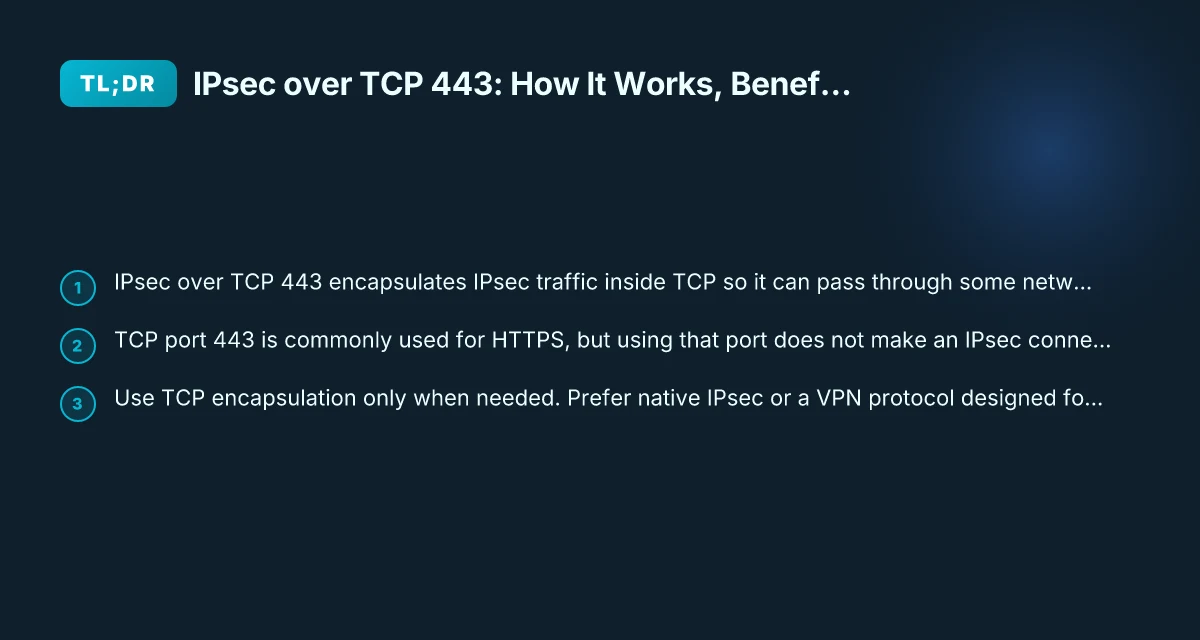
Use IPsec over TCP 443 as a compatibility option when ordinary IPsec connectivity is blocked and both VPN endpoints support the same encapsulation method. Prefer native IPsec when the network permits it, and consider a VPN transport designed for restrictive networks if TCP encapsulation is unreliable. Test the configuration on real user networks, document its limits, and choose the method that balances access, performance, and security. VPN for Microsoft Edge Extension: How to Choose and Use One