How to Check What Region a VPN Is Using
Check your VPN’s apparent region using your public IP, compare lookup services, and spot DNS or browser leaks.
To check what region a VPN is using, connect to a VPN server and look up your public IP address on an IP-location website. The country and city shown indicate where your internet connection appears to originate, not necessarily the VPN server’s exact physical location. For a more reliable picture, compare several lookup services and run a DNS leak test.

Editor's pick: NordVPN — fast, secure VPN — Strong encryption, a no-logs policy and apps for every device. 30-day money-back guarantee. Get NordVPN →
How each check helps identify your VPN region
| Check | What it shows | What to compare | Possible mismatch clue |
|---|---|---|---|
| Public IP lookup | Region associated with your IP | Country and city | Shows your non-VPN region |
| Second IP lookup | Another estimate of IP region | Country and city across sites | Results disagree |
| DNS leak test | DNS resolver information | Resolver location and provider | Resolver appears outside VPN region |
| Browser location check | Location access and reported position | Permission and displayed location | Browser reports your physical area |
| VPN app status | Selected VPN server | Server country and city | App shows a different server |
| Website region check | Region a site recognizes | Site content or region setting | Site uses an unexpected region |
| Network refresh | Whether a connection change helps | Results before and after reconnecting | Region remains inconsistent |
Compiled November 2026; check the provider's site for current details.
| VPN | Obfuscation | From / month | Plan | Free plan | Refund | Alipay | UnionPay | Crypto | Website opens in China | Trustpilot | |
|---|---|---|---|---|---|---|---|---|---|---|---|
 ZoogVPN | Turn on manually Shadow | $2.49/mo | 27 months: $59.99 | Yes | 7 days | ✓ | ✓ | ✓ | ✓ | Official site blocked; our special link opens (4.4 s) | 4.2/5 (195 reviews) |
 NordVPN | Turn on manually Obfuscated Servers / NordWhisper | $3.49/mo | 27 months: $94.23 | No | 30 days | ? | ✗ | ✓ | ✓ | ✗ Blocked | 4.2/5 (51,628 reviews) |
 ExpressVPN | ✓ On by default all servers | $3.00/mo | 28 months: $84 | No | 30 days | ✗ | ✗ | ✓ | ✗ | ✗ Blocked | 4.4/5 (29,706 reviews) |
 Surfshark | ✓ On by default Camouflage, with OpenVPN | See site | See site | No | 30 days | ✗ | ✗ | ✗ | ✓ | ✗ Blocked | 4.3/5 (31,823 reviews) |
 Proton VPN | Turn on manually Stealth, free plan too | $2.99/mo | 12 months: $35.88 | Yes | 30 days | ✗ | ✗ | ✗ | ✓ | ✗ Blocked | 2.1/5 (1,040 reviews) |
 Astrill VPN | Turn on manually StealthVPN / OpenWeb | $12.50/mo | 24 months: $300 | No | See site | ✗ | ✗ | ✗ | ✓ | ✗ Blocked | 1.3/5 (110 reviews) |
 Private Internet Access | Turn on manually Shadowsocks, OpenVPN only | $2.03/mo | 40 months: $81.2 | No | 30 days | ✗ | ✗ | ✗ | ✗ | ✗ Blocked | 4.2/5 (11,033 reviews) |
 CyberGhost | Turn on manually selected servers | $2.19/mo | 28 months: $61.32 | No | 45 days | ✗ | ✗ | ✗ | ✓ | ✗ Blocked | 4.0/5 (24,178 reviews) |
 PureVPN | Turn on manually switch to OpenVPN | $1.69/mo | 60 months: $101.55 | No | 31 days | ? | ? | ✗ | ✓ | ✗ Blocked | 4.4/5 (17,994 reviews) |
 AdGuard VPN | ✓ On by default TrustTunnel | $2.99/mo | 24 months: $71.76 | Yes | 30 days | ✓ | ✗ | ✓ | ✓ | Official site blocked; our special link opens (3.7 s) | 4.3/5 (290 reviews) |
 Mullvad | Turn on manually QUIC / Shadowsocks / LWO | $5.61/mo | €5/mo | No | 14 days | ✗ | ✗ | ✗ | ✓ | ✗ Blocked | 3.2/5 (192 reviews) |
 Windscribe | Turn on manually Stealth / WStunnel | $5.75/mo | 12 months: $69 | Yes | See site | ✗ | ✗ | ✗ | ✓ | ✗ Blocked | 4.7/5 (13,355 reviews) |
 StrongVPN | Turn on manually Scramble, OpenVPN TCP | See site | See site | No | 30 days | ✓ | ✗ | ✗ | ✗ | ✗ Blocked | 4.4/5 (2,695 reviews) |
 LightXtreme 闪连 | Not listed | $7.08/mo | 12 months: $84.99 | Yes | 30 days | ✓ | ✓ | ✓ | ✓ | ✓ Yes (3.5 s) | No page |
Prices checked 2026-11-10 on each vendor's pricing page (cheapest long plan, USD). Check the vendor's checkout for the final price.
Obfuscation checked 2026-11-14 on each vendor's site and help center: "on by default" = nothing to set; "turn on manually" = switch protocol or mode in settings; "not listed" = the vendor describes no obfuscation.
Payment methods checked 2026-11-10 on each vendor's payment pages: all 14 take cards and PayPal; ✗ = not listed, ? = the vendor's own pages disagree.
China access: whether the official website opens from mainland China networks (tests the website only, not the VPN connection). Last checked 2026-11-18 01:02 Beijing time.
Trustpilot score and review count checked 2026-11-10.
1. Check your public IP address
Your public IP is the address websites generally see when you connect. Before using a lookup tool, make sure the VPN is connected to the country or city you want to test.
Then visit an IP-checking or geolocation service, such as WhatIsMyIP.com or IPLocation.net. The result should show the IP address currently visible to the site and may also display a country, region, or city.
For a basic check:
- Connect to the VPN server you want to test.
- Open an IP-location website in your browser.
- Note the displayed IP address and location.
- Compare the result with the location selected in your VPN app.
If the lookup shows your usual public IP or home region instead of the VPN’s expected region, the VPN may not be connected properly, or your traffic may be escaping the tunnel. Disconnect and reconnect, then test again. Best VPN Free Trials: Top Options and How to Choose
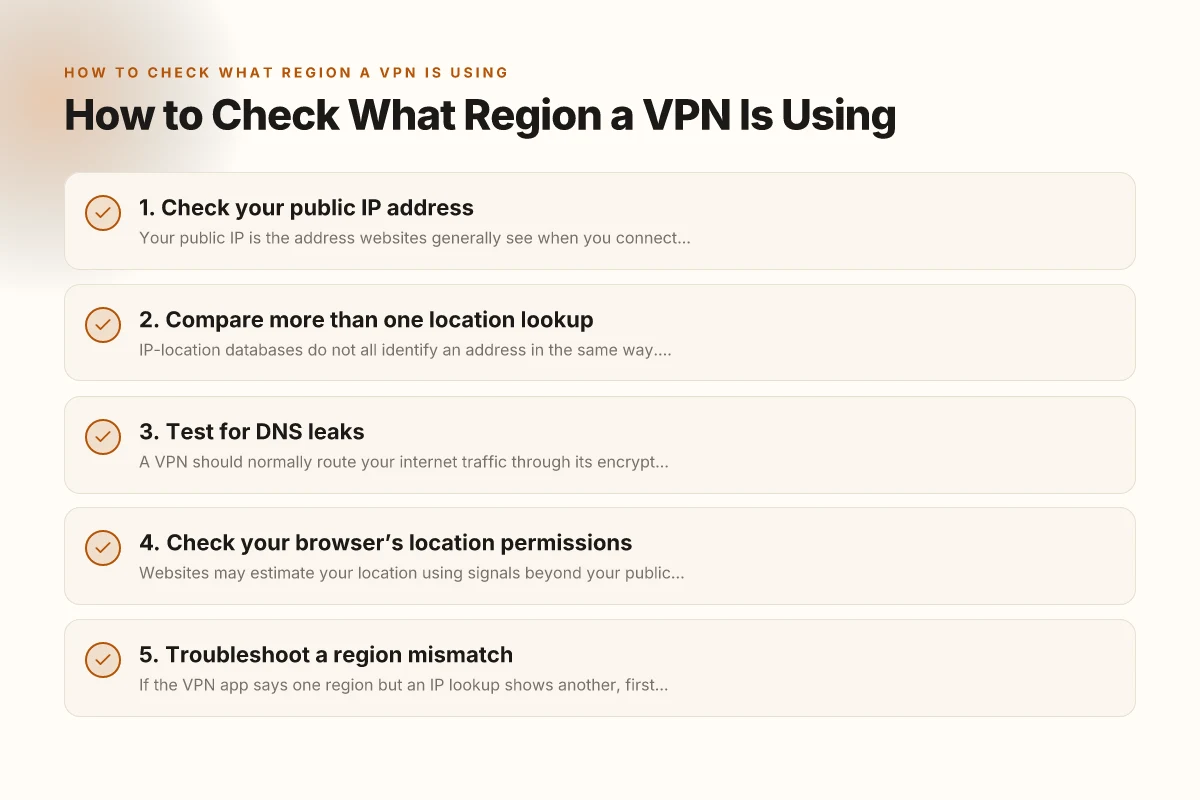
2. Compare more than one location lookup
IP-location databases do not all identify an address in the same way. One service may associate an IP with a city, while another reports only a country or a different nearby location. This can happen because providers maintain separate databases and update them at different times.
IPLocation.net, for example, presents location information from multiple geolocation providers. Comparing its results with another IP lookup can help you see whether the reported region is consistent.
| Check | What it can tell you | What it cannot confirm |
|---|---|---|
| Public IP lookup | The IP address and region websites may associate with your connection | The precise physical location of the VPN server |
| Multiple geolocation providers | Whether location databases broadly agree | That every website will show the same region |
| DNS leak test | Whether DNS requests appear to be handled outside the expected VPN connection | The exact location of the VPN hardware |
| VPN app server label | Which server or region you selected in the app | That geolocation databases identify it accurately |
Treat a city-level result as an estimate rather than proof of the server’s exact location. A VPN provider’s server label and a website’s IP-location result can differ without necessarily meaning that your real home IP is exposed.
Which location signal to trust when results disagree Best VPN Free Trial for Testing Streaming and Gaming
| Signal | Based on | Useful for | Limitation | What to check |
|---|---|---|---|---|
| Public IP lookup | Public IP address | Checking VPN exit region | Lookup databases can differ | Compare more than one lookup |
| DNS leak test | DNS requests and resolver | Finding DNS exposure | Does not identify every location signal | Check resolver details |
| Browser location | Browser permission and location data | Diagnosing location prompts | May not follow IP region | Review site permission |
| VPN app server | Selected VPN endpoint | Confirming intended connection | Does not prove every test uses it | Verify connection status |
| Website region | Site-specific signals | Understanding a particular service | Sites may use other signals | Compare with IP results |
| Search or map result | Service-specific location signals | Spotting browser location influence | May reflect permissions or account settings | Check browser settings |
| Multiple signals | Combined test results | Narrowing down a mismatch | Results may still vary by service | Look for a consistent pattern |
Compiled November 2026; check the provider's site for current details.
3. Test for DNS leaks
A VPN should normally route your internet traffic through its encrypted connection. DNS requests, the lookups that help your device find websites, can sometimes be handled in a way that reveals information about your connection outside the VPN.
Use an online DNS leak test, such as dnsleaktest.com, while connected to the VPN. Review the results for DNS servers or locations that appear inconsistent with the VPN connection. If the test suggests that your requests are not using the expected VPN route, check the VPN app’s settings and support guidance, then run the test again.
A DNS test is separate from an IP-location lookup. The IP lookup checks the public address visible to websites. The DNS test checks how domain-name requests appear to be resolved. Running both gives you a fuller check than relying on either one alone. How Do I Know Where My VPN Is Set To?
4. Check your browser’s location permissions
Websites may estimate your location using signals beyond your public IP. If you grant a site access to your device’s location, your browser or device may share location information that does not match the VPN region.
If a website still appears to know your usual location:
- Review that site’s location permission in your browser.
- Remove permission if the site does not need it.
- Retest in a private browsing window or a different browser.
- Check whether the result changes when you disable location access.
This does not mean the VPN has failed. It means a website may be using a separate source of location information rather than relying only on your public IP.
5. Troubleshoot a region mismatch
If the VPN app says one region but an IP lookup shows another, first confirm that the VPN connection is active and that you selected the intended server. Then close and reopen the browser, reconnect to the server, and check the IP again. How Do You Turn VPN Off to Correct Your Location in New Mexico (NM)?
Keep in mind that different services may use different location databases. A mismatch in the displayed city alone does not establish that the VPN is leaking your real address. Look at the actual public IP, compare several location providers, and review the DNS test before drawing a conclusion.
If your normal public IP appears, or the DNS results seem inconsistent, consult your VPN provider’s troubleshooting instructions. You can also contact its support team with the server name and test results. Avoid sharing personal account details or sensitive browsing information in public forums.
Troubleshooting a VPN region mismatch
| Symptom | Check first | Next step | What to look for |
|---|---|---|---|
| IP lookup shows the wrong country | VPN app status | Reconnect to the intended server | App and lookup region agree |
| Two IP lookups disagree | A second location lookup | Compare results from another service | Country consistency |
| DNS test shows an unexpected resolver | DNS leak test details | Review VPN or DNS settings | Resolver associated with VPN |
| Browser shows your physical location | Site location permission | Block or reset location access | Site no longer uses device location |
| One website shows another region | Other location checks | Review that site's location settings | Whether mismatch is site-specific |
| Results change after reconnecting | VPN connection status | Retest IP and DNS | Stable region after reconnect |
| Mismatch continues across checks | VPN app and network settings | Contact VPN support | Server and test details to share |
Compiled November 2026; check the provider's site for current details. Best VPN Free Trial: Top Options and How to Choose
Recommendation
For a quick, practical check, connect to the VPN, look up your public IP on two geolocation services, and run a DNS leak test. Use the country-level result as a guide and treat city-level matches as estimates: online tools can show the apparent region, but they cannot guarantee the VPN server’s exact physical location.