Does VPN Block Ads? What to Expect from a VPN’s Ad-Blocking Features
Find out whether a VPN blocks ads, how DNS filtering works, and when you may need a separate ad blocker.
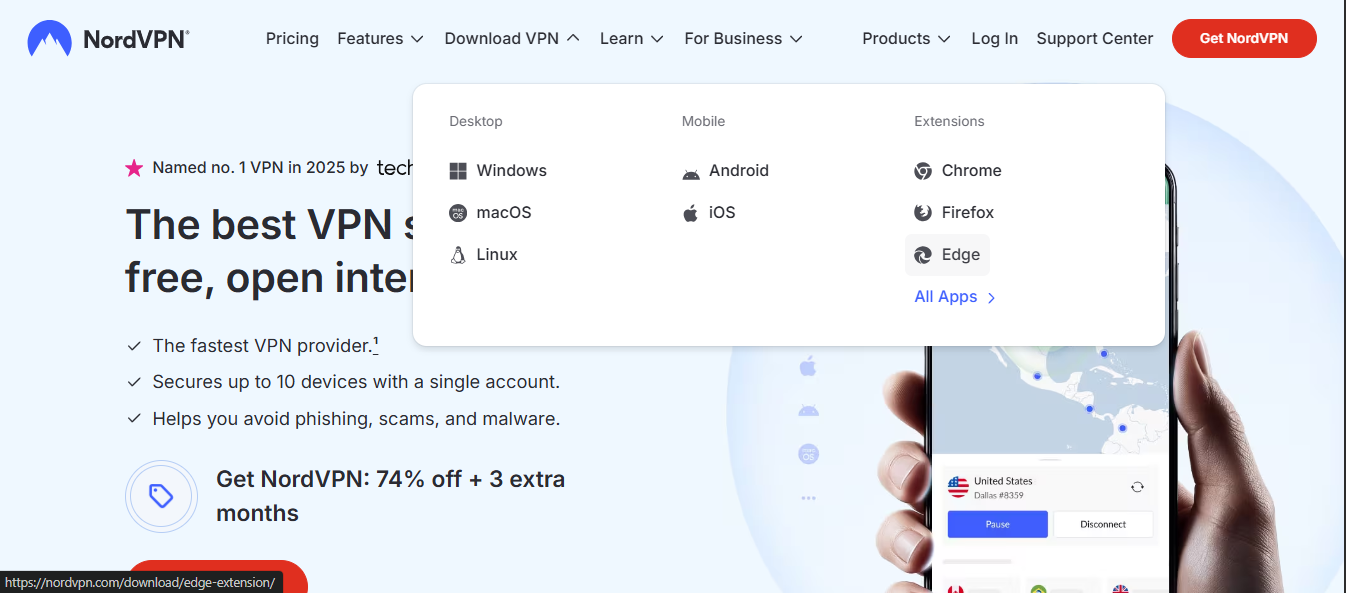
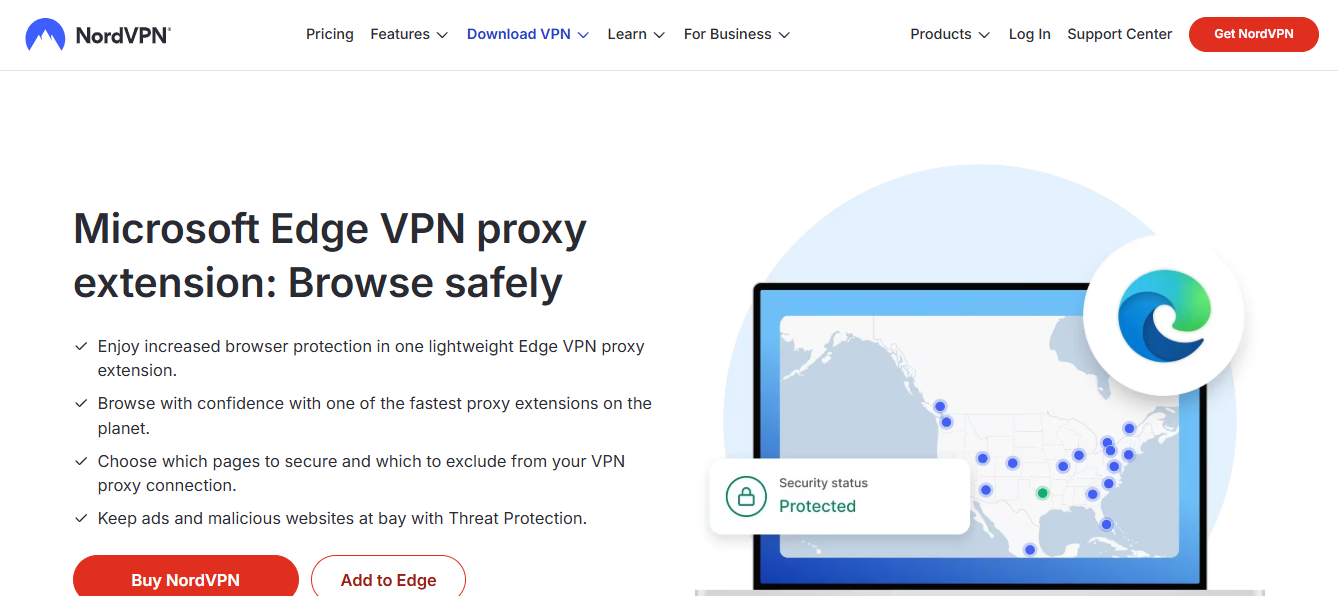
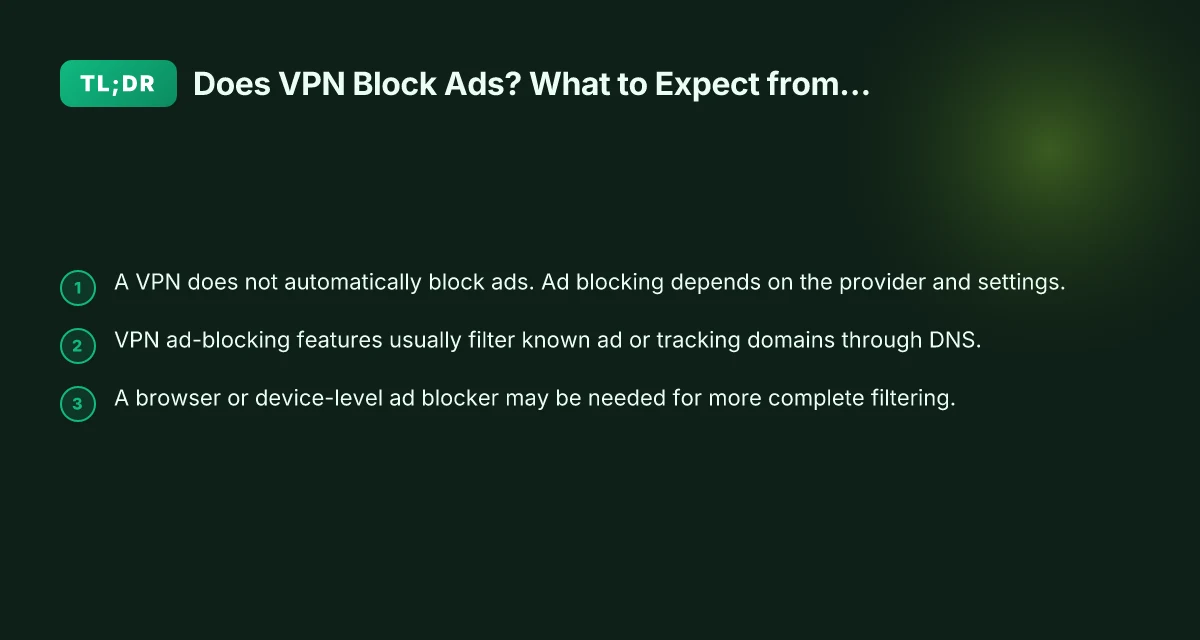
A VPN does not necessarily block ads. Its main job is to encrypt your internet traffic and route it through a VPN server, helping protect your connection and hide your IP address from sites you visit. Some VPNs also offer an optional ad-blocking feature, but the level of filtering varies by provider. If yours does not include that feature, or it is turned off, you may continue to see ads while connected.

Editor's pick: NordVPN — fast, secure VPN — Strong encryption, a no-logs policy and apps for every device. 30-day money-back guarantee. Get NordVPN →
What a VPN ad blocker can and cannot do
| Feature or task | VPN alone | VPN with ad blocking | Browser ad blocker | DNS filtering |
|---|---|---|---|---|
| Encrypts internet traffic | Yes | Yes | No | No |
| Hides your IP address from sites | Yes | Yes | No | No |
| Blocks some ad domains | No | Supported | Supported | Supported |
| Blocks every ad | No | No | No | No |
| Removes ads embedded in videos | No | Usually no | Limited | Usually no |
| Blocks trackers | No | Some services | Supported | Supported |
| Works across apps | Yes, for VPN traffic | Often | Usually browser-only | Often |
| Requires a separate app or setting | VPN app | VPN app feature | Browser extension or app | DNS setting or service |
Compiled November 2026; check the provider's site for current details.
| VPN | Obfuscation | From / month | Plan | Free plan | Refund | Alipay | UnionPay | Crypto | Website opens in China | Trustpilot | |
|---|---|---|---|---|---|---|---|---|---|---|---|
 ZoogVPN | Turn on manually Shadow | $2.49/mo | 27 months: $59.99 | Yes | 7 days | ✓ | ✓ | ✓ | ✓ | Official site blocked; our special link opens (4.4 s) | 4.2/5 (195 reviews) |
 NordVPN | Turn on manually Obfuscated Servers / NordWhisper | $3.49/mo | 27 months: $94.23 | No | 30 days | ? | ✗ | ✓ | ✓ | ✗ Blocked | 4.2/5 (51,628 reviews) |
 ExpressVPN | ✓ On by default all servers | $3.00/mo | 28 months: $84 | No | 30 days | ✗ | ✗ | ✓ | ✗ | ✗ Blocked | 4.4/5 (29,706 reviews) |
 Surfshark | ✓ On by default Camouflage, with OpenVPN | See site | See site | No | 30 days | ✗ | ✗ | ✗ | ✓ | ✗ Blocked | 4.3/5 (31,823 reviews) |
 Proton VPN | Turn on manually Stealth, free plan too | $2.99/mo | 12 months: $35.88 | Yes | 30 days | ✗ | ✗ | ✗ | ✓ | ✗ Blocked | 2.1/5 (1,040 reviews) |
 Astrill VPN | Turn on manually StealthVPN / OpenWeb | $12.50/mo | 24 months: $300 | No | See site | ✗ | ✗ | ✗ | ✓ | ✗ Blocked | 1.3/5 (110 reviews) |
 Private Internet Access | Turn on manually Shadowsocks, OpenVPN only | $2.03/mo | 40 months: $81.2 | No | 30 days | ✗ | ✗ | ✗ | ✗ | ✗ Blocked | 4.2/5 (11,033 reviews) |
 CyberGhost | Turn on manually selected servers | $2.19/mo | 28 months: $61.32 | No | 45 days | ✗ | ✗ | ✗ | ✓ | ✗ Blocked | 4.0/5 (24,178 reviews) |
 PureVPN | Turn on manually switch to OpenVPN | $1.69/mo | 60 months: $101.55 | No | 31 days | ? | ? | ✗ | ✓ | ✗ Blocked | 4.4/5 (17,994 reviews) |
 AdGuard VPN | ✓ On by default TrustTunnel | $2.99/mo | 24 months: $71.76 | Yes | 30 days | ✓ | ✗ | ✓ | ✓ | Official site blocked; our special link opens (3.7 s) | 4.3/5 (290 reviews) |
 Mullvad | Turn on manually QUIC / Shadowsocks / LWO | $5.61/mo | €5/mo | No | 14 days | ✗ | ✗ | ✗ | ✓ | ✗ Blocked | 3.2/5 (192 reviews) |
 Windscribe | Turn on manually Stealth / WStunnel | $5.75/mo | 12 months: $69 | Yes | See site | ✗ | ✗ | ✗ | ✓ | ✗ Blocked | 4.7/5 (13,355 reviews) |
 StrongVPN | Turn on manually Scramble, OpenVPN TCP | See site | See site | No | 30 days | ✓ | ✗ | ✗ | ✗ | ✗ Blocked | 4.4/5 (2,695 reviews) |
 LightXtreme 闪连 | Not listed | $7.08/mo | 12 months: $84.99 | Yes | 30 days | ✓ | ✓ | ✓ | ✓ | ✓ Yes (3.5 s) | No page |
Prices checked 2026-11-10 on each vendor's pricing page (cheapest long plan, USD). Check the vendor's checkout for the final price.
Obfuscation checked 2026-11-14 on each vendor's site and help center: "on by default" = nothing to set; "turn on manually" = switch protocol or mode in settings; "not listed" = the vendor describes no obfuscation.
Payment methods checked 2026-11-10 on each vendor's payment pages: all 14 take cards and PayPal; ✗ = not listed, ? = the vendor's own pages disagree.
China access: whether the official website opens from mainland China networks (tests the website only, not the VPN connection). Last checked 2026-11-18 01:02 Beijing time.
Trustpilot score and review count checked 2026-11-10.
What a VPN does, and what it does not do
When you connect to a VPN, your device creates an encrypted connection to a VPN server. Websites and apps generally see the server’s IP address instead of your actual one. This can improve privacy, particularly on public Wi-Fi, but it does not automatically remove advertising from webpages or apps.
Ads are delivered in different ways. A page may load them from separate advertising domains, embed them directly, or display them through its own app or website. A VPN focused on privacy and secure connections is not necessarily designed to identify and remove all of these formats.
A VPN also does not make you anonymous. Websites may still recognize you through cookies, account logins, browser fingerprinting, or other tracking methods. Blocking ads and trackers requires additional filtering beyond changing your network route.
How VPN ad blocking works
Some VPNs provide a feature with a name such as “ad blocker,” “tracker blocker,” or “malware protection.” Names and capabilities differ, so check the provider’s documentation rather than assuming the feature works in a particular way. Country Change VPN Free: How to Choose and Use One
Many of these features use DNS filtering. When your device tries to connect to a domain, a DNS service helps translate that domain name into an IP address. If the VPN’s filter recognizes the domain as an advertising, tracking, or malicious source, it can block the lookup. The ad or tracker may then fail to load.
This can be useful, but it has limits:
- The filter may block only domains listed in its database.
- Ads served from the same domain as the content may still appear.
- Filters may not catch every tracker or advertising network.
- Some websites can break if a required domain is mistakenly blocked.
- The feature may work only while the VPN app is connected.
Blocking unwanted domains can sometimes make pages feel cleaner or load faster, but results depend on the filter and the sites you use.
VPN ad blocking compared with other options
A VPN’s filtering feature is convenient because it can apply to more than one browser, depending on the app and device. A browser extension, by contrast, may offer more detailed control over what is blocked on webpages, but usually applies only to that browser. Does Proton VPN Auto Renew? What to Know Before Your Subscription Ends
| Option | Where it may work | Typical strengths | Common limitations |
|---|---|---|---|
| VPN ad-blocking feature | Across supported device traffic | Convenient and can filter known domains | May miss ads embedded in a site and offers limited control |
| Browser ad-blocking extension | A particular browser | More page-level controls and customizable lists | Does not usually cover other apps or browsers |
| Private DNS filtering service | Devices or networks configured to use it | Can filter domains across compatible apps | May not remove ads served from the same domain as content |
| Built-in app or browser settings | The relevant app or browser | Easy to enable and maintain | Protection may be basic or limited to that product |
These tools can complement one another, though running several filters may occasionally prevent a site or app from working properly. If a page stops loading, try temporarily disabling one filter or allowing the site, then test again.
Ad-blocking options compared
| Option | Blocks ads | Works beyond the browser | Can filter trackers | Main limitation |
|---|---|---|---|---|
| VPN without ad blocking | No | No | No | Protects the connection, not ad content |
| VPN with DNS-based blocking | Some | Often | Some | Misses ads served from allowed domains |
| Browser ad blocker | Many web ads | Usually no | Often | Typically limited to one browser |
| Private DNS filtering | Some | Often | Some | May not distinguish ads from other content |
| Hosts-file blocking | Some | Often | Some | Lists need upkeep; setup varies |
| Built-in browser protection | Some | No | Some | Coverage depends on browser |
| Dedicated network filter | Some | Often | Some | May require extra setup or hardware |
Compiled November 2026; check the provider's site for current details.
How to check whether your VPN blocks ads
Start by checking whether your VPN provider advertises an ad- or tracker-blocking feature. Then look in the VPN app’s privacy, security, or connection settings. The feature may be disabled by default, available only on certain plans, or limited to particular devices. Safe VPN Extension for Edge: How to Choose One
After enabling it, test a few sites you normally visit. Keep in mind that an ad appearing does not always mean the feature is broken: the ad may be served from the same domain as the site’s content or may not be included in the filter’s lists. Likewise, a page appearing ad-free does not prove that every tracker is blocked.
If the VPN app includes a status indicator or filtering log, use it to confirm that the feature is active. You can also consult the provider’s support pages for information on supported platforms and known limitations. Avoid installing unfamiliar filtering apps or changing network settings without understanding what they do.
Choosing the right setup
The best choice depends on what you want to block and where you want it blocked. For basic privacy while browsing, use a reputable VPN and make sure its security features are enabled. If your main goal is fewer ads in a particular browser, a well-maintained browser content blocker may give you more control. If you want filtering across multiple apps, look for a VPN or DNS service that clearly explains which traffic it covers.
Before choosing a tool, consider: Fortigate ipsecvpn: How to Configure and Troubleshoot a Secure VPN
- Whether it supports your operating system and browser.
- Whether filtering is included or requires a paid plan.
- What categories it blocks, such as ads, trackers, or malicious domains.
- How the provider handles DNS requests and usage data.
- How to troubleshoot sites that do not work with filtering enabled.
No single tool catches every ad or tracker. Using a VPN for connection privacy and a reputable ad blocker for browser content can address different needs, but neither guarantees complete anonymity or perfect blocking.
Checks before choosing an ad-blocking setup
| Check | What to look for | Why it matters | Practical next step |
|---|---|---|---|
| Feature availability | Ad blocking is included or offered | VPNs do not all block ads | Check the plan and app settings |
| Blocking method | DNS or domain filtering | Helps set expectations | Review the provider’s explanation |
| Device coverage | Supported devices and apps | Features may vary by platform | Check each device you use |
| Website compatibility | A way to allowlist sites | Blocking can disrupt pages | Test key sites and adjust settings |
| Video ad coverage | Clear limits on in-stream ads | Network filters may not remove them | Keep a separate option if needed |
| Privacy policy | What data the service collects | Filtering is not a privacy guarantee | Read the policy and settings |
| Independent testing | Recent, relevant test results | Marketing claims may be broad | Look for tests on your own devices |
| Overall setup | VPN plus browser or DNS tools | Layers can complement each other | Choose based on coverage and convenience |
Compiled November 2026; check the provider's site for current details.
Recommendation
A VPN can block some ads, but only if it includes an active ad-blocking feature, and that feature may not catch everything. Check your VPN settings and provider’s documentation. For stronger browser-level ad filtering, pair a trustworthy VPN with a reputable browser blocker, and adjust the filters if a site stops working. Does Microsoft Edge Have a VPN? What Edge Secure Network Does