Clash Meta for iOS: What It Is, How to Install It, and What to Know
Learn what Clash Meta for iOS does, how to find a trustworthy version, and how to configure it safely.
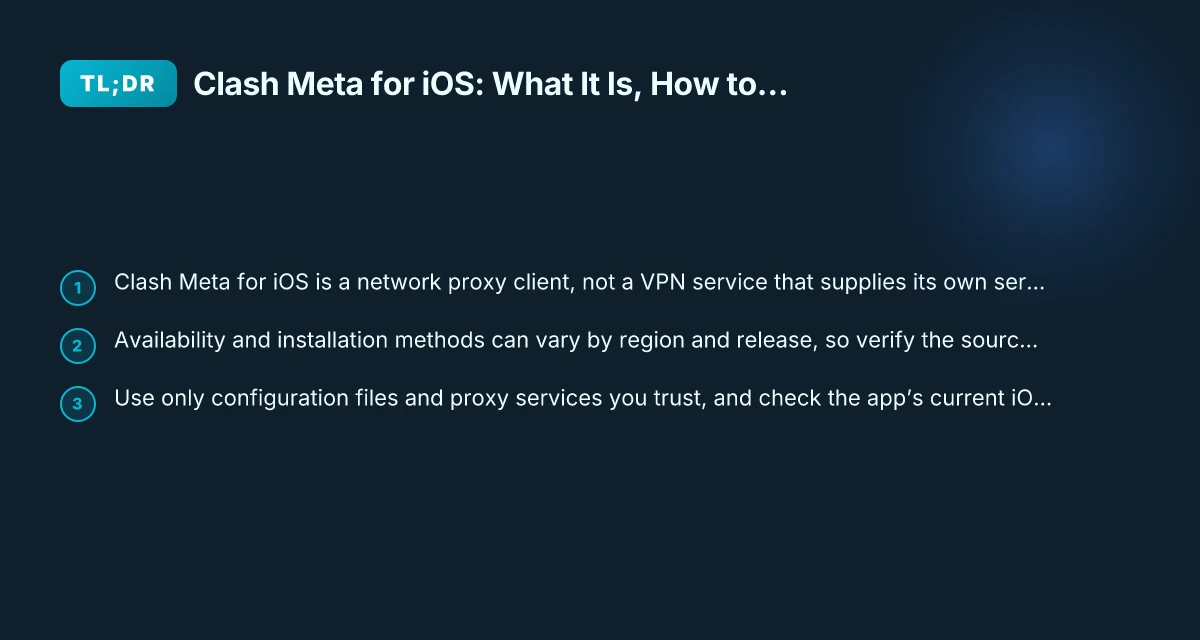
Clash Meta for iOS is an iPhone and iPad client for managing proxy connections and routing network traffic according to configuration rules. It does not provide a proxy subscription or server by itself: you need a compatible configuration or service. Because iOS availability and distribution can change, check the project’s official channels and the App Store before downloading anything.

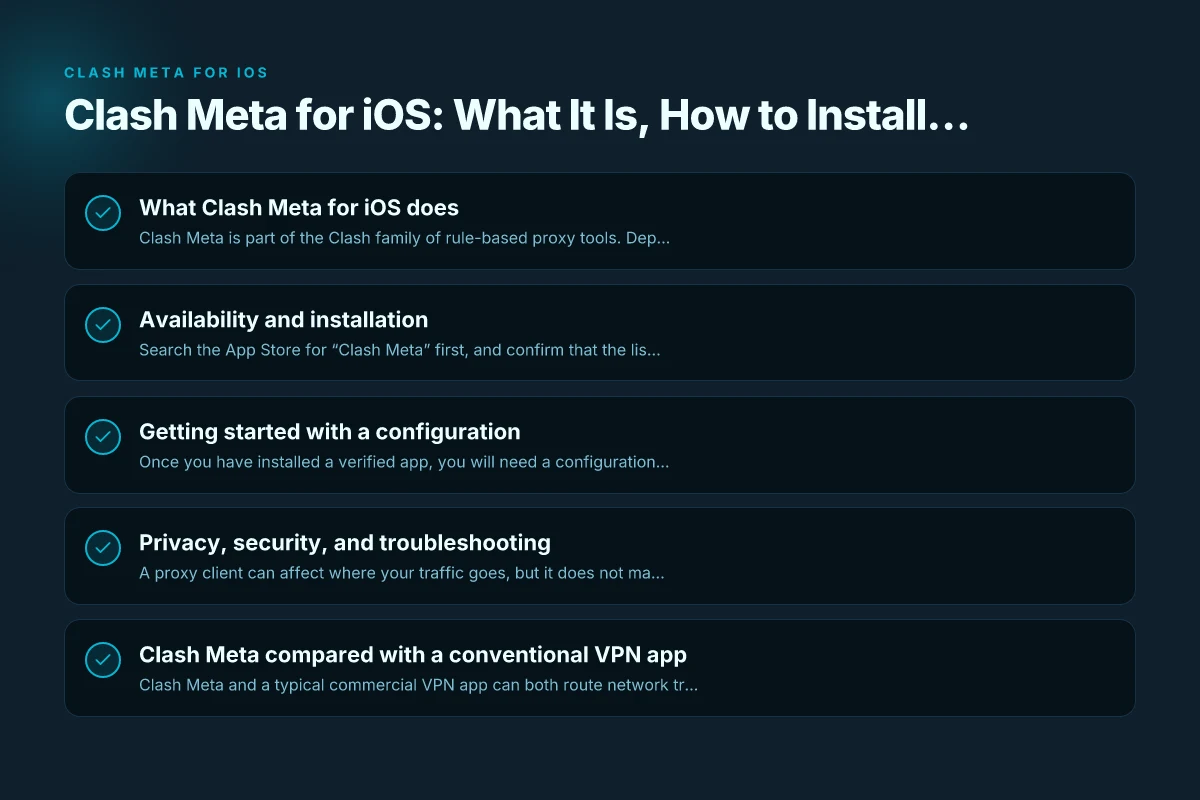
What Clash Meta for iOS does
Clash Meta is part of the Clash family of rule-based proxy tools. Depending on the specific iOS app or build, it can use a configuration to decide whether traffic should connect directly, use a selected proxy, or follow another routing rule. This can be useful for managing multiple proxy nodes or applying different policies to different kinds of traffic.
It is important to distinguish the client from the service. Installing the app alone does not create an internet connection through a proxy. You also need a compatible configuration and access to working proxy servers, which may come from a provider or from infrastructure you manage.
Features can differ between iOS apps and releases. Do not assume that every version supports the same protocols, configuration fields, or update process. Check the app’s documentation and release notes for the specific build you intend to use.
Availability and installation
Search the App Store for “Clash Meta” first, and confirm that the listing is genuine and maintained by the expected developer. Names that resemble well-known projects do not, by themselves, prove that an app is official or safe. Urban VPN Chrome: How It Works, Features, and What to Know
If there is no suitable App Store listing in your region, consult the project’s official website or repository for current distribution information. Availability may vary, and a previously mentioned installation method may no longer work. Avoid download sites, copied configuration bundles, and instructions that ask you to install unfamiliar profiles or certificates without explaining why.
| Option | What to check | Main consideration |
|---|---|---|
| App Store listing | Developer identity, version, reviews, and privacy details | Usually the simplest installation route when an authentic listing is available |
| Official project distribution | The project’s own documentation and release information | Availability and installation steps may change |
| Third-party download | Whether the source is explicitly trusted by the project | Higher risk of modified, outdated, or unsafe files |
Before installing, check the app’s iOS compatibility, its privacy information, and whether it is actively maintained. If a download asks you to trust a developer profile or install a certificate, pause and verify the instructions through a trusted source rather than relying on a link from a stranger.
Getting started with a configuration
Once you have installed a verified app, you will need a configuration compatible with that particular client. Follow the app’s documentation or your provider’s instructions for importing it. Depending on the app, this may involve opening a configuration file, using a subscription link, or adding settings manually.
Treat configuration links like passwords. Anyone who obtains a private subscription URL may be able to access or use the associated service. Do not post it publicly, share screenshots that reveal it, or import a file from an unknown person. Urban VPN Extension for Edge: How to Install and Use It
A sensible setup sequence is:
- Confirm the configuration is intended for the iOS client and its current version.
- Import it using the app’s documented method.
- Review the listed servers, routing rules, and other settings where available.
- Select a connection and test it with non-sensitive browsing.
- Check that you know how to disconnect and remove the configuration.
If the app requests permission to add a VPN configuration, that permission can be part of how iOS routes network traffic through a local proxy client. Read the system prompt and the app’s explanation before approving. A permission request should not be treated as proof that the app or the configuration is trustworthy.
Privacy, security, and troubleshooting
A proxy client can affect where your traffic goes, but it does not make all online activity anonymous or automatically protect every connection. Your proxy provider may be able to observe connection metadata, and websites can still identify you through account logins, cookies, or other signals. Use HTTPS, keep iOS updated, and choose a provider you trust.
If a connection fails, check the basics before changing advanced settings: Urban VPN for Edge Extension: How to Install and Use It
- Confirm that the subscription or configuration is current.
- Check your internet connection and the service provider’s status.
- Make sure the selected server and routing mode are appropriate.
- Update the client only through a source you have verified.
- Remove and re-import a configuration only if the provider’s instructions recommend it.
Be cautious if a configuration asks for broad permissions, contains unfamiliar rules, or comes from an unexplained source. A proxy can direct traffic through systems operated by someone else. If you do not understand who controls those systems, do not use the configuration for sensitive accounts or personal data.
Clash Meta compared with a conventional VPN app
Clash Meta and a typical commercial VPN app can both route network traffic, but they serve different needs. A conventional VPN app often emphasizes a straightforward connection to the provider’s network. Clash Meta is more configuration-oriented and may offer rule-based routing, depending on the iOS implementation.
| Need | Clash Meta for iOS | Conventional VPN app |
|---|---|---|
| Proxy servers included | Usually no; you supply a compatible service or configuration | Often included with the provider’s subscription |
| Setup | Requires configuration and some familiarity with routing | Usually designed for a simpler sign-in-and-connect process |
| Traffic handling | Can offer configurable rules, depending on the app | Often uses provider-defined settings |
| Best fit | Users who need control over proxy configurations | Users who want a straightforward provider-managed connection |
Neither option guarantees privacy by itself. The provider, configuration, app implementation, and your own browsing habits all matter.
Recommendation
Clash Meta for iOS may suit users who already have a trusted, compatible proxy configuration and want more control over routing. First confirm that the app is available from a legitimate source, then check its documentation and iOS compatibility. If you do not have a configuration or prefer a simpler setup, a reputable VPN app with clear privacy terms may be the more practical choice. Urban VPN Extension for Microsoft Edge: Setup, Features, and Safety