Clash for Android: What It Is, How to Install It, and What to Know

Learn what Clash for Android does, how to install it safely, and how to choose the right configuration.
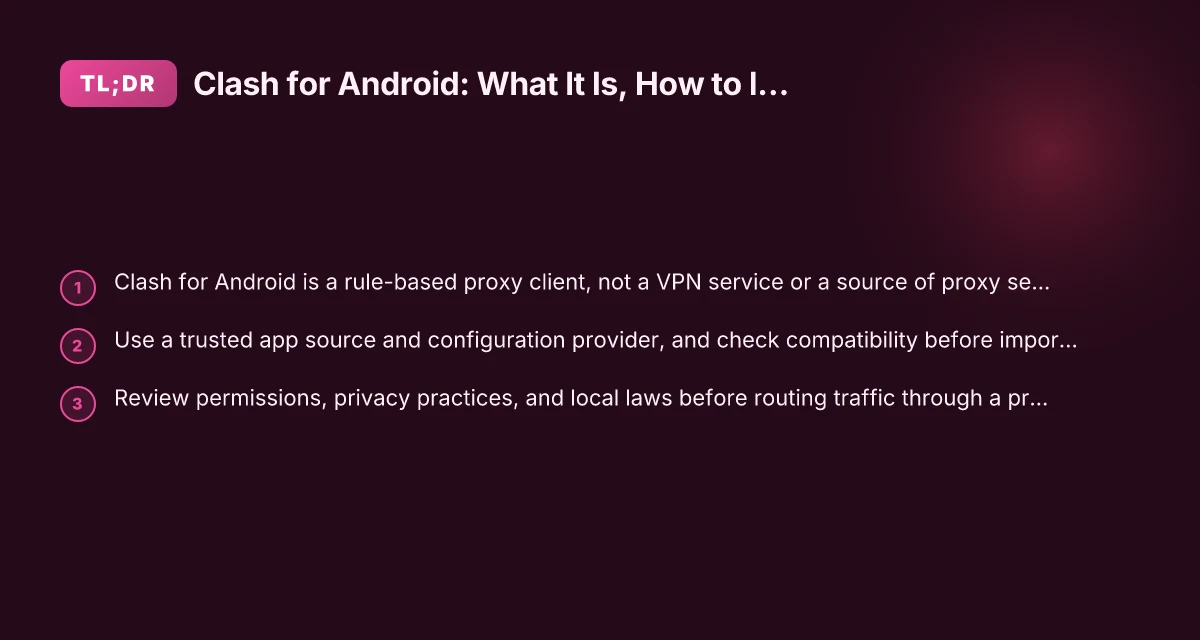
Clash for Android is an Android client for managing proxy connections and routing network traffic according to configurable rules. It can help you direct different apps or destinations through selected proxy servers, but it does not provide proxy servers or guarantee privacy by itself. To use it, you need a compatible configuration and a trustworthy proxy service.

Compare Android proxy clients
| App | Configuration approach | Compatibility | Best suited for |
|---|---|---|---|
| Clash for Android | Clash-compatible configuration | Depends on Android version and build | Users who want a graphical Clash client |
| sing-box | sing-box configuration | Android app available | Users needing a flexible proxy platform |
| v2rayNG | V2Ray-compatible configuration | Android app available | Users with V2Ray-based setups |
| NekoBox for Android | Multiple proxy formats | Android app available | Users seeking support for several protocols |
| Hiddify | App-managed profiles | Android app available | Users who prefer a guided setup |
| Manual system proxy | Enter proxy details in Android settings | Depends on Android version and network | Basic proxy use without a dedicated client |
Compiled November 2026; check the provider's site for current details.
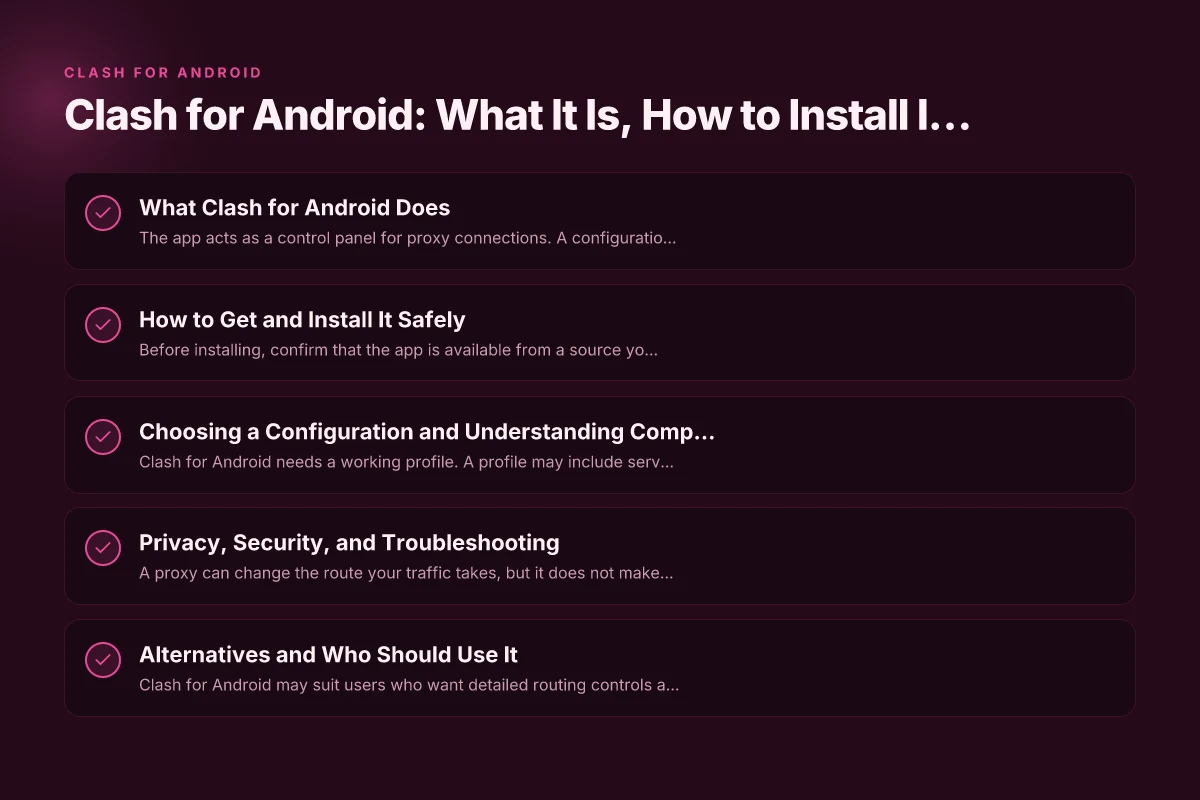
What Clash for Android Does
The app acts as a control panel for proxy connections. A configuration file, often called a profile, tells it which proxy nodes are available and how traffic should be handled. Rules can send traffic directly, through a proxy, or through another specified route.
Depending on the configuration and app version, common features may include:
- Importing profiles from a file, link, or clipboard
- Selecting a proxy node or group
- Applying domain- or IP-based routing rules
- Viewing connection activity and traffic usage
- Creating a local VPN connection to capture device traffic
That last feature can be confusing. Android may show a VPN indicator because the app uses Android’s VPN service to route traffic locally. This does not necessarily mean the app operates a commercial VPN network. The proxy provider and configuration determine where routed traffic goes.
How to Get and Install It Safely
Before installing, confirm that the app is available from a source you trust and that the version supports your Android release. Availability can vary by region, app version, and distribution channel. Avoid download pages that use misleading buttons, bundled installers, or claims that the app includes free, unlimited servers. VPN Extension for Microsoft Edge: How to Choose and Use One
A cautious installation process looks like this:
- Check the project’s official documentation or a reputable app distribution source for the current release.
- Verify the app name, developer or project identity, and version before downloading.
- Review the requested permissions and your device’s installation settings.
- Install the app, then import a profile from a provider you trust.
- Read the profile’s routing and proxy details before enabling it.
- Connect and test a few websites or apps. Disconnect if traffic behaves unexpectedly.
If installing an app package manually, you may need to allow installation from that source in Android settings. Turn that permission off again afterward if you do not need it. Never install a file simply because a search result labels it “official”. Check the source independently.
Choosing a Configuration and Understanding Compatibility
Clash for Android needs a working profile. A profile may include server addresses, credentials, routing rules, and proxy-group settings. Some providers supply a subscription link that refreshes configuration details automatically. Others provide a file for manual import.
Profiles are not automatically safe just because they load successfully. A configuration can direct traffic through servers controlled by its provider, and its rules may send more traffic through a proxy than you expect. Use a provider whose ownership, policies, and support you can evaluate. OpenVPN for Windows: How to Install, Configure, and Connect
Compatibility is another important consideration. The Clash ecosystem has multiple clients, versions, and configuration formats. A profile built for one client or engine may not work correctly in another. If import fails or options are missing, check the profile provider’s instructions and the client’s documentation rather than repeatedly trying random files.
| Option | What it provides | What to check |
|---|---|---|
| Clash for Android | An Android interface for managing compatible proxy configurations | App source, Android support, and profile compatibility |
| A proxy provider | Servers and account access, if offered | Ownership, privacy policy, reliability, and terms |
| A configuration profile | Servers and rules for routing traffic | Source, permissions, routing behavior, and update method |
| A conventional VPN app | Usually a provider-managed connection and server network | Provider reputation, privacy practices, and supported features |
The names “Clash” and “VPN” are sometimes used loosely online. Check what each service actually supplies before paying, subscribing, or entering credentials.
Check these points before installing Clash for Android
| Check | What to look for | Why it matters | Safer choice |
|---|---|---|---|
| App source | A reputable, verifiable project or distributor | Untrusted downloads may be modified | Verify the publisher and release |
| Maintenance | Recent project activity or clear status | Older builds may lack fixes | Choose a maintained option |
| Android support | Compatibility with your device and Android version | Installation or features may fail | Check release notes first |
| Configuration source | A provider or file you trust | Configurations can direct your traffic | Review the source and terms |
| Permissions | Requests relevant to the app’s function | Excess access can expose data | Avoid unexplained permissions |
| Profile links | Links from a trusted source | Links may reveal or replace profile details | Treat them as credentials |
| Updates | A clear way to get future releases | Updates can address security issues | Recheck the official source |
Compiled November 2026; check the provider's site for current details. Android Clash: How to Choose and Play Clash Games on Android
Privacy, Security, and Troubleshooting
A proxy can change the route your traffic takes, but it does not make every activity anonymous. The proxy operator may be able to observe connection metadata, and websites can still identify you through account logins, cookies, browser settings, or other signals. Encrypted connections such as HTTPS protect content in transit between your device and a website, but they do not remove all privacy risks.
Keep these precautions in mind:
- Use profiles only from providers you trust.
- Avoid entering sensitive credentials through unfamiliar proxy services.
- Check whether the profile routes all traffic or only selected destinations.
- Review app and profile permissions, and remove configurations you no longer use.
- Keep Android and the client updated where supported.
- Follow applicable laws, workplace policies, and network terms.
If the app will not connect, first confirm that your internet connection works without it. Then check whether the profile is current, credentials are correct, and the selected node is available. A different node may help if the provider offers one. If Android displays a VPN permission prompt, read it carefully. Only approve it if you intend to let the app route network traffic.
For connection problems, consult the profile provider’s setup guide. Avoid “fixes” that ask you to install unrelated certificates, disable security protections, or share your configuration publicly. Profiles can contain private access details. Free VPN for Edge Extension: How to Choose One Safely
Alternatives and Who Should Use It
Clash for Android may suit users who want detailed routing controls and are comfortable managing profiles. It can be less convenient for someone who simply wants a one-tap connection with servers included. In that case, a reputable VPN app or a simpler proxy client may be easier to set up.
Choose based on what you need:
- Flexible routing: A rule-based client can offer more control over which traffic uses a proxy.
- Simple setup: A provider’s own app may handle accounts, servers, and updates in one place.
- Basic privacy protection: Compare providers’ policies and technical details rather than relying on an app’s name.
- Compatibility: Confirm that your configuration format is supported before committing to a service.
Choose a setup based on your needs
| Your situation | Suitable choice | Configuration needed | Main consideration |
|---|---|---|---|
| You already have a Clash profile | Clash for Android, if compatible | Clash-compatible profile | Confirm the build supports your profile |
| You have a V2Ray profile | v2rayNG or another compatible client | V2Ray-compatible profile | Match the client to the profile format |
| You need multiple proxy formats | A client that supports your formats | Provider-specific profile | Verify protocol support before importing |
| You want a guided experience | A client with app-managed setup | Often a provider profile | Check who operates the service |
| You only need a basic proxy | Android’s manual proxy settings, where supported | Proxy address and port | May not cover every app or protocol |
| You cannot verify a configuration source | Do not import it yet | None until verified | Unknown configs can route traffic elsewhere |
| Your device or Android version is unsupported | A compatible alternative or device | Depends on the option | Check current compatibility notes |
Compiled November 2026; check the provider's site for current details. VPN Free Edge Extension: What to Know Before You Install One
Recommendation
Clash for Android is worth considering if you need rule-based proxy management and already have a reliable, compatible profile. Install it only from a trustworthy source, verify the configuration provider, and understand which traffic will be routed. If you want a ready-to-use service with minimal setup, choose a reputable provider’s dedicated app instead.